
Why Your “Free Rent” Might Cost You: 5 Hidden Truths About Short-Term Cancellation Penalties in Japan
The Unwelcome Move-Out Surprise
Here is a scenario your real estate agent rarely highlights: You’ve just spent a fortune moving into a trendy new Tokyo apartment, attracted by “Zero Deposit” and “Free Rent” signs. Six months later, your company announces a sudden transfer, or perhaps a family emergency requires you to move back home. You pull out your lease, expecting a standard exit, only to find a demand for two months’ rent as a “Short-Term Cancellation Penalty” (短期解約違約金 / Tanki Kaiyaku Iyaku-kin).
This isn’t just a minor fee; it’s a financial hurdle that can wipe out every yen you saved on initial costs. As a consumer advocate, I want you to look past the “free” marketing and understand the strategic debt you’re actually signing into.
For many foreign tenants renting an apartment in Japan for the first time, this penalty comes as a shock. In many countries, tenants can usually terminate a lease with a standard notice period (often 30 or 60 days). In Japan, however, leases often include contractual penalties for leaving early, even if proper notice is given.
Understanding these clauses before signing the lease is particularly important for foreign residents, who may unexpectedly need to return to their home country due to job changes, visa issues, or personal circumstances.
The Basic Rule: How Lease Termination Normally Works in Japan
Before discussing penalties, it is important to understand the basic rule of residential lease contracts in Japan.
Most rental apartments in Japan use what is called a Standard Lease Agreement (普通賃貸借契約 / Futsu Chintai Shaku Keiyaku).
Under this type of contract, tenants generally have the legal right to terminate the lease by giving advance notice to the landlord.
In practice, most contracts require one month’s notice, although some leases specify two months’ notice. As long as the tenant provides the required notice period, they are normally free to move out.
In other words, the basic legal principle is that tenants are allowed to terminate a lease early as long as they provide proper notice.
However, this is where many tenants misunderstand the system.
Even if the tenant gives the required notice, a separate contractual clause may still impose a short-term cancellation penalty if the tenant moves out within a certain period after moving in.
For example, a lease may state:
- “If the tenant terminates the contract within one year, one month’s rent will be charged as a short-term cancellation penalty.”
This means the tenant is still allowed to terminate the lease, but the contract requires compensation if the termination occurs too early.
If you’re new to the Japanese rental system, you may want to read our guide: How to Rent an Apartment in Japan.
The “Invisible Red Ink”: Why Owners Aren’t Just Being Greedy
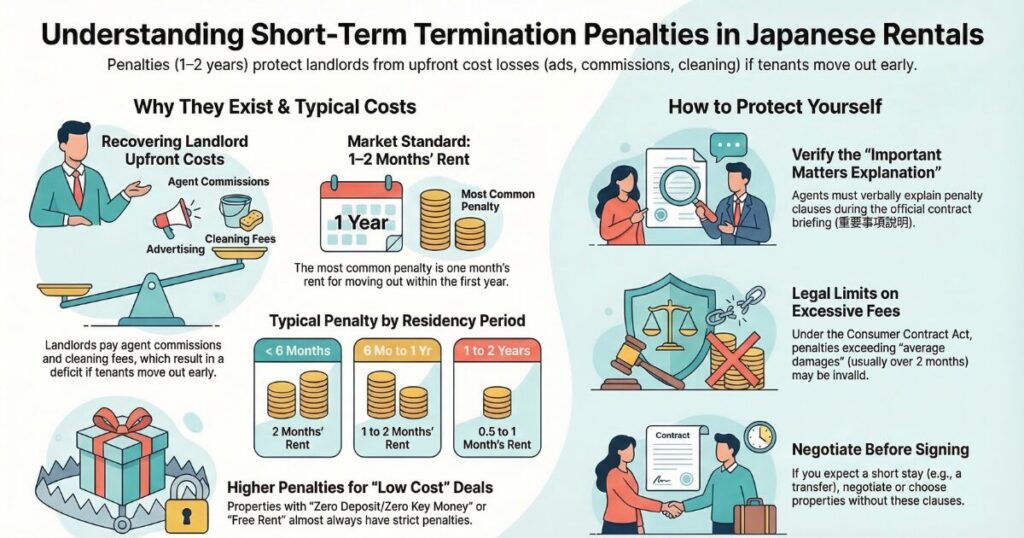
It is easy to view landlords as predatory when they demand penalties, but there is a harsh economic logic behind the “red ink.” To get you into that room, the owner also pays upfront costs that you never see: advertising fees (広告宣伝費 / AD), cleaning expenses, and even minor renovations.
The advertising fee (AD) is the real kicker. In Japan’s rental market, landlords often pay advertisement fee in addition to a commission to real estate agents to secure tenants. In competitive markets, this advertising fee can sometimes reach two to three months’ rent.
If a tenant leaves quickly, the owner has not had enough time to recover these costs.
In other words, short-term cancellation penalties were partly developed as a defensive mechanism in the Japanese rental market.
The “Zero-Zero” Trap: The High Price of Low Upfront Costs
Here’s the insider truth: “Free Rent” is almost never a gift; it is a deferred cost.
When a landlord waives initial fees, they are effectively making an investment in acquiring a tenant. They are betting that you will stay long enough to make the investment worthwhile.
To hedge that risk, they often include strict cancellation penalties in the lease contract.
“Red Flag” Property Types
Certain types of properties are much more likely to include these clauses:
Free Rent Properties
Units offering 1–2 months of rent-free living
Zero-Zero Properties
Apartments with zero deposit (敷金) and zero key money (礼金)
Campaign Properties
Units with temporary rent discounts or reduced move-in costs
In these cases, the penalty often functions as a delayed key money payment.
If you didn’t pay it at the beginning, you may effectively pay it when you leave.
From the landlord’s perspective, these incentives are marketing tools, not gifts. The rental market in major cities like Tokyo is extremely competitive, and landlords frequently use these promotions to attract tenants quickly.
The “One-Month” Benchmark: Knowing the Legal Ceiling
While landlords use these clauses to protect their margins, they do not have unlimited freedom to impose penalties. Japanese law and court precedents provide guidance on what is considered reasonable compensation for damages.
Typical Penalty Structure
Under 6 months: often 2 months’ rent
6 months to 1 year: typically 1 month’s rent
Less than 2 years: occasionally 0.5 months’ rent
In many contracts today, the most common clause is:
“If the tenant cancels the lease within one year, one month’s rent will be charged as a penalty.”
However, not all contracts include such penalties, and the conditions can vary depending on the landlord and the property.
Before signing a lease, read your contract carefully. Also, Japanese law also requires a formal explanation called Important Matters Explanation (Juyo Jiko Setsumei). make sure that if there is a penalty clause for short-term cancellation.
Legal Insight
The Consumer Contract Act (消費者契約法) protects tenants from excessive penalty clauses.
Japanese courts often evaluate whether the penalty exceeds the landlord’s “average damages.”
Historically, courts—including decisions by the Tokyo District Court—have frequently viewed one month’s rent as a reasonable benchmark for damages.
However, courts may allow two months’ rent if the tenant received significant benefits such as:
- Free rent campaigns
- Waived key money
- Discounted move-in costs
According to industry guidance such as LIFULL HOME’S legal commentary, once a penalty reaches three months’ rent, it enters a legal “danger zone.”
Clauses demanding four months or more may be deemed excessive and therefore invalid.
This means that while penalties are legal, they must remain proportionate.
The Neighbor Dilemma: Why “It’s Not My Fault” Rarely Works
One of the most frustrating calls I receive is from tenants moving out due to neighbor noise or deteriorating living conditions.
Tenants often argue that because the move is unavoidable, the penalty should not apply.
Unfortunately, the law rarely agrees.
Unless the tenant can demonstrate landlord negligence, such as:
- Ignoring documented noise complaints
- Failing to repair serious structural problems
- Leaving major defects unresolved (for example, severe leaks)
the cancellation penalty generally remains enforceable.
From a legal standpoint, personal circumstances—such as job relocation, family issues, or conflicts with neighbors—are usually considered tenant-side decisions.
To the landlord, the financial loss caused by early departure remains the same regardless of the reason.
The “Important Matters” Safety Net: Your Paper Trail Defense
Your strongest defense isn’t a handshake; it’s the Important Matters Explanation (重要事項説明 / Juyo Jiko Setsumei).
Under Japanese law, a licensed real estate agent (宅地建物取引士 / Takken-shi) must explain key contract conditions before you sign.
This includes short-term cancellation penalties.
Expert Strategy Tips
The “Tokuyaku” Hunt
Don’t just read the main lease agreement.
Always check the Special Provisions section (特約 / Tokuyaku) at the end of the contract. This is where penalty clauses are typically written.
Special provisions override general contract terms.
Verify the Verbal Record
During the Important Matters Explanation, the agent must explain important clauses verbally.
If a penalty clause exists in the contract but was never explained, its enforceability may be questioned.
Negotiate Before Signing
If your job situation is uncertain, ask the agent whether the clause can be modified.
Possible negotiations include:
- Reducing the penalty period
- Removing the clause entirely
- Shortening the restriction period
Once the contract is signed and the keys are handed over, negotiation becomes extremely difficult.
Conclusion: Beyond the Fine Print
Short-term cancellation penalties are part of the modern low-cost rental model in Japan.
They help landlords manage financial risk in a competitive market, but for tenants, they represent a hidden financial obligation.
Understanding these clauses is essential for anyone renting an apartment in Japan, especially for foreign residents relocating to Tokyo.
When you see advertisements promoting:
- Free Rent
- Zero Deposit
- Zero Key Money
take a moment to ask the critical question:
What happens if I need to move out early?
The initial savings may look attractive, but the real cost may only appear when life changes unexpectedly.
Before signing any lease, always confirm:
- The short-term cancellation clause
- The penalty amount
- The length of the restriction period
True transparency in contracts is the foundation of a healthy rental market—one where both landlords and tenants understand the real costs involved.
Where to Seek Help for Rental Disputes in Japan
If you encounter problems during your tenancy, the first step is usually to contact the real estate company or property management company handling your apartment. In many cases, they can act as an intermediary between you and the landlord and help resolve the issue.
However, the level of support can vary. Some agencies may not respond very proactively after the tenant has already moved in, or they may simply state that “the contract says so” and be reluctant to address the problem further.
If this happens and the situation remains unresolved, it may be helpful to seek advice from a Consumer Affairs Center (Shōhi Seikatsu Center). In Japan, tenants can call 188, a national consumer hotline, which connects them to the nearest consultation office.
For disputes specifically related to real estate transactions, tenants may also consult real estate industry associations or local government housing consultation services, and in more serious cases, consider seeking advice from a lawyer specializing in real estate law.
Need Help Renting an Apartment in Tokyo?
Relocating to Japan and navigating the rental market can be complicated—especially when contracts, fees, and legal terms differ significantly from what many international residents are used to.
I am a licensed real estate agent based in Tokyo, specializing in helping foreign residents and international clients find housing and understand the Japanese real estate system. My work focuses on making the rental and purchase process clearer and more transparent for people moving to Japan.
If you are planning to rent an apartment in Tokyo or have questions about rental contracts, fees, or negotiations with landlords, feel free to reach out.
👉 Contact me for guidance on renting or buying property in Tokyo.