
Essential Steps Before and Right After Arriving in Japan
Whether you’ve traveled from the other side of the world or from elsewhere in Asia, arriving in Japan after a long flight is no small feat—Otsukaresama. And welcome to Japan!
You may be eager to enjoy authentic Japanese food, explore the neon-lit streets, or start your sightseeing adventure right away. It’s an exciting time, and you deserve to soak it all in. However, before you can truly relax and embrace your new life, there are several critical milestones ahead to ensure you are fully settled.
“Where do I start? What are the exact procedures to follow?”
The real work of settling in begins the moment you land, and the sheer amount of bureaucracy—from managing your COE and Residence Card to navigating Rental Contracts and other required paper works—can feel overwhelming. Many newcomers find themselves stuck in a loop, wondering how to open a bank account without a permanent address, or how to rent an apartment without a bank account.
This guide is designed to bridge that gap. We have organized everything you need to know, from essential preparations before you fly to the administrative must-dos right after you land.
This guide is to help you navigate these essential first steps smoothly and efficiently. By following this roadmap, you can move from “just arrived” to truly feeling at home in Japan, as stress-free as possible. Let’s get started.
Before Departure: Once Your Move to Japan Is Confirmed, the First Step Is Obtaining a COE
Once it is confirmed that you will be moving to Japan for work or study, the first and most important step before departure is obtaining a Certificate of Eligibility (COE).
The COE is a document issued by Japan’s Immigration Services Agency that confirms you meet the requirements for a specific status of residence. For most long-term stays, it is an essential prerequisite for obtaining a visa.
Step 1: A Sponsor in Japan Applies for the COE
In most cases, the COE is applied for from within Japan by a sponsoring party, such as:
- Your employer
- Your school
- A sponsoring organization
- An immigration lawyer or administrative scrivener acting on your behalf
Applicants outside Japan generally cannot apply for a COE on their own.
The sponsor submits required documents—such as employment details, school enrollment information, or family relationship records—to immigration.
Step 2: COE Issuance by Immigration
If approved, immigration issues the COE.
This process typically takes 1 to 3 months, depending on the visa type and time of year.
Once issued, the COE is sent to you either as:
- A physical document, or
- An electronic COE (PDF), which is now widely accepted
Step 3: Apply for a Visa at a Japanese Embassy or Consulate
After receiving the COE, you apply for a visa at a Japanese embassy or consulate in your home country.
You will need:
- Your passport
- The COE (original or electronic)
- A visa application form
Step 4: Prepare Key Financial Documents for Renting in Japan
If you plan to rent housing on your own in Japan (rather than through a company-arranged relocation), it is strongly recommended to prepare the following documents before leaving your home country:
- Bank balance certificate
- Proof of income (employment contract, salary certificate, tax payment certificate or recent pay slips)
These documents are often requested during:
- Rental screening
- Guarantor company review
Obtaining these documents after arriving in Japan can take extra time or be difficult, especially if your overseas bank requires in-person requests.
Preparing them in advance can:
- Speed up the apartment application process
- Improve approval chances
If your permanent residence in Japan has not yet been decided before departure, secure a temporary place to stay in advance.
Step 5: Finding the Real Estate Agent
- Secure a Trusted Agent Before You Fly
Establish a relationship with a reliable, English-speaking agent while you are still in your home country will help. By sharing your preferences and documents early, your agent can filter out “foreigner-friendly” properties in advance, saving you days of frustration.
- Leverage Online Viewings
Some agents can take you on a virtual tour via Zoom or FaceTime, showing you not just the room, but also the view from the window and the condition of the common areas.
- Aim for “Ready to Move In” on Day One
Depending on the property, it is possible to complete the application and even sign the contract before you depart. Imagine landing at Narita or Haneda, picking up your bags, and heading straight to your own apartment.
Tips: Completing your housing search before arrival isn’t just “convenient”—it allows you to focus your first week on what really matters: registering your address, opening your bank account, and starting your new life.
(A separate article will cover “How to Find the Real Estate Agent for Expats in Japan”)
After Arrival: Step-by-Step Setup in Japan
Step 6: Enter Japan and Receive Your Residence Card (在留カード)
Once the visa is issued, you can enter Japan.
For most long-term residents:
- A Residence Card is issued at the airport upon arrival
- Your status of residence and period of stay are printed on the card
- Your address is not yet registered
To receive your Residence Card:
- Passport with visa
- Landing permission from immigration
After securing your home in Japan, you must register your address at your local city office.
Step 7: Securing a Temporary Base (Until Your Lease Begins)
Since it often takes a few weeks to finalize a long-term rental contract and pass the tenant screening, you will need a place to stay immediately after landing.
However, this isn’t just about finding a bed—it’s about finding a strategic “base” that allows you to start your paperwork.
Your Options for a Temporary Base:
- Serviced Apartments / Monthly Mansions: This is the most recommended option. Unlike standard hotels, many serviced apartments allow you to register their address at the ward office. This allows you to get your Resident Record (Jumin-hyo) and open a bank account while you are still searching for or waiting to move into your long-term apartment.
- Short-term Stays (Airbnbs/Hotels): Fine for a few days, but be careful. Most hotels will not allow address registration. If your long-term rental takes 3 weeks to finalize, you will be stuck without a bank account or phone number during that entire period.
⚠️ The “Transition Strategy”: I strongly suggest booking a serviced apartment for at least your first month. This gives you:
- A legal address to start official procedures immediately.
- A stress-free environment to visit properties and sign your long-term lease.
- A buffer in case your long-term apartment move-in date is delayed.
By securing a “registration-friendly” temporary home before you fly, you ensure that your first week in Japan is productive, not just a waiting game.
Step 8: Get a Japanese Mobile Phone Number
A Japanese phone number is often required for:
- Apartment applications
- Bank account applications
- Utility and service setup
However, major carriers usually require:
- A Residence Card with a registered address
The major mobile phone carriers in Japan include NTT Docomo, au (KDDI), SoftBank, and Rakuten Mobile. Their shops can be found throughout cities across Japan.
Walk-ins are generally accepted, but stores are often busy, so making an online reservation in advance is strongly recommended. I also recommend checking with the store in advance regarding the required documents, as requirements may vary depending on your situation.
If your address has not yet been finalized, your options with major carriers may be limited, as they typically require a registered address on your Residence Card. In such cases, starting with a temporary SIM card or an MVNO plan is often the most practical solution. Some MVNO providers may accept a temporary address, allowing you to stay connected while you secure long-term housing.
Once your address is officially registered, you can then switch to a full mobile phone contract with a major carrier if needed.
This allows you to proceed with applications while completing other steps.
Step 9: Registering Your Address at City Hall (住民登録)
This step is mandatory and foundational.
Deadline: Within 14 days of deciding your residence
Location: City Hall / Ward Office of your residential area
What to bring:
- Residence Card
- Passport
- Address details (lease agreement may be requested)
What happens:
- Address is printed on the back of your Residence Card
- You are registered as a resident
- You receive a Resident Record (住民票 / Juminhyo)
To register your address, you need to visit your local city hall (ward office) or a branch office that serves your residential area and submit the required documents. No appointment is required.
In the Tokyo metropolitan area, many offices provide multilingual guidance, and staff members are generally accustomed to assisting foreign residents. Unless your situation is unusual, the process is generally quite straightforward. If you feel unsure, you may contact the office in advance to ask whether language support in your preferred language is available—some offices can accommodate this upon request.
Because several documents are required for address registration, it is recommended that you confirm the required documents in advance before your visit.
Address registration can also be completed by mail, but this method tends to be more complicated and time-consuming. For most people, visiting the local branch office in person is the simplest and fastest option.
In addition, visiting the city hall or branch office allows you to learn about local services, community resources, and administrative support available in your area, making it a worthwhile visit beyond address registration alone.
Step 10: Opening a Bank Account in Japan
Because rent in Japan is typically paid by automatic bank withdrawal, having a Japanese bank account not only makes the rental process smoother but also expands the range of properties you can apply for. A Japanese bank account is also often required for salary payments, making it an essential part of daily life in Japan.
In general, a bank account can be opened after you have completed address registration at your local city office.
That said, many Japanese banks require you to have resided in Japan for at least six months before opening a standard account. However, some banks may allow earlier account opening if your employer or school is confirmed.
In addition, some banks, such as Japan Post Bank (Yucho Bank), allow new arrivals to open a non-resident account within the first three months, which can serve as a practical temporary solution after arrival.
It is also important to note that some service providers do not accept overseas-issued credit cards. For this reason, I recommend having at least one Japan-issued credit card whenever possible. To apply for a Japanese credit card, a Japanese bank account is generally required.
As a result, some newcomers find themselves in a frustrating loop:
you cannot open a bank account without an address, and you cannot finalize a rental contract without a bank account.
In that case, until your bank account is fully set up, arrangements such as advance rent payments or bank transfers can be negotiated, allowing the rental process to move forward without unnecessary delays.
(A detailed guide about bank is covered in a separate article.)
Step 11: National Health Insurance & Pension — Protecting Your Health and Your Visa Status —
Once you have registered your address, the next critical step at the ward office is enrolling in Japan’s social security systems. In Japan, health insurance and pension coverage are mandatory by law for all residents.
1. Do You Need to Register Personally?
Before you apply, check your employment status:
- If you are a full-time employee: Your company usually enrolls you in “Social Insurance” (Shakai Hoken). They deduct premiums from your salary and handle the paperwork. You generally do not need to apply at the ward office.
- If you are a student, freelancer, or dependent: You must manually enroll in the National systems at your local city hall or ward office.
2. National Health Insurance (国民健康保険 – Kokumin Kenko Hoken)
This is your safety net for medical expenses. Without it, a single trip to the emergency room could cost you thousands of dollars.
- The Benefit: You only pay 30% of your medical bills; the government covers the other 70%.
- Where to Apply: At the same time you register your address at the ward office.
- What to Bring: Residence Card and Passport.
- The Cost: Monthly premiums are calculated based on your previous year’s income in Japan. For newcomers with no prior Japanese income, the premiums are usually quite low.
3. National Pension (国民年金 – Kokumin Nenkin)
All residents aged 20–59 must join the pension system. While it may feel like a long-term concern, it has immediate legal importance.
- The Cost: A flat rate of approximately ¥17,000 per month (as of 2025/2026).
- Exemptions: If you are a student or have a low income, you can apply for a payment exemption or reduction. Do not just ignore the bills; apply for the exemption officially!
- Lump-Sum Withdrawal: If you leave Japan permanently after paying into the system for at least 6 months, you can claim a partial refund (Lump-sum Withdrawal Payment).
⚠️ Critical Warning: Why You Must Not Skip This
Some newcomers try to avoid these payments to save money, but this can lead to serious consequences:
- Visa Issues: The Immigration Bureau now strictly checks your insurance and pension payment history during visa renewals or PR (Permanent Residency) applications. Unpaid bills can lead to a visa denial.
- Back-Payments: If you join late, you will be billed for all the months since you arrived in Japan, resulting in a large, unexpected bill.
- 100% Medical Costs: Without your insurance card, you must pay the full price for any medical treatment upfront.
Practical Tip for Newcomers
When you go to the ward office for your address registration, simply tell the staff: “Koku-ho (Health Insurance) and Nenkin (Pension), please.” In major cities like Tokyo or Osaka, multilingual staff or translation tablets are usually available to help you navigate the forms. It’s a straightforward process that usually takes less than an hour, but it provides peace of mind for your entire stay in Japan.
Step 12: Other Important Notifications
Depending on your situation:
- Notify immigration of address changes
- Register children for school
- Apply for a My Number card
- Update visa status if changing jobs
Common Mistakes to Avoid
- Delaying address registration
- Assuming banking is quick and easy
- Signing leases without understanding requirements
- Underestimating how long setup takes
Why Preparing in Advance Matters
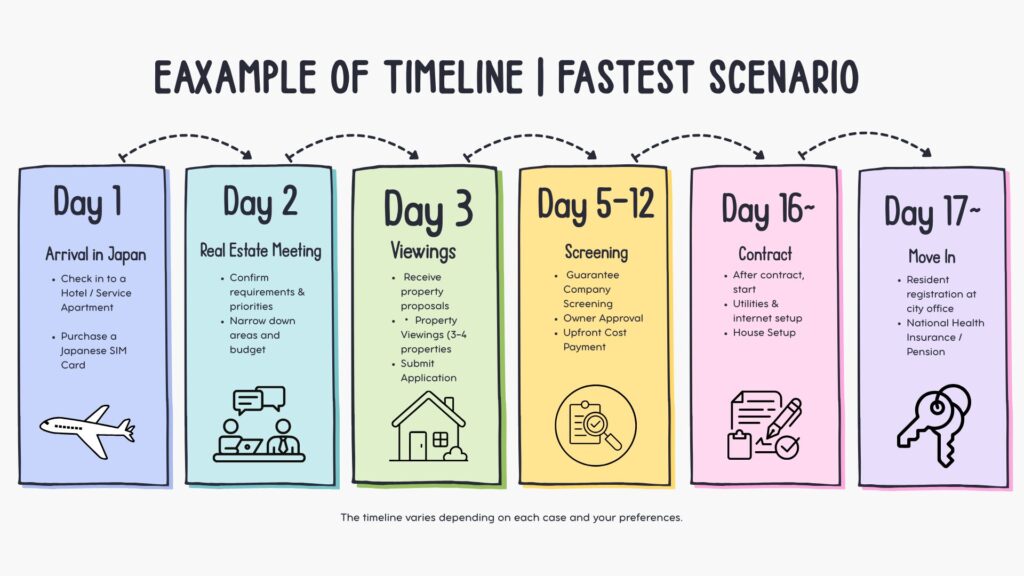
If you start your home search from scratch after arriving in Japan, it can sometimes take around a month before you are able to finally move in.
Ideally, it’s best to move into your new home as soon as you arrive in Japan—but in reality, that doesn’t always happen.
Even so, starting your home search before arriving in Japan can make a big difference. By shortlisting properties in advance and then viewing them shortly after arrival, you can significantly reduce the time it takes to settle in. I also offer online viewings, which are especially helpful when you are still overseas.
Having the necessary documents prepared ahead of time can further speed up the process. Every expat’s situation is different, and the best approach varies depending on factors such as visa type, employment status, and timing. I take the time to understand your circumstances and work with you to find the most practical and stress-free way forward.
Relocating to a new country comes with many administrative tasks, and handling them in an unfamiliar language and environment can feel overwhelming. To ease that stress, I provide hands-on relocation support, including accompanying you to banks and local government offices when needed, so you don’t have to navigate these procedures alone.
If you’d like personalized support—from housing to relocation logistics—the initial consultation is completely free, and I’m happy to help you plan a smoother start to life in Japan.