
Moving Out in Japan: 5 Essential Rules to Protect Your Security Deposit
Have you ever seen the term “restoration costs” when moving out of an apartment in Japan and wondered what it really means?
Or perhaps you’ve accidentally scratched the floor during your tenancy and worried, “What if I’m charged a large repair fee when I move out?”
And another common question: How much of my security deposit will I actually get back?
In Japan, there are clear legal guidelines that define a tenant’s responsibility and how costs are settled at the time of move-out. This article explains what tenants are actually responsible for, how restoration costs are calculated, and what you should know to avoid unexpected charges.
If you are moving out in Japan, you do not have to return your apartment in brand-new condition. Under Japanese law, tenants are responsible only for damage caused by negligence or improper use. Natural wear and aging are the landlord’s responsibility, and most interior materials are depreciated over six years.
Yet disputes remain common. Understanding exactly how restoration costs are divided — and how real-world cases unfold — is essential to protecting your security deposit.
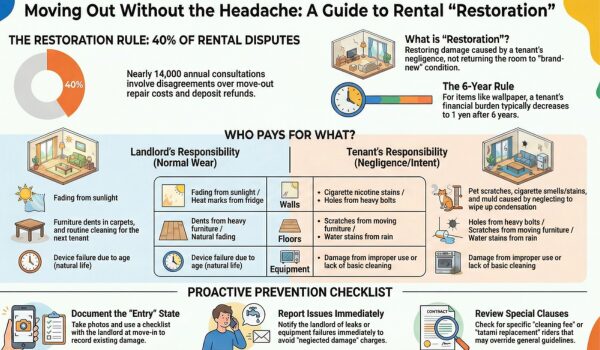
Landlord’s Responsibility: Natural Wear and Aging
Under Japanese restoration rules, costs that arise from normal living and aging are considered already covered by your monthly rent. These are not additional charges that can automatically be passed to the tenant.
Typical examples of the landlord’s responsibility include:
- Floors: Dents or marks left by heavy furniture such as sofas or refrigerators. Simply placing ordinary household furniture in a room does not constitute negligence.
- Walls: Discoloration of wallpaper caused by sunlight (fading) or dark “electric burns” that appear behind televisions or refrigerators due to heat and airflow.
- Minor Holes: Small pinholes from thumbtacks or pins used to hang posters or calendars, as long as the underlying wallboard does not require replacement.
- Maintenance and Turnover Cleaning: Cleaning for the next tenant or professional disinfection, provided that you performed regular, ordinary cleaning during your stay.
These examples reflect a fundamental principle: ordinary use leads to gradual change, and that change is factored into rent.
Tenant’s Responsibility: Negligence or Improper Use
By contrast, tenants must pay for damage caused by intentional acts, negligence, or failure to maintain the property properly. The issue is not whether damage exists, but whether reasonable care was exercised.
Examples of tenant responsibility include:
- Kitchen Neglect: Heavy oil or soot stains in the kitchen caused by failing to clean regularly.
- Bathroom and Toilet Issues: Mold or water scale buildup due to lack of cleaning and ventilation.
- Spills and Stains: Stains or mold on carpets or floors caused by spilled drinks that were not cleaned up properly.
- Neglected Leaks: If you notice a window leak or condensation forming and fail to report it or wipe it away, leading to wall rot or mold, you become liable for the resulting damage.
- Smoking Damage: Yellowing wallpaper or lingering odors caused by cigarette smoke.
- Pet Damage: Scratches on pillars, chewed frames, or persistent odors caused by keeping pets — even in pet-friendly apartments if the damage exceeds normal use.
The legal standard applied is whether the tenant exercised reasonable care as a prudent occupant. Failing to clean, report, or maintain can shift responsibility entirely to the tenant.
The 6-Year Depreciation Rule Still Applies
Even when damage is attributable to the tenant, Japan’s depreciation system reduces liability.
Wallpaper, carpets, and cushion flooring are generally considered to have a six-year service life. After six years, the residual material value is treated as one yen. Therefore:
- If damage occurs after three years, only about half of the material cost should be charged.
- If damage occurs after more than six years, the material value itself is effectively zero.
- However, labor and installation costs may still apply if the damage resulted from negligence.
This rule becomes particularly important in disputes involving long-term tenants.
Real-World Case Studies: What Actually Happens
Official reports from the National Consumer Affairs Center (NCAC) highlight recurring patterns in restoration disputes. The following cases illustrate common problems.
Case 1: The “Zero-Zero” Trap
A tenant moved out of a “zero deposit/zero key money” apartment after two years. They were billed more than 100,000 yen, including 50,000 yen for cleaning, even though they had not smoked and their contract only required air-conditioner cleaning if smoking occurred. Because they had no security deposit to deduct from, they received a large lump-sum invoice.
This case demonstrates the hidden risk of zero-deposit properties. Without a deposit buffer, restoration costs are billed directly, and tenants may face significant unexpected charges.
Case 2: The 25-Year Long-Term Stay
A tenant lived in an apartment for 25 years. Upon move-out, the landlord claimed replacement costs for flooring and wallpaper. However, because the tenant had stayed so long, the value of those materials had depreciated to virtually zero. The wear was deemed natural aging rather than tenant-caused damage.
This case underscores the power of the depreciation rule. Long occupancy significantly reduces material liability.
Case 3: Unproven Pre-Existing Damage
A tenant was charged for scratches on walls and doors that they insisted were present when they moved in. However, because they had not taken photos or completed a move-in checklist, they had no proof. As a result, disputing the charge became extremely difficult.
This case illustrates why documentation at move-in is critical. Without evidence, restoration disputes become one person’s word against another’s.
Why These Details Matter
Moving out in Japan is not about restoring perfection. It is about determining:
- Was the damage caused by negligence?
- Has depreciation been properly applied?
- Were special clauses clearly explained at signing?
- Can the tenant prove the original condition?
When tenants understand these principles, disputes often resolve quickly. When they do not, restoration invoices can feel arbitrary and unfair.
Practical Steps to Protect Your Deposit
- Check for Special Clauses (Tokuyaku): Landlords can add “Special Restoration Clauses” that override general guidelines (e.g., “The tenant always pays for professional cleaning”). These are valid only if they are specific, reasonable, and clearly agreed upon at the time of signing.
- Document at Move-In: Take clear, timestamped photos of every existing scratch, stain, or dent the day you get your keys. If the landlord provides a “Checklist,” fill it out meticulously and keep a copy.
- Perform Regular Cleaning: Failing to clean your kitchen fan or bathroom can lead to “neglect” charges.
- Attend the Final Inspection: Always be present for the “room check” when you move out. If you disagree with a charge, do not sign the settlement form immediately. Ask for a breakdown and compare it to the MLIT guidelines.
What to Do If You Are Overcharged in Japan
If your landlord refuses to return your security deposit or presents excessive charges, begin by negotiating using official guidelines and depreciation rules.
If negotiation fails, you may:
- Call the National Consumer Affairs Hotline (188)
- Contact the Tokyo Foreign Residents’ Advisory Center
- Use civil mediation (minji chotei)
- File a small claims case for disputes under 600,000 yen
Japan’s system is structured and accessible. Many disputes are resolved once tenants reference the correct rules.
FAQ: Moving Out in Japan
Do I have to repaint or replace wallpaper when moving out in Japan?
No, unless the damage was caused by negligence. Normal fading and aging are the landlord’s responsibility.
What is the 6-year rule in Japan apartments?
Interior materials like wallpaper are depreciated over six years. After that period, their material value is considered one yen.
Is the cleaning fee mandatory in Japan?
It depends on your contract. Fixed cleaning fees are often valid if clearly written and properly explained before signing.
Can I dispute move-out charges in Japan?
Yes. You can negotiate, seek consumer consultation, pursue mediation, or file a small claims case.
Final Takeaways
As a licensed real estate agent in Tokyo, I often see disputes arise not because the rules are unclear, but because tenants were unaware of how responsibility is divided. The most expensive mistakes usually occur at the beginning of the lease — when clauses are signed without full understanding — not at the end.
Moving out in Japan does not require returning your apartment in brand-new condition. It requires reasonable care, awareness of depreciation, and proper documentation.
Understanding these rules before you sign a lease is the strongest protection you can have when you move out.