
How to Rent An Apartment in Japan―A Step-by-Step Guide for Foreigners
Congratulations on your move to live in Japan!
You must be excited about starting a new chapter of your life here.
At the same time, many of you may be wondering where to even begin.
The language is different, the customs are unfamiliar, and the systems can feel completely confusing at first—especially when it comes to finding a place to live.
If you’re feeling a bit overwhelmed, don’t worry. You’re not alone.
In this article, I’ll walk you through how to search for and rent a typical private apartment in Japan, focusing on the points that often confuse or concern foreigners.
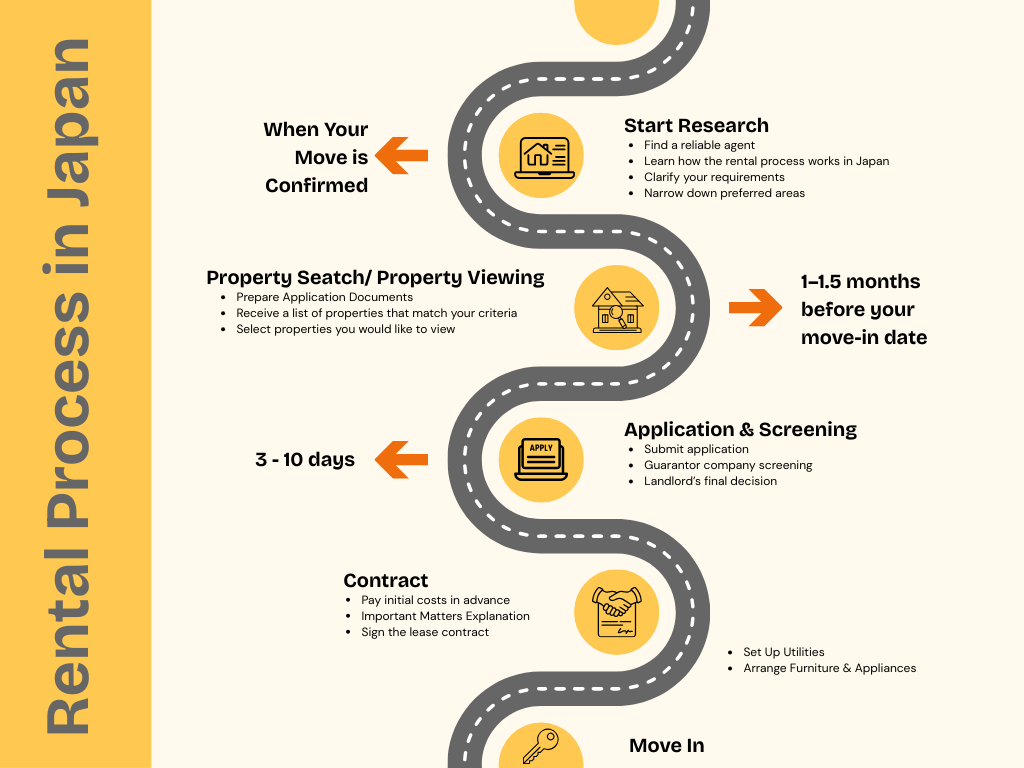
When Should You Start Looking for an Apartment?
There is no disadvantage to starting your research early.
Since you may not yet be familiar with different neighborhoods, I recommend:
- Researching Japanese rental customs
- Narrowing down preferred areas
- Understanding what kind of properties are available within your budget
That said, if your move-in date is still several months away, keep in mind that Japanese rentals generally cannot be reserved far in advance.
Unlike some countries, there is usually no “hold” or “pre-booking” system.
As a general rule:
- Property viewings typically begin 1 to 1.5 months before your intended move-in date
- The contract start date is usually within one month after application
Peak Season: January to March
From January to March, demand is extremely high due to school graduations and job transfers.
During this period, I often advise clients to prepare thoroughly and be ready to make decisions quickly, as good properties are taken very fast.
Prepare the Necessary Documents
About two months before your move, you are now entering the stage of actively searching for properties. However, before you begin, it’s important to prepare the required documents for application.
The rental market in Tokyo Greater Area moves quickly. You may spend time researching, visiting properties, and finally find a place you really like—but if you cannot submit an application immediately, that opportunity may be taken by other candidates.
Rental applications require specific information and documents, so it is best to prepare them in advance. For foreign applicants in particular, the required documents may vary depending on individual circumstances, so I recommend consulting with your agent early in the process.
For more details on the required documents, please see this article.
In fact, real estate agents often ask at the inquiry stage whether you already have the necessary documents, especially when dealing with foreign applicants.
Being prepared can make a significant difference.
How to Search for Rental Properties
(1) Using Online Platforms
Many people begin their search using online platforms, including some that offer listings in English.
These platforms allow you to filter properties by:
- Area
- Budget
- Floor plan
- Size
- Distance from the nearest station
- Building age
- Surrounding environment
Because searches often return a large number of results, I recommend narrowing down your preferred areas first.
(I will explain how to choose the right neighborhood in a separate article.)
Understanding Japanese Floor Plan Terminology
In Japan, floor plans are typically labeled as:
- 1R (One Room): A single room with no separation
- 1K: One room plus a separate kitchen
- 1DK / 1LDK: One room with a dining or living-dining area
- 2LDK: Two bedrooms plus a living-dining-kitchen area
Beyond this, the number simply increases as bedrooms are added.
When choosing a layout, think about:
- How many bedrooms you actually need
- Whether you prefer one larger open space
- Or clearly separated rooms, which may feel smaller but offer privacy
Once you find a property that interests you, you can submit an inquiry directly through the platform.
Limitations of English-Language Platforms
It is important to note that English-language rental websites often show only a limited portion of the market.
Most Japanese residents use platforms such as SUUMO or At Home, which list the vast majority of available rentals—but these sites are almost entirely in Japanese.
For this reason, I believe the most efficient approach for foreigners is to work with a real estate agent experienced in international transactions, who can propose suitable properties from the full market.
(2) Visiting Local Real Estate Offices
Another option is to visit real estate offices directly in your desired neighborhood.
Local agencies usually know their area very well and can introduce many properties within that district.
If the agency specializes in rentals, they may accept walk-in clients if staff are available.
However, to ensure a smooth experience, I recommend contacting them in advance and sharing your basic requirements.
That said, most local agencies are not used to communicating in English, so this approach can be challenging unless you are comfortable in Japanese.
Property Viewings
When you inquire about a property, I recommend you to ask the real estate agent to propose several other options that match your criteria, not just the property you initially contacted them about.
Review the list carefully, and then schedule viewings for the properties you are interested in seeing in person.
Some agencies that specialize in foreign clients offer online viewings, but many traditional agencies are still not accustomed to this.
Additionally, many agents prefer in-person viewings to avoid misunderstandings later.
In Japan, a real estate agent always accompanies you during a viewing.
You usually meet at the property or at the agency’s office, and the agent unlocks the unit and shows you around.
Viewings are:
- Completely free
- Non-binding
In theory, there is no strict limit on the number of properties you can view. However, since viewings take time for both you and the agent—and an agent cannot accompany clients indefinitely—it is common practice to view up to three or four properties within the same area before making a decision.
Because rentals move quickly, I strongly recommend deciding on the same day or by the next day, and clearly communicating your intention to apply.
Application
Once you decide to proceed, you submit an application form to your real estate agency or agent. At this stage, the agency will first check with the landlord to confirm whether they are willing to accept the application.
At this point, the landlord does not review detailed documents yet. Instead, the agent typically shares basic information—such as your occupation, age, and general background—and if the landlord is comfortable, the application is provisionally approved to move forward to guarantor screening.
For this reason, documents required by the guarantor company are usually requested at the time of application. With the exception of a few guarantor companies, a Japanese address and phone number are often required at this stage. (I’ll cover this in more detail in a separate article.)
Applicant Information
- Name
- Address (must match ID documents)
- Date of birth
- Contact details
- Employment information/School information
- Annual income (approximate is acceptable)
- Length of employment
Guarantor (if required)
In Japan, rental contracts traditionally required tenants to appoint a joint guarantor—a person who would be jointly and severally responsible for paying the rent if the tenant was unable to do so. In the past, it was common to ask a close family member to serve in this role.
However, in recent years, rent guarantor companies have become widely used as an alternative to individual guarantors. From a landlord’s perspective, guarantor companies offer greater security and reliability, which is why they are now the standard option in most rental contracts.
That said, not all properties require or accept a guarantor company even today, and some landlords may still prefer a traditional joint guarantor depending on the property and circumstances.
Emergency Contact
An emergency contact is still required in most cases.
Ideally, this is a family member in Japan, but for foreign tenants, this is often not possible.
In practice, I usually recommend:
- A supervisor or manager at your workplace in Japan
- An advisor from your school or university
Some landlords accept friends who live in Japan, so it is best to consult with your agent.
At this stage, in addition to the application form, you will also be asked to submit the other required documents mentioned earlier in this article.
Application Deposit (Holding Deposit)
You may be asked to pay an application or holding deposit.
This deposit:
- Temporarily reserves the property
- Is refundable if the contract does not proceed
- May be applied toward initial costs if the contract is finalized
The typical amount ranges from ¥10,000 to one month’s rent.
If requested, I strongly advise confirming the refund conditions in advance.
Can I Negotiate the Rent?
Technically, rent negotiation is possible in Japan, but it is generally not recommended.
When an applicant asks for a rent reduction from the very beginning, landlords may perceive them as a potentially troublesome tenant, and in many cases, the application may be rejected for that reason alone.
That said, it is acceptable to ask with a “no harm in trying” mindset, understanding that if the landlord declines, that is the end of the discussion.
In cases where a property has been vacant for some time and the landlord is struggling to find a tenant, there is, of course, a higher chance that they may agree to a rent reduction.
As with many aspects of renting in Japan, this is something you should consult with your agent about, as timing and approach are key.
Screening Process
After submission, the application is sent to a guarantor company for screening.
How Long Does Guarantor Company Screening Take for Foreign Applicants?
For foreign applicants, screening by a guarantor company typically takes 2 to 5 business days once all required documents have been submitted.
In some cases, the process may be completed within 1–2 business days, but it can also take up to a week or longer if additional verification is required—such as confirming overseas documents, employment details, or income information.
During the screening period, the property is usually held for the applicant. However, if the process takes too long and there is another interested applicant waiting, the landlord may decide to proceed with the next application instead.
For this reason, make sure you have all documents ready in advance, respond promptly to any follow-up requests, and work closely with an agent who understands the process. Being well-prepared can help prevent unnecessary delays and reduce the risk of losing the property.
Hurray! Your application has passed the guarantor company’s screening
— but it’s not the final step yet.
Even if the guarantor company approves, the final decision always rests with the landlord.
Because tenant rights are strongly protected in Japan and it is extremely difficult to request a tenant to move out once problems arise, landlords are very cautious when deciding whether to accept a tenant.
Unfortunately, some landlords still refuse tenants simply because they are foreigners. However, this is usually confirmed before viewings take place, so rejection solely based on nationality at this stage is rare.
That said, landlords only learn detailed information—such as employment and income—at the application stage, and they make their final decision based on a comprehensive review.
Small Tip!
Landlords almost always ask the agent what the applicant was like.
Since agents value their relationship with landlords, they may advise against proceeding if an applicant seems problematic.
For this reason, it is important to behave appropriately and professionally not only with the landlord but also with the real estate agent.
They also often ask the agent what kind of impression the applicant made.
For this reason, maintaining a respectful and professional attitude throughout the process is very important.
In most cases, unless there are special circumstances, landlords will respond on the same day or the next day the guarantor company’s screening is approved.
Contract
Once approved, a contract date is scheduled.
Before the contract, you will receive a statement of initial costs, which must be paid by the deadline. Bank transfer is the most common payment method for initial costs, but in recent years, some agencies also accept credit card payments, so it is worth checking in advance. (I will explain the initial costs in detail in a separate article.)
What Happens on the Contract Day in Japan
In Japan, the rental contract is usually completed at the real estate agency’s office.
The landlord does not attend the contract signing in person.
On the contract day, you will first receive a legally required explanation called the Important Matters Explanation (Jūyō Jikō Setsumei).
This explanation is mandated by law and must be given by a licensed real estate agent.
During this explanation, the agent will go through key points such as:
- Details of the property
- Rent, management fees, and contract term
- Rules and restrictions (including prohibited uses)
- Conditions for renewal and termination
- Responsibilities for repairs and maintenance
- Rules regarding deposits and move-out procedures
This step is especially important for foreign residents, as many rental customs and legal concepts in Japan differ from those in other countries.
In particular, garbage disposal rules in Japan are very strict and can easily become a source of trouble with neighbors, so be sure to ask and fully understand the rules.
There are also many things that may be acceptable in your home country but are not allowed in Japan, such as leaving personal items in shared spaces. If you have any questions or uncertainties, do not hesitate to ask and make sure everything is clear.
After the Important Matters Explanation, you will proceed to sign the lease agreement and any related documents.
By this point, the initial costs should already have been paid, and no payment is typically made on the day of the contract.
Once the contract is completed, the agent will explain the next steps, including:
- When and how to receive the keys
- The official move-in date
- Utility arrangements and move-in procedures
Taking the time to fully understand the contract on this day will help prevent misunderstandings and problems later on.
Moving In
You may move in from the contract start date.
Keys are usually collected from the agency on or just before that date.
In Japan, tenants are responsible for arranging their own utilities.
You should complete utility applications before your move-in date. This can usually be done online. Please note that gas activation requires an in-person appointment after move-in.
Furniture and Fixtures
In Japanese rentals, furniture, appliances, curtains, and lighting are generally not provided.
Downlights, bathroom lights, and kitchen lighting are usually installed, so you may be able to manage initially with those.
However, curtains are almost never provided and must be prepared by the tenant. To ensure a smooth start to your new life, you may want to prepare as much as possible before moving in.
Even before your move-in date, you may be allowed to enter the apartment to take measurements, or in some cases, the real estate agency may take measurements for you. If this is necessary, it is a good idea to consult with your agent in advance.
For more details on how to set up your home, please refer to this article.
Move-In Inspection
Upon moving in, you will usually receive a move-in inspection sheet.
To avoid being charged later for damage you did not cause, carefully check and record any scratches or damage that already exist at the time of move-in.
Starting Your Life in Japan
Renting an apartment in Japan requires preparation and understanding of local practices.
I support foreigners who are moving to Japan so they can find a best-fit home without unnecessary stress.
My services are designed not only for those already in Japan, but also for clients who are still overseas and planning their move.
My aim is to help you move directly into your new home from your very first day in Japan. I provide a range of tailor-made services, carefully adapted to each client’s situation and schedule.
My support goes beyond simply finding an apartment and includes assistance with move-in arrangements as well as ongoing support after you begin living in your new home.
From housing consultations to online viewings and contract procedures, full online support is available.
Please feel free to reach out if you have any questions or would like to discuss your housing needs.
I hope this guide helps you feel more confident as you begin your housing search in Japan.