
Greater Tokyo Existing Home Market Trend (Jan 2026)
Rising Prices, Falling Transactions — and What It Really Means
(January 2026 Latest Report)
“Should I sell my home now, or wait?”
“I want to buy in Tokyo, but prices feel too high.”
These are questions I hear frequently from both foreign residents and international investors.
According to the January 2026 data, the Greater Tokyo existing home market has entered an unusual phase—one that requires careful interpretation.
In simple terms:
Fewer homes are selling, yet prices continue to rise.
This growing mismatch between supply and demand is becoming increasingly clear. Let’s look at what’s actually happening—and how to read the market correctly.
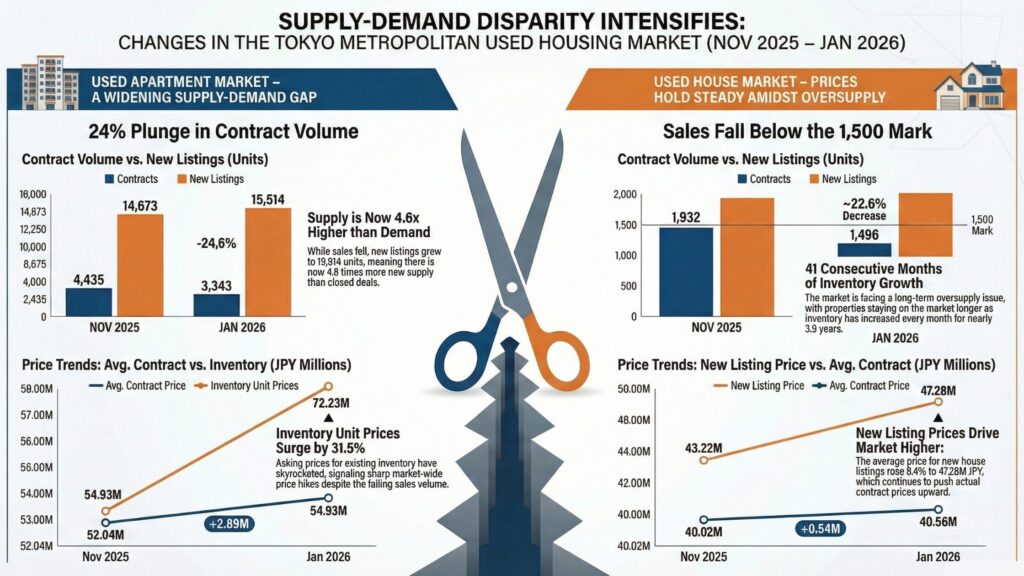
1. Existing Condominiums: Prices Above Bubble Levels, Oversupply at 4.6x
On the surface, the condominium market looks exceptionally strong.
- Prices beyond the bubble era
The average transaction price per square meter in January 2026 reached ¥869,900, exceeding the previous all-time high recorded in September 1990 during Japan’s asset bubble. - 69 consecutive months of price growth
Prices have risen continuously since May 2020—more than five and a half years without interruption.
However, beneath these headline numbers lies a clear imbalance.
- Oversupply is widening
In January, 15,514 properties were newly listed, while only 3,343 transactions were completed.
This means the market supplied approximately 4.6 times more properties than were actually sold.
While year-on-year transaction volume shows a slight increase, sales have dropped sharply over the past two months, which could be interpreted as a sign that buyers are becoming increasingly cautious. However, my sense on the ground is somewhat different.
Given that the market remains relatively strong, a sizable group of sellers is listing their properties at higher prices to test the market. Many are not under pressure to sell, which is why prices are not breaking down easily.
At the same time, buyer interest remains strong, but current pricing levels are making it difficult for many to move forward with transactions.
2. Existing Detached Houses: Slower Sales, Growing Inventory
The same pattern appears even more clearly in the detached housing market.
- Transaction volumes declining
January 2026 recorded 1,496 completed transactions, down from 1,932 in November 2025—a decline of about 22% in just two months. - Inventory rising for 41 consecutive months
Homes are taking longer to sell, and excess supply has become structural rather than temporary. - Prices remain elevated
Despite weaker demand, the average transaction price rose to ¥40.56 million, up 7.1% year-on-year.
3. Why Are Prices Rising When Homes Aren’t Selling?
Under normal market conditions, falling demand leads to lower prices.
But today’s existing home market in Greater Tokyo is behaving differently.
The key driver is listing prices.
- Condominiums: New listing prices are up 30.0% year-on-year
- Detached houses: New listings are up 9.4% year-on-year, averaging ¥47.28 million
As I mentioned above, this means that sellers across the market are raising their asking prices.
As a result, the limited number of transactions that do occur are pulled upward by these higher expectations—keeping average prices elevated even as liquidity declines.
4. What This Means for Foreign Buyers
For foreigners unfamiliar with Japan’s market dynamics, this environment can feel confusing.
The key takeaway:
Headline prices alone do not tell the full story.
- Inventory is abundant
- Properties are staying on the market longer
- Negotiation opportunities are increasing, especially for long-listed homes
This is particularly true outside Tokyo’s central wards, including parts of Chiba, Saitama, Yokohama, and Kawasaki.
5. Investor View: Yield, Liquidity, and Negotiation
From an investment perspective, the current market shows clear warning signals:
- Liquidity is declining
- Oversupply is persistent
- Price inflation is seller-driven, not demand-driven
At the same time:
- Acquisition prices are compressing yields
- Rent growth has not kept pace with listing price increases
- Cap rate expansion risk must be considered, especially if interest rates rise further
This is not a uniform seller’s market—it is a market with pricing inefficiencies.
For disciplined investors, opportunities may exist in:
- Long-listed or overpriced assets
- Motivated sellers adjusting expectations
- Non-prime but well-connected locations
Selective underwriting and negotiation strategy are essential.
Final Insight: Expensive Locally, But Still Affordable Globally
Despite these cautionary signals, one critical point should not be overlooked:
Compared to many major global cities, Greater Tokyo remains relatively affordable.
When viewed against markets such as New York, London, Hong Kong, or Singapore, Tokyo still offers:
- Lower price per square meter
- Clear and stable ownership rights
- A large, liquid metropolitan market
- Consistent rental demand in central and commuter-accessible areas
This is why many international buyers and investors continue to see Tokyo not as an overheated market, but as a long-term, structurally sound market with reasonable entry pricing.
The key is not perfect market timing—but choosing the right property, in the right location, at the right price.
📺 YouTube Video Available
I also explain this market situation in detail in my YouTube video.
If you’re considering buying or selling property in Tokyo, understanding these market dynamics is key.
Feel free to reach out if you’d like a personalized view of how current pricing and demand may affect your specific situation.