
Explanation of Important Matters (Jusetsu) in Japan: What Foreign Residents Must Understand Before Signing a Rental Contract
If you are relocating to Japan and planning to rent an apartment in Tokyo, one of the most important steps in the rental process is something called the “Explanation of Important Matters” (重要事項説明), known in Japanese as Jūyō Jikō Setsumei or simply Jusetsu.
For many foreigners moving to Japan, this step can feel confusing or overly formal. However, it is not just paperwork. It is a legally required procedure designed to protect tenants and prevent disputes. Understanding this process is essential for anyone renting property in Japan for the first time.
This article explains what Jusetsu is, why it matters, what you must check carefully, and how to avoid costly misunderstandings when signing a Japanese rental contract.
What Is the Explanation of Important Matters in Japan?
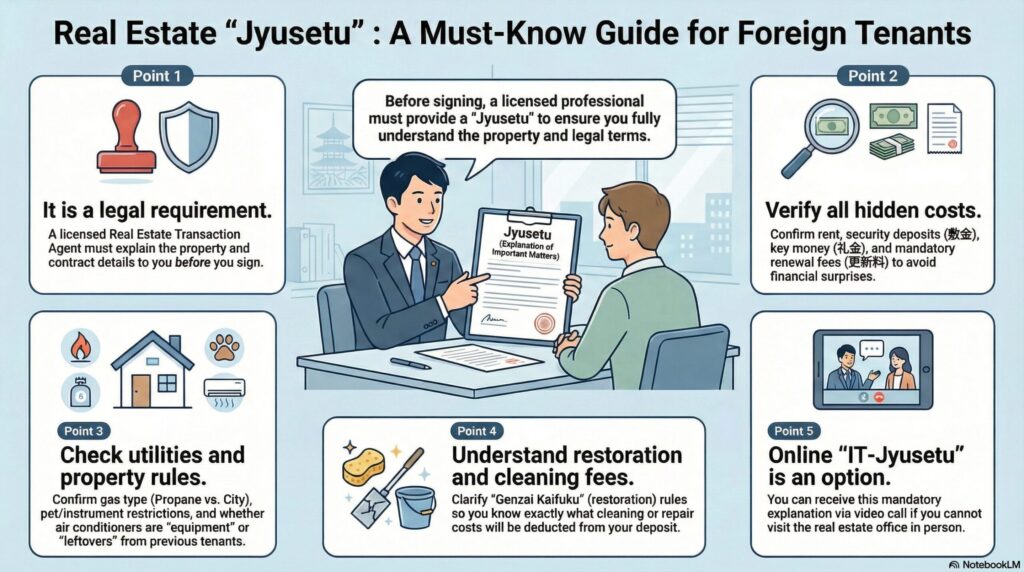
The Explanation of Important Matters is a mandatory pre-contract session required under Japan’s Building Lots and Buildings Transaction Business Act. Before you sign a rental agreement, a licensed real estate professional called a Takuchi Tatemono Torihikishi (宅地建物取引士) must explain the legal and contractual details of the property.
This explanation must include:
- The legal status of the property
- The contract terms and duration
- Renewal conditions and fees
- Repair responsibilities
- Restrictions and usage rules
- Financial obligations beyond rent
The person conducting the session must show their official license card. If they do not, it is a violation of Japanese law.
For foreign residents, this session is especially important because Japanese lease contracts often contain clauses that may not exist in other countries. The Jusetsu is your final opportunity to understand every obligation before you become legally bound.
Most importantly, you are not required to sign the lease after the Jusetsu. If something is unclear or unacceptable, you have the right to walk away.
Why Jusetsu Is Critical for Foreigners Moving to Japan
Many disputes between landlords and foreign tenants occur not because of bad intentions, but because of misunderstandings about responsibility.
In Japan:
- Rental contracts are typically two years.
- Upfront costs are high.
- Renewal fees are common.
- Move-out charges follow specific legal standards.
- Guarantee companies often replace personal guarantors.
If you do not fully understand the terms during Jusetsu, problems may only appear later — when moving out or renewing.
Taking the Explanation of Important Matters seriously protects your finances and your peace of mind.
Lifelines: Gas, Utilities, and Internet Setup
Infrastructure details can significantly impact your monthly expenses and daily comfort.
One major distinction is City Gas vs. Propane (LP) Gas. In Tokyo, propane gas is generally 1.5 to 2 times more expensive than city gas. This difference can noticeably affect monthly utility costs, especially in winter.
You should also confirm whether utilities use individual meters or shared billing systems. In older buildings, water charges may be collected as a fixed monthly amount by the landlord rather than billed directly by the utility company.
Internet setup is another area where foreign residents often face unexpected delays. Confirm whether the building is:
- “Internet complete” (connection ready for use)
- “Internet compatible” (you must contract and install service yourself)
Some buildings restrict which providers you may use, and installation appointments can take weeks. If you work remotely, this detail is critical.
Fixtures vs. Leftover Items (Zanchibutsu)
One of the most common misunderstandings in Japanese rentals concerns equipment classification.
During Jusetsu, confirm whether items such as air conditioners, lighting, or stoves are:
- Fixtures (設備 / setsubi) – The landlord must repair or replace them if they fail under normal use.
- Leftover items (残置物 / zanchibutsu) – The landlord has no repair obligation. If they break, you may bear the cost.
Many foreigners assume that anything inside the apartment is covered by the landlord. This is not always the case in Japan.
If an air conditioner is categorized as a leftover item and stops working in summer, you could be responsible for replacement costs. Always ask for clarification in writing.
Restoration Costs and the Tokyo Ordinance
Tokyo has a specific rule called the Tokyo Rental Housing Dispute Prevention Ordinance, which defines responsibility at move-out.
Under this ordinance:
Natural aging and normal wear — such as wallpaper fading from sunlight or minor floor dents from furniture — are the landlord’s responsibility.
Damage caused by negligence — such as cigarette burns, scratches from dragging furniture, or mold caused by poor ventilation — is the tenant’s responsibility.
However, many contracts include special clauses requiring professional cleaning fees regardless of room condition. These cleaning fees are extremely common in Tokyo and should be clearly explained during Jusetsu.
Before signing, confirm:
- The exact cleaning fee amount
- Whether it is fixed or variable
- Any additional restoration obligations beyond standard wear and tear
Understanding this now prevents disputes later.
Financial Obligations Beyond Monthly Rent
Rent is only part of the total cost of renting in Japan.
During Jusetsu, carefully review:
- Renewal fee (often one month’s rent every two years)
- Renewal administrative fees
- Short-term cancellation penalties
- Guarantee company initial and renewal fees
- Fire insurance costs
- Lock exchange fees
In Tokyo, renewal fees are standard practice and may surprise foreigners who are unfamiliar with this system. If you plan to stay long-term, this should be factored into your total housing cost calculation.
Short-term cancellation penalties are especially common in properties offering “zero deposit” or “free rent.” If you leave within one year, you may owe one or two months’ rent as a penalty.
Rules, Restrictions, and Mandatory Disclosures
Building rules in Japan are often stricter than in Western countries.
Confirm restrictions on pets, musical instruments, smoking, and business use. “Pet-friendly” may still limit size, breed, or number.
The broker must also disclose negative information (告知事項), such as prior incidents in the unit or significant nearby environmental issues. If you have concerns, ask directly whether any disclosure items apply to the property.
Hazard Maps and Disaster Explanation
Real estate agents in Japan are legally required to explain a property’s location on official hazard maps during the Explanation of Important Matters (Jusetsu).
This means the agent must show you the relevant government-issued hazard map (such as flood or storm surge maps) and clearly explain whether the property is located within a designated risk zone. If it is, they should also clarify the type of risk involved — for example, river flooding or heavy rainfall — and indicate the expected inundation depth based on municipal data.
Under the law, the agent’s obligation is specifically to show the relevant hazard map and indicate where the property is situated within it. The legal requirement does not extend to providing a detailed risk analysis beyond identifying the location.
However, if the property falls within a designated flood zone, it is advisable to ask about the type of flood risk, the expected inundation depth, and the location of nearby evacuation areas. While these additional explanations may not all be strictly mandated, understanding them is essential for making an informed rental decision in Tokyo.
If you are relocating to Japan, do not hesitate to ask where the nearest evacuation area is and how the local government defines the hazard zone. Understanding this information is an essential part of making an informed rental decision in Tokyo.
IT Jusetsu: Completing the Process from Overseas
If you are relocating to Japan and have not yet arrived, you may complete Jusetsu via video conference.
You must:
- Clearly see the broker and their license
- Receive documents in advance
- Have stable internet access
It is strongly recommended to print the documents before the session so you can review details carefully.
Final Advice for Foreigners Renting in Japan
Never rush the Jusetsu simply because the market is competitive. A good apartment is important, but a clear contract is more important.
Ask practical questions such as who to contact in emergencies, how maintenance is handled, and what happens if you need to terminate early.
If you pay a holding deposit before signing, confirm in writing that it is refundable if you cancel before contract execution.
By understanding the Explanation of Important Matters in Japan, you are not just completing a legal formality. You are protecting yourself financially and ensuring that your new life in Tokyo begins with clarity and confidence.
If you are relocating to Japan and would like professional guidance in English throughout the rental contract process, feel free to reach out. Personalized support can prevent misunderstandings and make your move significantly smoother.