Kyoko Estate Theme

Upfront Costs When Renting in Japan — And How to Reduce Them

Moving to Japan is an exciting journey, but the apartment-hunting process can be a financial culture shock. Rental customs in Japan are quite different from those in many other countries, and Japan has a unique system of fees that must be paid upfront at the time of contract signing.

In this guide, I explain the upfront costs of renting in Japan and share practical tips for keeping initial expenses down. Since customs and market practices vary across Japan, this guide focuses on typical trends in the Tokyo metropolitan area.


How Much Are the Total Upfront Costs?

As a rule of thumb, you should prepare to pay 4 to 6 months’ worth of rent at the time of signing.
For example, if your monthly rent is ¥100,000, you will likely need ¥400,000 to ¥600,000 available in your bank account.

These upfront payments are called initial costs (初期費用 / shoki hiyō) and are paid at the time the lease contract is executed.


Breakdown of Initial Costs in Japan (What You’re Paying For)

Below are the most common fees you may see on a Japanese rental invoice.

1) Advance Rent (Prepaid Rent)

It is standard practice in Japan to pay one month of rent upfront.
If you move in mid-month, you may also be required to pay pro-rated rent for the remaining days of that month.

In Japan, rent is typically paid by automatic bank transfer. If you do not yet have a Japanese bank account and cannot set up automatic withdrawal at the time of contract, you may be required to prepay additional rent until the bank setup is completed.

2) Maintenance / Management Fee (管理費・共益費)

If your listing shows rent plus a separate management or maintenance fee, this fee covers shared building expenses, such as:

  • Cleaning of common areas
  • Elevator maintenance
  • Lighting in hallways
  • Building management services

This fee is often collected together with the advance rent at the time of contract.

3) Security Deposit — Shikikin (敷金)

This is a partially refundable deposit held by the landlord to cover:

  • Unpaid rent
  • Cleaning costs
  • Repairs beyond normal wear and tear

Deductions at move-out are common. The typical range is 1–2 months of rent, though some listings require no deposit.

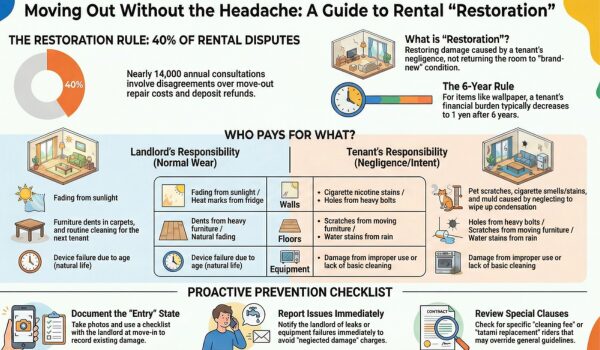
Details regarding move-out settlements and repair charges will be explained in a separate article.

4) Key Money — Reikin (礼金)

Key money is a non-refundable payment made to the landlord, sometimes described as a “thank-you” gift.

Many expats assume that a “gift” should be optional, but when key money is listed as a condition, it is mandatory in order to rent the property.

That said, no–key-money listings are not uncommon.

  • Popular, high-demand properties often require key money because landlords can be selective.
  • Properties that have been vacant for a long time may remove key money to attract tenants.

In that sense, key money can sometimes reflect a property’s popularity or market demand—though there are also many excellent properties with no key money at all.

5) Agency Fee — Chūkai Tesūryō (仲介手数料)

This is the brokerage fee paid to the real estate agency at contract signing.
It covers services such as:

  • Initial consultation
  • Property search and viewings
  • Contract explanation and coordination
  • Key handover

The commonly referenced maximum is up to one month’s rent + tax.

6) Guarantor Company Fee (保証会社費用)

Most rentals require a guarantor company, especially for foreign tenants.

The initial fee is usually 50–100% of one month’s rent, with possible renewal fees later.
For those who are new to Japan or do not yet have a Japanese bank account, 100% of one month’s rent is quite common.

7) Insurance (Fire & Liability Insurance)

Most leases require tenant insurance, usually purchased as a 2-year policy.

This insurance typically covers:

  • Fire damage
  • Water leaks
  • Personal liability (damage caused to neighboring units)

Many tenants forget about this insurance after moving in, but if something unexpected happens during your stay, you should always check whether the insurance applies.
If needed, I can also assist with contacting the insurance company and handling claims.
(Not all real estate agents provide post-move-in support, so this is something to confirm in advance.)

8) Key Exchange / Lock Replacement Fee

Many landlords or management companies charge a one-time lock replacement fee at move-in, typically ¥15,000–¥30,000.

FAQ: Can this fee be skipped?
Technically, it is not legally mandatory. However, most management companies insist on it for security and liability reasons. If the locks are not changed, the previous tenant may still have a spare key.

Note:
For high-security dimple keys or smart locks, the fee may be higher and replacement is usually mandatory.

9) “Optional” Fees That Often Appear

Depending on the property and management company, you may also see:

  • Cleaning fee: ¥30,000–¥60,000
  • Disinfection / pest control fee: ¥10,000–¥25,000
  • 24-hour support service fee: ¥10,000–¥20,000
  • Document preparation / administration fee: ¥5,000–¥15,000

These fees vary widely and are another reason why comparing total move-in cost is more important than rent alone.

Fee Summary Table (Japan)

Fee ItemJapanese NameRefundable?
Security DepositShikikin (敷金)Yes (partially)
Key MoneyReikin (礼金)No
Agency FeeChūkai Tesūryō (仲介手数料)No
Guarantor FeeHoshō-gaisha Hiyō (保証会社費用)No

Average Move-in Costs in Tokyo

Tokyo’s rental market is premium. Below is a practical budget guideline.

Apartment TypeAvg. Monthly RentEstimated Total Upfront Cost
Studio (1K / 1R)¥80,000 – ¥120,000¥320,000 – ¥720,000
1BR (1LDK)¥120,000 – ¥250,000¥480,000 – ¥1,500,000
2BR (2LDK)¥200,000 – ¥350,000¥800,000 – ¥2,100,000

Real-Life Simulation: Renting a ¥200,000 1LDK in Tokyo

Example invoice for a high-end 1LDK in Shibuya or Minato:

  • Rent: ¥200,000
  • Security Deposit (1 mo): ¥200,000
  • Key Money (1 mo): ¥200,000
  • Agency Fee (1.1 mo): ¥220,000
  • Advance Rent (1 mo): ¥200,000 *Depending on your move-in timing
  • Guarantor Company Fee (1 mo): ¥200,000
  • Fire Insurance & Lock Exchange: ¥40,000

TOTAL ESTIMATE: ¥1,260,000


FAQ: Can I Negotiate Initial Costs?

Yes, negotiation is possible—but it must be handled carefully.

You can ask for rent reductions or waivers of key money. However, aggressive negotiation may cause the landlord to view you as a “difficult tenant,” which could negatively affect screening results.

If a property has been vacant for a long time, or if the landlord’s situation allows flexibility, negotiations may succeed.
This is why it’s best to consult your agent first, as agents often know which properties are negotiable.

If you’d like to learn about common obstacles foreigners face when renting in Japan, please see this article.

Practical Ways to Reduce Initial Costs

Look for “Free Rent” Listings

Some properties offer 1–2 months of free rent, meaning you do not pay rent during that period. This significantly reduces upfront costs.

Free rent is often offered when:

  • The landlord wants to fill a vacancy quickly
  • A newly built apartment is leasing multiple units at once

Negotiating rent reductions is often frowned upon, but free-rent listings are relatively common and worth targeting if budget is a concern.


Check for “No Key Money” Listings

Many properties are advertised with no key money.
Removing key money alone can reduce upfront costs by 1–2 months’ rent.


Consider UR Housing

UR rentals are government-affiliated properties with:

  • No agency fee
  • No key money
  • No guarantor company fee

The quality is generally good, but availability is limited and competition is high, which can be a challenge.

You can find more details about UR Housing here.


The “Off-Season” Advantage

Moving in July, August, or November gives you more leverage.
During peak season (January–March), landlords receive many applications and rarely negotiate.

However, properties that remain vacant after March often prompt landlords to become more flexible—making them good negotiation targets.

Timing Affects Cash Required

Because you may need to pay pro-rated rent plus a full month in advance, your move-in date affects how much cash is required upfront.

In some cases, moving in at the very beginning or end of a month may reduce the immediate payment. However, this depends on whether automatic bank transfer is already set up, so it is always case by case.

The steps for opening a bank account in Japan will be covered in a separate article.

Renewal Fees: One Thing to Keep in Mind

While not part of the initial move-in costs, renewal fees are an important factor to consider for future expenses—especially if you plan to stay for more than two years.
In Japan, residential leases are typically for two years, and at the time of renewal it is common to pay a renewal fee equivalent to one month’s rent. That said, some properties do not charge a renewal fee. For this reason, whether or not a renewal fee applies can be an important decision point when searching for a property, particularly if you want to keep long-term housing costs down.

Have You Considered Buying Instead?

In Japan, depending on the area and the property, some homes can be purchased at surprisingly accessible prices—for example, studio units under ¥10 million and 1LDK units starting in the ¥10 million range.

If you later move out, you can sell or rent out the property.
Unlike rent, which is purely an expense, purchasing creates an asset.

For foreign buyers paying in cash, purchasing can sometimes be easier than renting. If you are considering Japan as an investment destination, buying may be worth exploring. I also assist with property purchases.

Reduce Costs by Preparing Before You Arrive

During the period between arriving in Japan and securing a home, many people stay in serviced apartments or hotels, which means paying high short-term rent on top of the upfront move-in costs.

If you start searching for a home only after arriving in Japan, the timeline to move in can vary depending on your situation, but even in the fastest cases, it usually takes around two weeks, and in many cases three weeks to a month or more before you can move into a long-term rental.

To reduce these expenses and shorten the temporary stay, preparing as much as possible before arriving in Japan is essential. Having the required documents ready in advance can also make the rental process much smoother and help shorten the overall timeline.

I can support the entire rental process fully online, allowing you to complete the contract before your arrival if needed.

For a step-by-step overview of the rental process in Japan and a list of required documents, please refer to this article.

Conclusion

Japan’s rental system may feel surprising compared to your home country, but understanding the costs and preparing in advance can greatly reduce stress.

I can support you from before your arrival in Japan, including area and property recommendations, online viewings, and even completing the lease contract fully online. By understanding your priorities and situation, I aim to help you find a home that truly fits your needs—while also proposing practical ways to keep your overall costs as low as possible. I provide tailored property searches based on your budget and situation, along with practical advice and negotiation strategies.

Initial consultation is completely free, so please feel free to reach out if you’d like personalized guidance.

Key Considerations When Choosing Where to Live in Tokyo

If you are not very familiar with Tokyo, it can feel almost impossible to know where to start when choosing an area to live. Tokyo is vast, and without local knowledge, everything can look equally confusing at first glance.

Before looking at floor plans or listing photos, it’s important to imagine how you want to live in Tokyo.

Most clients do not have clear preferences at the beginning. Especially in an unfamiliar city, where there are so many options, it’s very easy to feel overwhelmed and unsure about what is truly best.

That’s why I work with clients to clarify their priorities—thinking together about what is realistically possible in Tokyo—and then select areas and properties that best match their overall vision and needs.

Some people actually feel overwhelmed if they are asked too many questions, so I adjust my approach on a case-by-case basis. But I usually talk through these topics casually during our conversations.

  • How long of a commute is acceptable for you?
  • Do you work from home?
  • Do you prefer a quiet environment, or do you enjoy lively neighborhoods?
  • Are you comfortable walking from the station, and if so, how many minutes?
  • Do you like neighborhoods with a traditional, local “shitamachi”(old charm) atmosphere?
  • Or do you prefer Tokyo’s most modern and cutting-edge areas?
  • How do you usually like to spend your weekends?
  • How often do you go grocery shopping? (Refrigerators in Japan might be smaller than those in your countries!)

By talking over these points together, we gradually narrow down suitable areas and properties.

As a next step, when further refining specific locations and properties, below are key points to consider when choosing a property’s area and location—including factors that don’t appear in listings and may not always be highlighted by your agent.


Location and Rent: What Really Drives Prices in Tokyo

In Tokyo, rent prices are driven primarily by transportation convenience and distance from the station.

A good starting point is to think about where you commute to—such as your office, school or your child’s school—and decide how many minutes of travel time you are willing to accept. From there, consider areas within that radius and compare their characteristics.

Transportation Considerations

Tokyo has an extremely well-developed public transportation system. A 20-minute train ride can take you in almost any direction.

That said, if you dislike commuting, it’s often better to look for areas where you can minimize travel time, or even live within walking or cycling distance. If you need to commute during peak hours, it’s also important to consider whether you can tolerate Tokyo’s notoriously crowded trains.

On the other hand, some people don’t mind being on the train. In those cases, living a bit farther from the city center often means lower rent and a calmer residential environment.

Families and School Considerations

For families with children, it’s common to struggle between living close to school or close to work. This choice depends entirely on each family’s values.

Ideally, attending a school close to your workplace is the most convenient. In central areas like Roppongi and Azabudai, there are international schools such as ASIJ preschool, British schools, Tokyo International School, International School of the Sacred Heart and so on.

However, well-established international schools with spacious campuses—such as ASIJ and St. Mary’s International School—are often located slightly outside the city center.

When considering international schools, think about whether car drop-off is possible, whether school buses are available, and how easy the commute is by train.

(Education options will be covered in a separate article.)

Distance from the Station

In Tokyo, the closer a property is to the station, the more expensive the rent tends to be. If you expect to use trains frequently, living near a station is ultimately more convenient, with more shops and daily amenities nearby. However, station areas are often commercial zones, which can feel busy and cluttered. If you prefer a calm residential neighborhood, looking a bit farther from the station can make sense—particularly when it allows you to rent a property of similar quality at a more reasonable price.

Safety

However, especially for women, keep in mind that residential neighborhoods in Tokyo can become very quiet at night, with little foot traffic. While Tokyo is very safe, walking alone at night on streets with almost no people around may not feel comfortable. This is another important factor worth considering when choosing your home.

The atmosphere of a neighborhood can feel very different during the day compared to at night, so it’s important to keep that in mind when viewing properties.

Terminal Stations and Rent Levels

Major terminal stations such as Ikebukuro, Shinjuku, and Shibuya are large commercial areas, so there are relatively few residential properties directly nearby (though you will find apartments if you walk a bit).

In redeveloped stations like Shibuya, some commercial buildings now include residential floors on upper levels. If you really want to live close to a terminal station, looking between that station and the next one is often a good strategy.

In general, rent decreases the farther you move from terminal stations.

Express Stops vs. Local Stops

Stations where express trains stop tend to be more convenient and therefore slightly more expensive. Stations served only by local trains can have fewer services and feel less convenient.

However, express trains are often crowded, so if you’re comfortable taking local trains at a slower pace, this may not be an issue.

Even along the same train line, convenience can vary greatly from one station to the next depending on how developed the station area is.

Hidden Pitfalls of Train Lines

Some train lines are consistently crowded, prone to delays, or only served by local trains, which can mean fewer services than expected. Japan’s trains have been famous for their punctuality, but in recent years delays have become more common as rail networks have expanded and grown increasingly complex. (As a Japanese, I personally find it hard to tolerate waiting more than 10 minutes for a train at the station.) Since delay patterns tend to vary by train line, it’s a good idea to understand these differences when deciding where to live. These factors are not always obvious from listings alone, so consulting an agent is the most reliable way to avoid unpleasant surprises.

If You Rely on a Car

If your main mode of transportation is driving, proximity to a station becomes much less important. Instead, you should focus on whether parking is included or if nearby parking is available.

That said, it’s important not to underestimate Tokyo traffic. A 30-minute drive in Tokyo traffic might be very different from a 30-minute drive on a quiet highway in your country.

Slopes and Elevation

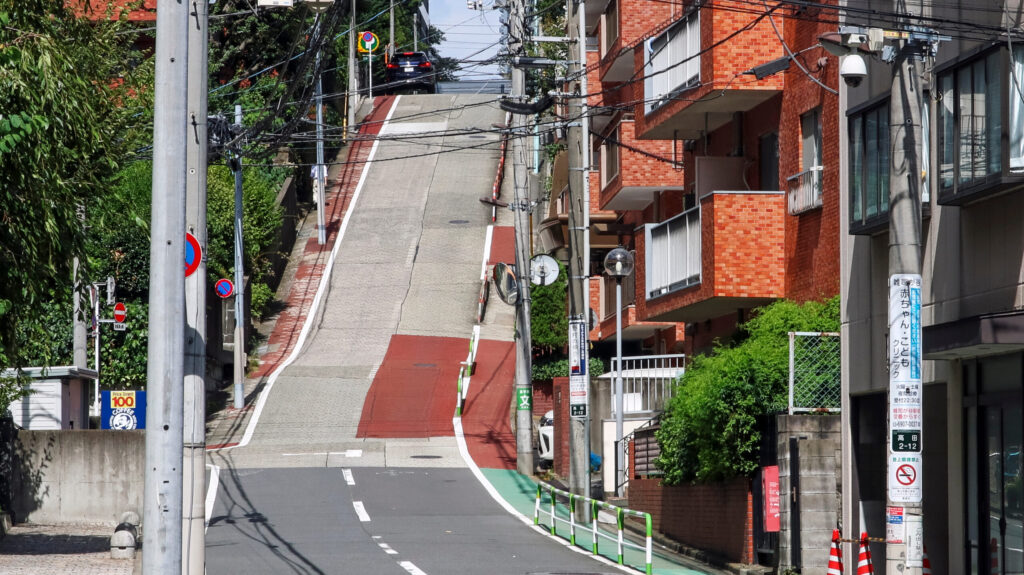
Tokyo has many hills and slopes more than you expect. Even if a property is listed as “a few minutes from the station,” steep slopes can make the walk more challenging than expected, so this is something to check carefully.

That said, areas on higher ground are often considered higher-grade residential neighborhoods.

Alternative Transportation

Bicycles are also a convenient way to get around, but even cyclists can struggle to find parking. In Japan, bicycles parked in unauthorized areas may be removed by local authorities. In that sense, rental bicycles are extremely convenient, as they eliminate the need to search for parking spaces.

In recent years, shared bicycles and electric scooters have become much more common in Tokyo and are very convenient. Considering crowded trains and traffic congestion, choosing a property with these options in mind can be a practical approach.

Your choice of train line significantly affects your daily life, and even stations on the same line can feel very different. Understanding each area’s characteristics and finding a property that truly fits your needs is much easier—and more reliable—when working with an agent who knows Tokyo well.

Lifestyle & Hobbies

Where Do You Want to Escape on Weekends?

Tokyo is surrounded by mountains, so by traveling just a short distance outside the city by car or train, you can enjoy the sea or the mountains even on a day trip. However, because Tokyo itself is so massive, crossing the city to reach the opposite side can be surprisingly time-consuming.

For this reason, your personal preferences—such as loving the ocean or wanting to go skiing almost every weekend in winter—can also become an important factor when deciding where to live.

  • Northern areas offer easy access to Chiba, where many golf courses are located. Chiba has also gained attention in recent years for second homes, such as in Katsuura, where you can enjoy a marine lifestyle. Access to Narita Airport is another advantage.
  • Southern areas provide easy access to Kanagawa, making weekend trips to Shonan, Hayama, Hakone, and Izu very convenient. These areas also offer easier access to the Tokaido Shinkansen without going all the way to Tokyo Station, making trips to Osaka and Kyoto smoother. Proximity to Haneda Airport is another benefit.
  • Western areas offer good access to Nagano and popular resort areas such as Karuizawa, , making them a great choice for snow sports lovers.
  • Central Tokyo provides easy access to expressways, making weekend escapes to the suburbs manageable. Dining and shopping options are unmatched, making it ideal for those who enjoy eating out. Some central business areas can feel surprisingly quiet on weekends, which I personally enjoy.

Disaster Preparedness & Safety

Tokyo is very safe, but there is also the reality that we must always be prepared for natural disasters.

Things I check with clients include:

  • Flood and earthquake hazard maps
  • Building age and compliance with current earthquake resistance standards
  • Whether the property is in a low-lying or reclaimed area

Even if a building meets modern earthquake standards, properties on soft ground or in flood-prone areas can be more vulnerable.

  • Tokyo has many rivers, and river-adjacent areas often have softer ground. In addition, many waterfront areas are built on reclaimed land. While these areas are engineered with this in mind and are not automatically dangerous, they are sometimes avoided from a ground-condition perspective. That said, riverside and waterfront properties often offer excellent views.
  • While walking through the city, you may sometimes notice pleasant greenways that are ideal for walking and enjoying the surroundings. Greenways were typically built over former rivers, meaning the ground in these areas is also considered relatively weak.
  • Older neighborhoods may have very narrow, unplanned streets where emergency vehicles have difficulty accessing properties. In addition, such areas often have dense clusters of older wooden houses, which can increase fire risk and make firefighting more difficult.

(Disaster preparedness will be explained in more detail in a separate article.)

One more Tip

As mentioned, Tokyo is also a city with many hills. Areas with names including “-dai” or “-yama” are often on higher ground and tend to be desirable residential neighborhoods.

If You Want to Keep Rent Low

Tokyo’s borders are lined by rivers such as the Tama River and Arakawa. Simply crossing into neighboring prefectures like Kanagawa, Saitama, or Chiba often results in noticeably lower rent.

While crossing rivers by car can be inconvenient due to bridge access, by train it’s often just one or two stops away, with little loss of convenience. These areas also tend to have more affordable shops and lower overall living costs compared to central Tokyo.

My Personal Recommendations

My clients often ask, “So where is actually good to live?”
Tokyo has so many interesting and wonderful neighborhoods that narrowing it down to just a few is truly difficult. That said, I’d like to share the areas I personally recommend most.

Hiroo

A rare balance of convenience, livability, and greenery. If you want to actively enjoy Tokyo, living closer to the city center is often more practical. While Hiroo is known as an expensive area, it also has many older buildings, and depending on conditions, you can sometimes find surprisingly reasonable options.

Ebisu

The neighboring station between Hiroo and Shibuya. With access to both the Hibiya Line and JR Yamanote Line, it is actually more convenient than Hiroo in some ways. It offers large station buildings, refined complexes like Ebisu Garden Place, and many local restaurants. Despite being just one stop from Shibuya, it remains calm and mature. Daikanyama is within walking distance, making it one of my top recommendations for living alone in Tokyo.

Sakurashinmachi

A quiet residential area slightly outside the city center. The station area features a large, well-organized shopping street lined with cherry trees—quite rare in Tokyo. Komazawa Park is within cycling distance. Although the Den-en-toshi Line can be crowded, access to Shibuya is excellent, offering a balance of calm living and convenience.

Musashi-Koyama

A unique blend of strong local character and modern redevelopment. Just four minutes from Meguro Station on the Meguro Line, it features a lively covered shopping arcade full of traditional local shops. At the same time, ongoing redevelopment has added a modern touch. One Italian client once described Musashi-Koyama as “the Venice of Tokyo” (though I can’t fully confirm that!). The large Rinshi-no-Mori Park is also nearby.

Finding a Home That Truly Fits Your Life

Photos and online listings don’t tell the full story. The most popular area is not always the best for you. Choosing a home in Tokyo is about aligning your priorities with the realities of the city.

If you’re unsure where to start, feel free to reach out

As a Tokyo native and an independent real estate agent, I work across all areas of Tokyo and the surrounding regions, without being limited to specific locations or listings. I do not have to prioritize company interests, and I always act in my clients’ best interests.

I take the time to understand your priorities and circumstances, help you narrow down the areas and properties that best fit your needs, and guide you through the process with practical, local insight.

Beyond home searching, I also support clients with other relocation-related challenges that come with moving in Japan, helping you avoid common pitfalls and settle in with confidence.

The consultation is completely free, so please feel free to reach out.

Here are some related articles that may help you take the next step.

Where to Live in Tokyo?―Understanding Tokyo’s Residential Areas

As a real estate agent working with international clients, I’m often asked the same question:

“Which area of Tokyo is the best to live in?”

The honest answer is that there is no single “best” area.
What matters is how each area fits your lifestyle, budget, and daily commute.

Tokyo is a gigantic city, and every neighborhood has its own appeal.
That diversity is one of Tokyo’s greatest strengths. Cutting-edge buildings stand next to long-established local shops that continue to thrive, while new stores and concepts are constantly emerging. Large parks are scattered throughout the city, and neighborhoods continuously evolve as businesses change.

Because of this, Tokyo is an exciting city where there is always something new to discover.

Explaining Tokyo in full detail would require an entire guidebook.
However, to help you grasp the overall picture as a first step before choosing where to live, this article introduces the broad characteristics of Tokyo’s main residential areas.

(For more detailed guidance on how to choose a property, please refer to this article.)


The Four Main + One Areas Around the Castle

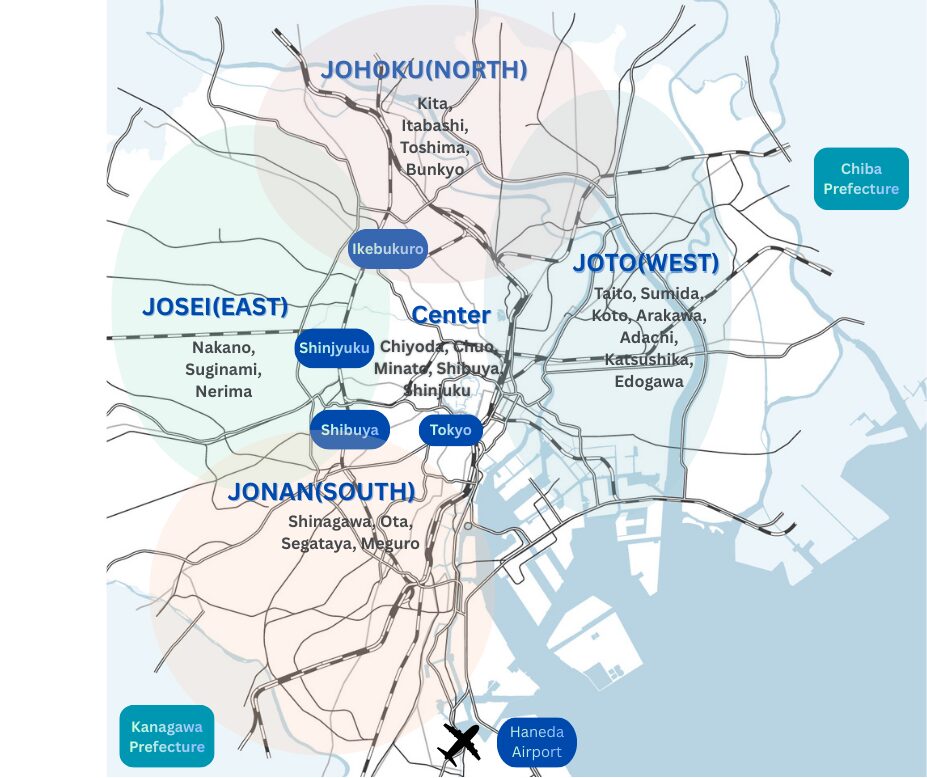
Although Tokyo is vast, it is often helpful to think of it as being divided into four major areas:

  • Johoku (North Tokyo:Kita, Itabashi, Toshima, Bunkyo)
  • Jonan (South Tokyo:Shinagawa, Ota, Meguro, Setagaya)
  • Joto (East Tokyo)
  • Josei (West Tokyo)

The prefix “Jo” (城) means castle, referring to the Imperial Palace (formerly Edo Castle).
These areas are defined by their relative position—north, south, east, and west—around the Imperial Palace. These area classifications are informal and may differ depending on the source. For clarity, I would add Central in addition to these 4 areas.

Understanding Tokyo Major Areas


Central Areas

Chiyoda Ward

Chiyoda sits at the heart of Tokyo’s 23 wards. It is home to key national institutions such as the Prime Minister’s Office and the National Diet.
At the same time, it includes some of Japan’s most prestigious residential neighborhoods, such as Bancho, along with Marunouchi, one of Tokyo’s best-known business districts, and Akihabara, a global center for electronics and subculture.
All of these areas surround the Imperial Palace, creating a uniquely diverse urban landscape.

Chuo Ward

Chuo Ward blends history and modernity. Nihonbashi, the historical starting point of Japan’s major highways, and Tsukiji, known for high-quality food culture, retain a traditional atmosphere.
At the same time, Ginza, one of Japan’s premier luxury shopping districts, and the redeveloped waterfront areas of Harumi and Tsukishima, which played a role in the Tokyo 2020 Olympics, represent a modern and glamorous side of Tokyo.
Redevelopment in Nihonbashi has also led to an increase in high-end modern residences.

Shibuya Ward

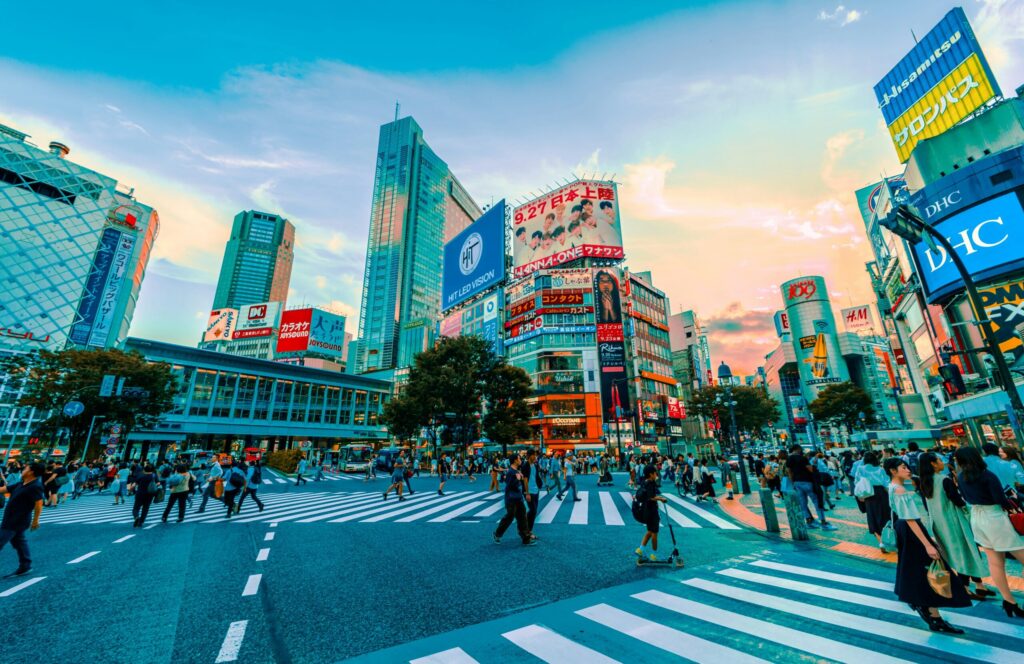
Shibuya Ward is home to Shibuya Station, one of Tokyo’s most iconic and representative downtown districts.
It is widely known as a center of fashion and trends, with numerous large-scale commercial facilities.

Despite being located in the heart of the city, the area also offers abundant greenery, including Meiji Jingu Shrine and Yoyogi Park.

where to live in Tokyo Shibuya ward


In addition, it features highly desirable residential neighborhoods such as Ebisu, which consistently ranks near the top of “most desirable places to live” surveys, and Shoto, a well-known high-end residential area.
As a result, Shibuya Ward enjoys an excellent living environment as well as strong urban appeal.

Shinjuku Ward

Shinjuku Ward continues to develop around Shinjuku Station, the world’s busiest station in terms of daily passenger volume.
It is home to the Tokyo Metropolitan Government Building and the high-rise office district of Nishi-Shinjuku, as well as major entertainment areas such as Kabukicho, often referred to as “the city that never sleeps.”

At the same time, the ward also includes areas such as Takadanobaba where many universities and educational institutions are concentrated, including Waseda University. Ochiai, which has seen rapid population growth as a residential area in central Tokyo. There are also many Japanese language schools.
As a result, Shinjuku is a diverse area where people of all generations live side by side.


Johoku – North Tokyo

Smart Value, Residential Comfort, and Long-Term Stability

Includes:
Kita, Itabashi, Toshima, Bunkyo

General View

Johoku is where you can find a strong balance between price and livability.
Rents and purchase prices tend to be lower than in central or southern Tokyo, while train access remains excellent.

Major Areas

Bunkyo Ward

An academic district with numerous educational institutions including Tokyo University. It attracts students as well as education-focused Japanese families.
Residential neighborhoods such as Nezu, Gokokuji, and Hongo coexist with historical buildings like the Hatoyama Residence, gardens such as Chinzanso and Koishikawa Korakuen, and historic shrines including Nezu Shrine and Yushima Tenjin.

Toshima Ward

Home to Ikebukuro, one of Tokyo’s major sub-centers, along with Sugamo (“Grandma’s Harajuku”) and the upscale residential area of Mejiro.
Toshima has one of the highest population densities in Japan and excellent access to other prefectures via JR and private railways.

Kita Ward

Known for its large number of JR stations—11 in total, the most in Tokyo’s 23 wards.
Stations such as Oji, Akabane, and Tabata function as important transport hubs with multiple lines.

Itabashi Ward

A residential-focused area that includes large housing complexes such as Takashimadaira as well as traditional upscale neighborhoods like Tokiwadai.
Served by four major rail lines, providing convenient access to central Tokyo.


Schools

  • Tokyo University
  • Rikkyo University
  • Gakushuin University
  • Tokyo International University

Easy Access from Johoku

  • Direct rail access to Saitama Prefecture and Ibaraki Prefecture
  • Close to expressway interchanges, making trips to Nagano and Niigata very convenient (Particularly suitable for those who enjoy mountains over weekends!)
  • Rental prices tend to become more affordable north of Ikebukuro

While Johoku is not known as a trendy or fashion-forward area, it offers a rich variety of local shops and restaurants, providing a comfortable and very “Japanese” everyday lifestyle.


Jonan – South Tokyo

International Appeal, Convenience, and Premium Living

Includes:
Shinagawa, Ota, Meguro, Setagaya

General View

This area retains its reputation as a high-end residential zone due to its historical background of former daimyo estates and elite residences.
It offers a rare balance of trendiness, greenery, and calm living environments, and has long been home to many embassies, as well as numerous international schools.
As a result, many international families choose to live in this area.

Major Areas

Meguro Ward

Well known for Nakameguro, famous for cherry blossoms, and stylish neighborhoods such as Daikanyama and Jiyugaoka.
Residential areas like Aobadai, Yakumo, and Komaba are highly regarded. The ward also features historic slopes and landmarks.

Shinagawa Ward

Rapidly redeveloped areas such as Osaki and waterfront districts coexist with traditional shopping streets like Togoshi-Ginza, Hatanodai, and Musashi-Koyama. The Jonan Gozan area is a discreet but prestigious residential zone. Shinagawa also serves as a gateway to the Shinkansen and Haneda Airport, making regional and intercity travel highly convenient. With large-scale redevelopment projects continuing, the area is attracting growing attention.

Ota Ward

Home to Haneda Airport, along with upscale residential areas such as Denenchofu and Sanno. This area historically had a high concentration of small factories, and even today you can find a blend of old townscapes woven into the neighborhood.
Its excellent access by train, car, and plane, combined with abundant greenery, makes it very popular with families.

Setagaya Ward

The most populous ward in Tokyo. Known for large parks such as Komazawa Park and Kinuta Park, and home to many foreign families.
Prestigious residential areas like Seijo and the redeveloped Futakotamagawa, where Rakuten’s headquarters is located, attract many expatriates.


Schools

  • High concentration of international schools and preschools
  • University of Tokyo (Komaba Campus)
  • Keio University, Sacred Heart University, Komazawa University, Nippon Sport Science University
  • Keio University Hiyoshi Campus (in neighboring Kanagawa)

Easy Access from Jonan

  • Easy access to Tokaido Shinkansen
  • Easy weekend trips to Hayama, Kamakura, Hakone, and the Izu Peninsula
  • Close to Haneda Airport, ideal for frequent travelers

Who I Recommend Jonan To

  • Expats and executives
  • Clients who value international environments
  • Those with flexible budgets seeking convenience

Joto – East Tokyo

Space, Value, and Waterfront Living

Includes:
Taito, Sumida, Koto, Arakawa, Adachi, Katsushika, Edogawa

General View

Compared to the Jonan area, Joto generally offers lower rents, while still providing reasonable access to Tokyo Station.
Its strong downtown atmosphere appeals to those who enjoy traditional neighborhoods.

Major Areas

Adachi Ward

Adachi Ward is rich in natural environments such as rivers and parks, including the Arakawa River.
After developing historically as a post town, the population increased with the expansion of railway networks, and today it has become a popular residential area.

The area around Kitasenju, a terminal station served by five rail lines—including the JR Joban Line, Tokyo Metro Chiyoda Line and Hibiya Line, Tobu Isesaki Line, and the Tsukuba Express—is particularly lively.
The ward has actively promoted redevelopment projects and attracted universities, resulting in a vibrant and dynamic atmosphere.

Arakawa Ward

Arakawa Ward has undergone large-scale redevelopment, particularly around Minami-Senju, which is said to be one of the largest redevelopment projects in Tokyo.

While the influx of families has been notable, the ward still retains traditional streetscapes such as small factories and workshops, and many long-time residents continue to live there.
It is one of the areas in Tokyo where the shitamachi (traditional downtown) atmosphere can be felt most strongly.

Taito Ward

Taito Ward includes Ueno, a major gateway to eastern Japan where Shinkansen lines operate, as well as Asakusa, a highly popular tourist destination.
Because of this, the ward enjoys strong recognition among international visitors.

In addition to serving as a hub for tourism and transportation, Taito Ward is home to many cultural and historical sites, including the Tokyo National Museum, the National Museum of Western Art, and the Former Iwasaki Residence.
Not only the exhibits but also the architectural styles of these buildings can be appreciated.
This is an area where urban sophistication and traditional downtown character coexist.

Sumida Ward

Sumida Ward is characterized by traditional neighborhoods such as Ryogoku, Kyojima, and Mukojima, and a strong downtown atmosphere permeates the entire ward.

While preserving a deep connection to history and culture dating back to the Edo period, Sumida Ward has continued to evolve by balancing tradition and innovation.
In recent years, redevelopment has progressed alongside the opening of Tokyo Skytree, symbolizing this coexistence.

Koto Ward

Koto Ward faces Tokyo Bay and is characterized by its many rivers and canals.
This area was reclaimed during the Edo period and developed over time.

Neighborhoods such as Fukagawa and Kameido retain a strong downtown culture and a warm, community-oriented atmosphere.
At the same time, waterfront areas such as Toyosu and Ariake have seen rapid development, with high-rise buildings and tower condominiums.
These areas also served as venues for the Tokyo 2020 Olympic Games.

Katsushika Ward

Katsushika Ward is known for its strong sense of downtown warmth and for being the setting of classic Japanese films that evoke traditional Japanese life.

Shibamata has been designated as one of Tokyo’s first Important Cultural Landscapes, and scenic sites such as Horikiri Iris Garden, which was selected as one of the famous landscapes of Edo, continue to preserve a rich historical atmosphere.


Schools

  • Increasingly popular with families
  • Good access to international schools in eastern and central Tokyo

Easy Access from Joto

  • Excellent access to Chiba Prefecture, ideal for marine sports and beach activities
  • Easy trips to Tokyo Disney Resort and Narita Airport

Josei – West Tokyo

Includes:

Nakano, Suginami, Nerima

General View

This area also extends along the Chuo Line and has a strong and loyal following.
Neighborhoods such as Ogikubo and Koenji consistently rank high in surveys of the most desirable places to live.

Major Areas

Nakano Ward

Nakano Ward is located close to central areas such as Shinjuku, yet it is characterized by a large number of shopping streets and residential neighborhoods, and people from a wide range of generations live here.
It is known as a center of subculture and attracts attention from both within Japan and overseas, particularly for Nakano Broadway, which is filled with shops that are irresistible to enthusiasts and collectors.

At the same time, in recent years, redevelopment projects such as Nakano Shiki no Machi have promoted the attraction of universities and companies, bringing in new groups of residents and further diversifying the area.

Suginami Ward

Where to live in Tokyo

Suginami Ward is a residential area with two faces: the advantages of living close to the city center and the comfort of suburban living.
While it is home to prestigious residential neighborhoods such as Eifuku and Hamadayama, it also has many lively shopping streets and a down-to-earth atmosphere, along with active local events that reflect a strong sense of community.

In particular, seasonal events such as the Asagaya Tanabata Festival and the Koenji Awa Odori attract more than 800,000 visitors from both inside and outside the ward each year, and have become well-loved summer traditions in Tokyo.

Nerima Ward

Where to live in Tokyo

Nerima Ward is known as the birthplace of Japanese animation.
Around Oizumi-Gakuen Station, where Toei Animation is located, there are many spots unique to this “sacred place,” such as Oizumi Anime Gate and Oizumi Yumeteru Shopping Street, and nearly 100 animation production companies are concentrated in the ward.

In addition to its convenient access to central Tokyo, Nerima Ward has the largest amount of greenery and park space among Tokyo’s 23 wards.
Major parks such as Hikarigaoka Park and Shakujii Park contribute to the ward’s reputation as a residential area that successfully balances urban convenience with a green living environment.

Schools

Where to live in Tokyo
  • Chuo University, Seikei University, ICU

Easy Access from Josei

  • Convenient access to western Tokyo and Yamanashi
  • Popular for hiking, lakes, and Mount Takao
  • A good balance of city life and nature

Who I Recommend Josei To

  • Professionals and young families
  • Clients prioritizing train access and lifestyle
  • Those comfortable with competitive markets

Final Thoughts

Tokyo is constantly evolving. While it is impossible to capture every detail, historical trends still shape the overall character of each area.
At the same time, redevelopment projects or sometimes university relocations continue to change neighborhoods.

Again, rather than trying to understand all of Tokyo at once, I recommend first narrowing your options based on commutable distance from your workplace or school.

Also, there is no need to give up simply because popular areas are often associated with higher rents.
Depending on the property’s specific conditions, it is sometimes possible to find reasonably priced options even in highly sought-after areas.
For this reason, it is important not to rule out popular neighborhoods from the beginning and to explore your options carefully.

For more detailed guidance, please refer to the article on key points to consider when choosing a property in Tokyo.

Next Steps in Your Tokyo Home Search

I hope this article has helped you get a general sense of Tokyo as a first step in your home search.

That said, Tokyo is still an enormous city, and choosing the right area can feel overwhelming.
But don’t worry—let’s talk about your home search together. I’ll take the time to understand your preferences and circumstances, and help you identify the area and property that best fit your needs.

As an agent who was born and raised in Tokyo, I’m able to share insights that go beyond what you can find in listings alone—such as the true character of each neighborhood and how it actually feels to live there. I always take the time to listen carefully to each client’s needs and circumstances, and then help narrow down suitable areas and properties together.

As an independent real estate agent, I don’t push properties based on company priorities—I focus on what truly works best for you.

If you have any worries or questions about moving, I’m more than happy to talk them through with you.
Please feel free to reach out anytime—I’d love to help make your move to Tokyo as smooth and stress-free as possible.

To better understand the rental process in Japan, please refer to this step-by-step guide.

Documents Required to Rent an Apartment in Japan

When you decide to move to Japan, your first instinct may be to start browsing listings and exploring what kind of homes are available and what kind of homes you want to live in. Of course, researching neighborhoods and properties is important. However, at the same time, it is equally important to understand the rental application process and the required documents—and to start preparing them in parallel.

Why?

In Japan, rental properties—especially good ones—can be taken very quickly. Applications are often reviewed on a first-come, first-served basis, and landlords tend to favor applicants who can submit complete documentation immediately. Even if you find the perfect apartment, delays in paperwork can mean losing the opportunity to another applicant.

(For a detailed explanation of the rental process in Japan, please refer to this article.)


Why Preparing Documents Early Is Important

In Japan, good rental properties can be taken very quickly. Many applications are handled on a first-come, first-served basis. That is why, when planning a move to Japan, I strongly recommend thinking about both property research and application preparation at the same time. Being ready with the right documents not only reduces stress but also significantly improves your chances of securing the home you want.

In Japan, using a rent guarantor company has become standard practice in residential leasing. As a result, when you apply for a rental apartment, your application is usually reviewed first by a guarantor company. Your identity and financial situation are thoroughly reviewed by a guarantor company. If the guarantor approves your application, the landlord then makes the final decision. This is why various documents are required at the application stage.

This is especially important for foreign applicants, as required documents vary depending on individual circumstances. Even if you have not yet arrived in Japan, it is still possible to rent an apartment—but doing so may require additional coordination regarding residency status and documentation.

Once you arrive in Japan, obtaining documents from your home country can become time-consuming and inconvenient. In addition, adjusting to daily life in a new country is already stressful, and it is best to minimize administrative burdens as much as possible.

For these reasons, I recommend that you start preparing the necessary documents at the same time you begin considering renting in Japan.

Please keep in mind that required documents may vary depending on your situation (company employee, student, self-employed, newly arrived, etc.). If you are unsure, the best first step is to consult a trusted real estate agent early.


Why Rental Screening Is So Strict in Japan

Japan has strong legal protections for tenants. Once a tenant moves in, it can be very difficult for a landlord to terminate a lease or refuse renewal. To do so, the landlord must demonstrate a legally recognized “justifiable reason,” and the threshold for this is quite high.

While there are limited situations where termination may be permitted—such as prolonged rent delinquency or serious tenant misconduct—the process is complex, time-consuming, and burdensome for landlords. As a result, landlords are very cautious at the screening stage.

In addition, guarantor companies are legally responsible for covering unpaid rent on your behalf. Naturally, they conduct strict screening to assess your financial stability and reliability.

As a result, documentation is used to confirm the following:

  • Identity
  • Stable income or ability to pay rent
  • Employment or school status
  • Emergency contact information
  • Residency status and expected length of stay

Checklist: Core Documents Most Applicants Need

Below are the documents most commonly required when applying for a rental apartment in Japan.


1) Identification

You will typically be asked to submit one or more of the following:

  • Passport (including visa page)
  • Residence Card (Zairyū Card) — if applicable
  • A Certificate of Eligibility (COE) (If you have not yet obtained a visa.): A document issued by the Immigration Services Agency of Japan confirming that a foreign national meets the requirements for a specific residence status.
  • Certificate of Residence

Important notes:

  • Residence cards are issued either at the major airports upon arrival. If a residence card is not issued at the airport, it will be mailed by the Immigration Services Agency to your registered address after you complete your resident registration at the local municipal office. (Residence cards are issued only to long-term residents staying for more than three months.)
  • The residence card issued at the airport does not include your address. After securing housing in Japan, you must complete resident registration at the local municipal office that has jurisdiction over your address (within 14 days of establishing your residence).
  • Once registered, you can obtain a Certificate of Residence (Juminhyo), and your address will be recorded on your residence card.
  • Your visa expiration date must extend beyond the lease term you are applying for.

2) Proof of Income / Ability to Pay

This is one of the most important elements in the screening process.

Commonly requested documents include:

  • Certificate of employment
  • Recent payslips (usually 3 months)
  • Tax-related documents
  • Bank balance statement (often required for overseas applicants, students, or self-employed individuals)

If you are relocating for work and have not yet started your job, you may submit:

  • Offer letter or employment contract showing salary and start date
  • Company transfer letter (if applicable)

3) Employment / Company Information

Applications typically require details such as:

  • Company name and address
  • Company phone number
  • Your job title or position
  • Length of employment (or start date if newly hired)

4) Emergency Contact Information

Even when using a guarantor company, you will usually be required to provide an emergency contact in Japan.

Commonly accepted options include:

  • A family member living in Japan (often difficult for foreign residents)
  • Your supervisor or manager at your Japanese workplace
  • A school or university representative (for students)

In some cases, landlords may accept a friend living in Japan, but this is not guaranteed. Your real estate agent can advise what is likely to be accepted for the specific property you are applying for.


If You Are a Student

Students are often required to submit additional documentation, such as:

  • Student ID or proof of enrollment
  • Acceptance letter from the school
  • Scholarship documentation (if applicable)
  • Financial sponsor information (if supported by parents or guardians)

In some cases, parents or guardians living overseas may also be asked to submit proof of financial ability.


Bank Account and Phone Number : A Common Challenge for New Arrivals

In addition to the documents listed above, a Japanese phone number and a Japanese bank account are typically required when applying to a guarantor company.

For those who have not yet arrived in Japan—or who have arrived only recently—this can be tricky.

Rent is usually paid via automatic withdrawal from a Japanese bank account, so bank account information is generally required at the contract stage. However, opening a bank account in Japan requires having a registered address.

Similarly, most foreigners do not have a Japanese phone number prior to arrival.

As a result, many people find themselves caught in a loop:
you need a home in order to open a bank account or get a phone number, but you need a bank account and phone number in order to rent a home. This often leaves people wondering where they should even begin.

That said, some guarantor companies are flexible and are willing to work around this issue as long as you can demonstrate the ability to pay. In many cases, the initial costs—typically includes more than one month’s rent—must be paid in advance by bank transfer.

In addition, until automatic bank withdrawals can be set up, some guarantor companies may accept alternative payment methods, such as bank transfers, overseas credit cards, or convenience store payments, depending on the situation.

When it comes to mobile phone services, major carriers in Japan generally require a registered Japanese address. However, there are providers that do not require an address, or in many cases, newcomers use an eSIM temporarily until their address is registered.

Compared to applying after arrival, renting before coming to Japan involves higher procedural hurdles, but it is certainly not impossible.

On the other hand, arriving in Japan without secured housing can also be extremely stressful.

(I will cover the typical strategies for that situation in a separate article.)

Personal Support for a Smooth Move to Japan

As this article has shown, relocating to Japan can feel overwhelming, with many unfamiliar procedures and requirements. Finding a rental home that is friendly to foreign residents is only part of the process. I also provide personalized support with document preparation, and can accompany you to local government offices, banks, and mobile phone shops as needed. At times, I meet my clients at the airport upon their arrival in Japan to hand over the keys to their new home.

My goal is to help things move forward smoothly, efficiently, and with as little stress as possible, by offering flexible support tailored to each client’s individual situation and needs.
This level of flexibility and hands-on support is one of the key advantages of working with an independent agent.

If you have any questions or would like guidance at any stage of your move, please feel free to get in touch for a consultation.

How to Rent An Apartment in Japan―A Step-by-Step Guide for Foreigners

Congratulations on your move to live in Japan!
You must be excited about starting a new chapter of your life here.

At the same time, many of you may be wondering where to even begin.
The language is different, the customs are unfamiliar, and the systems can feel completely confusing at first—especially when it comes to finding a place to live.

If you’re feeling a bit overwhelmed, don’t worry. You’re not alone.
In this article, I’ll walk you through how to search for and rent a typical private apartment in Japan, focusing on the points that often confuse or concern foreigners.

How to rent an apartment in Japan

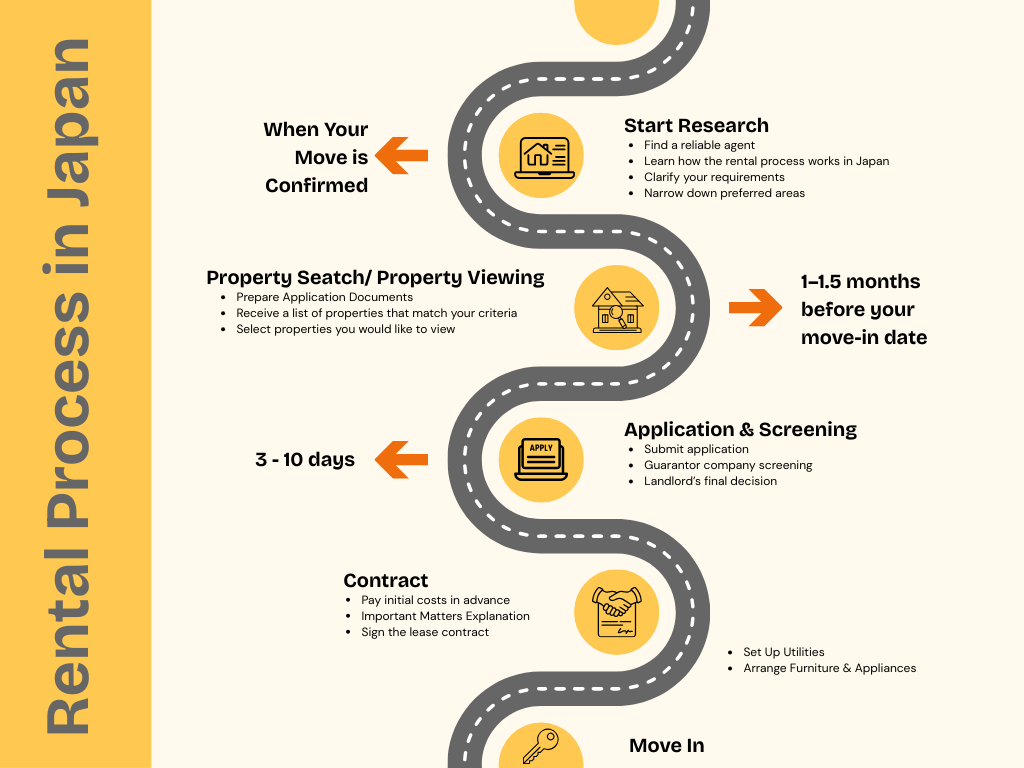
When Should You Start Looking for an Apartment?

There is no disadvantage to starting your research early.
Since you may not yet be familiar with different neighborhoods, I recommend:

  • Researching Japanese rental customs
  • Narrowing down preferred areas
  • Understanding what kind of properties are available within your budget

That said, if your move-in date is still several months away, keep in mind that Japanese rentals generally cannot be reserved far in advance.
Unlike some countries, there is usually no “hold” or “pre-booking” system.

As a general rule:

  • Property viewings typically begin 1 to 1.5 months before your intended move-in date
  • The contract start date is usually within one month after application

Peak Season: January to March

From January to March, demand is extremely high due to school graduations and job transfers.
During this period, I often advise clients to prepare thoroughly and be ready to make decisions quickly, as good properties are taken very fast.

Prepare the Necessary Documents

About two months before your move, you are now entering the stage of actively searching for properties. However, before you begin, it’s important to prepare the required documents for application.

The rental market in Tokyo Greater Area moves quickly. You may spend time researching, visiting properties, and finally find a place you really like—but if you cannot submit an application immediately, that opportunity may be taken by other candidates.

Rental applications require specific information and documents, so it is best to prepare them in advance. For foreign applicants in particular, the required documents may vary depending on individual circumstances, so I recommend consulting with your agent early in the process.

For more details on the required documents, please see this article.

In fact, real estate agents often ask at the inquiry stage whether you already have the necessary documents, especially when dealing with foreign applicants.

Being prepared can make a significant difference.

How to Search for Rental Properties

(1) Using Online Platforms

Many people begin their search using online platforms, including some that offer listings in English.

These platforms allow you to filter properties by:

  • Area
  • Budget
  • Floor plan
  • Size
  • Distance from the nearest station
  • Building age
  • Surrounding environment

Because searches often return a large number of results, I recommend narrowing down your preferred areas first.
(I will explain how to choose the right neighborhood in a separate article.)

Understanding Japanese Floor Plan Terminology

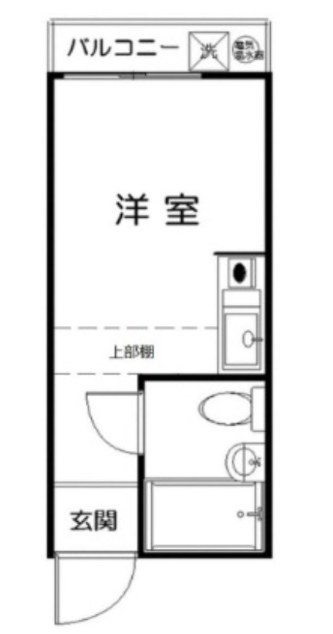
In Japan, floor plans are typically labeled as:

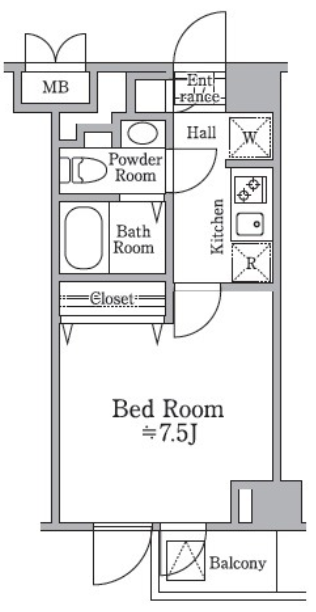
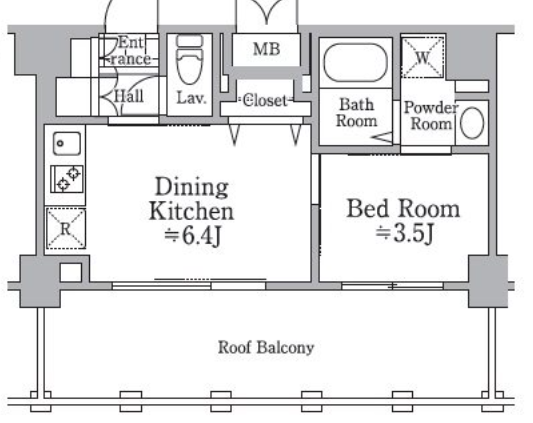
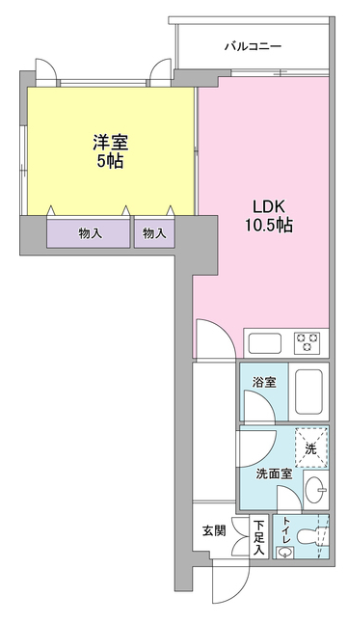
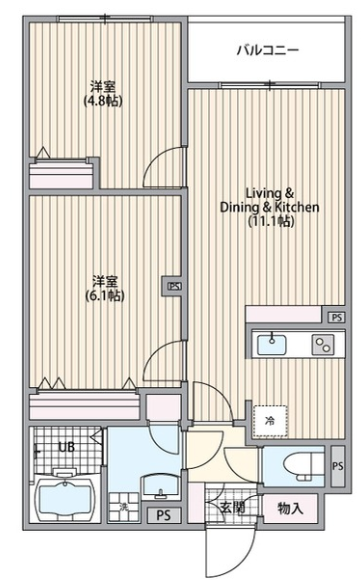
  • 1R (One Room): A single room with no separation
  • 1K: One room plus a separate kitchen
  • 1DK / 1LDK: One room with a dining or living-dining area
  • 2LDK: Two bedrooms plus a living-dining-kitchen area

Beyond this, the number simply increases as bedrooms are added.

When choosing a layout, think about:

  • How many bedrooms you actually need
  • Whether you prefer one larger open space
  • Or clearly separated rooms, which may feel smaller but offer privacy

Once you find a property that interests you, you can submit an inquiry directly through the platform.


Limitations of English-Language Platforms

It is important to note that English-language rental websites often show only a limited portion of the market.

Most Japanese residents use platforms such as SUUMO or At Home, which list the vast majority of available rentals—but these sites are almost entirely in Japanese.

For this reason, I believe the most efficient approach for foreigners is to work with a real estate agent experienced in international transactions, who can propose suitable properties from the full market.


(2) Visiting Local Real Estate Offices

Another option is to visit real estate offices directly in your desired neighborhood.

Local agencies usually know their area very well and can introduce many properties within that district.

If the agency specializes in rentals, they may accept walk-in clients if staff are available.
However, to ensure a smooth experience, I recommend contacting them in advance and sharing your basic requirements.

That said, most local agencies are not used to communicating in English, so this approach can be challenging unless you are comfortable in Japanese.


Property Viewings

When you inquire about a property, I recommend you to ask the real estate agent to propose several other options that match your criteria, not just the property you initially contacted them about.

Review the list carefully, and then schedule viewings for the properties you are interested in seeing in person.

Some agencies that specialize in foreign clients offer online viewings, but many traditional agencies are still not accustomed to this.
Additionally, many agents prefer in-person viewings to avoid misunderstandings later.

In Japan, a real estate agent always accompanies you during a viewing.
You usually meet at the property or at the agency’s office, and the agent unlocks the unit and shows you around.

Viewings are:

  • Completely free
  • Non-binding

In theory, there is no strict limit on the number of properties you can view. However, since viewings take time for both you and the agent—and an agent cannot accompany clients indefinitely—it is common practice to view up to three or four properties within the same area before making a decision.

Because rentals move quickly, I strongly recommend deciding on the same day or by the next day, and clearly communicating your intention to apply.


Application

Once you decide to proceed, you submit an application form to your real estate agency or agent. At this stage, the agency will first check with the landlord to confirm whether they are willing to accept the application.

At this point, the landlord does not review detailed documents yet. Instead, the agent typically shares basic information—such as your occupation, age, and general background—and if the landlord is comfortable, the application is provisionally approved to move forward to guarantor screening.

For this reason, documents required by the guarantor company are usually requested at the time of application. With the exception of a few guarantor companies, a Japanese address and phone number are often required at this stage. (I’ll cover this in more detail in a separate article.)

Applicant Information

  • Name
  • Address (must match ID documents)
  • Date of birth
  • Contact details
  • Employment information/School information
  • Annual income (approximate is acceptable)
  • Length of employment

Guarantor (if required)

In Japan, rental contracts traditionally required tenants to appoint a joint guarantor—a person who would be jointly and severally responsible for paying the rent if the tenant was unable to do so. In the past, it was common to ask a close family member to serve in this role.

However, in recent years, rent guarantor companies have become widely used as an alternative to individual guarantors. From a landlord’s perspective, guarantor companies offer greater security and reliability, which is why they are now the standard option in most rental contracts.

That said, not all properties require or accept a guarantor company even today, and some landlords may still prefer a traditional joint guarantor depending on the property and circumstances.

Emergency Contact

An emergency contact is still required in most cases.
Ideally, this is a family member in Japan, but for foreign tenants, this is often not possible.

In practice, I usually recommend:

  • A supervisor or manager at your workplace in Japan
  • An advisor from your school or university

Some landlords accept friends who live in Japan, so it is best to consult with your agent.

At this stage, in addition to the application form, you will also be asked to submit the other required documents mentioned earlier in this article.


Application Deposit (Holding Deposit)

You may be asked to pay an application or holding deposit.

This deposit:

  • Temporarily reserves the property
  • Is refundable if the contract does not proceed
  • May be applied toward initial costs if the contract is finalized

The typical amount ranges from ¥10,000 to one month’s rent.
If requested, I strongly advise confirming the refund conditions in advance.


Can I Negotiate the Rent?

Technically, rent negotiation is possible in Japan, but it is generally not recommended.

When an applicant asks for a rent reduction from the very beginning, landlords may perceive them as a potentially troublesome tenant, and in many cases, the application may be rejected for that reason alone.

That said, it is acceptable to ask with a “no harm in trying” mindset, understanding that if the landlord declines, that is the end of the discussion.

In cases where a property has been vacant for some time and the landlord is struggling to find a tenant, there is, of course, a higher chance that they may agree to a rent reduction.

As with many aspects of renting in Japan, this is something you should consult with your agent about, as timing and approach are key.


Screening Process

After submission, the application is sent to a guarantor company for screening.

How Long Does Guarantor Company Screening Take for Foreign Applicants?

For foreign applicants, screening by a guarantor company typically takes 2 to 5 business days once all required documents have been submitted.

In some cases, the process may be completed within 1–2 business days, but it can also take up to a week or longer if additional verification is required—such as confirming overseas documents, employment details, or income information.

During the screening period, the property is usually held for the applicant. However, if the process takes too long and there is another interested applicant waiting, the landlord may decide to proceed with the next application instead.

For this reason, make sure you have all documents ready in advance, respond promptly to any follow-up requests, and work closely with an agent who understands the process. Being well-prepared can help prevent unnecessary delays and reduce the risk of losing the property.

Hurray! Your application has passed the guarantor company’s screening

— but it’s not the final step yet.

Even if the guarantor company approves, the final decision always rests with the landlord.

Because tenant rights are strongly protected in Japan and it is extremely difficult to request a tenant to move out once problems arise, landlords are very cautious when deciding whether to accept a tenant.

Unfortunately, some landlords still refuse tenants simply because they are foreigners. However, this is usually confirmed before viewings take place, so rejection solely based on nationality at this stage is rare.

That said, landlords only learn detailed information—such as employment and income—at the application stage, and they make their final decision based on a comprehensive review.

Small Tip!

Landlords almost always ask the agent what the applicant was like.
Since agents value their relationship with landlords, they may advise against proceeding if an applicant seems problematic.

For this reason, it is important to behave appropriately and professionally not only with the landlord but also with the real estate agent.
They also often ask the agent what kind of impression the applicant made.

For this reason, maintaining a respectful and professional attitude throughout the process is very important.

In most cases, unless there are special circumstances, landlords will respond on the same day or the next day the guarantor company’s screening is approved.


Contract

Once approved, a contract date is scheduled.
Before the contract, you will receive a statement of initial costs, which must be paid by the deadline. Bank transfer is the most common payment method for initial costs, but in recent years, some agencies also accept credit card payments, so it is worth checking in advance. (I will explain the initial costs in detail in a separate article.)

What Happens on the Contract Day in Japan

In Japan, the rental contract is usually completed at the real estate agency’s office.
The landlord does not attend the contract signing in person.

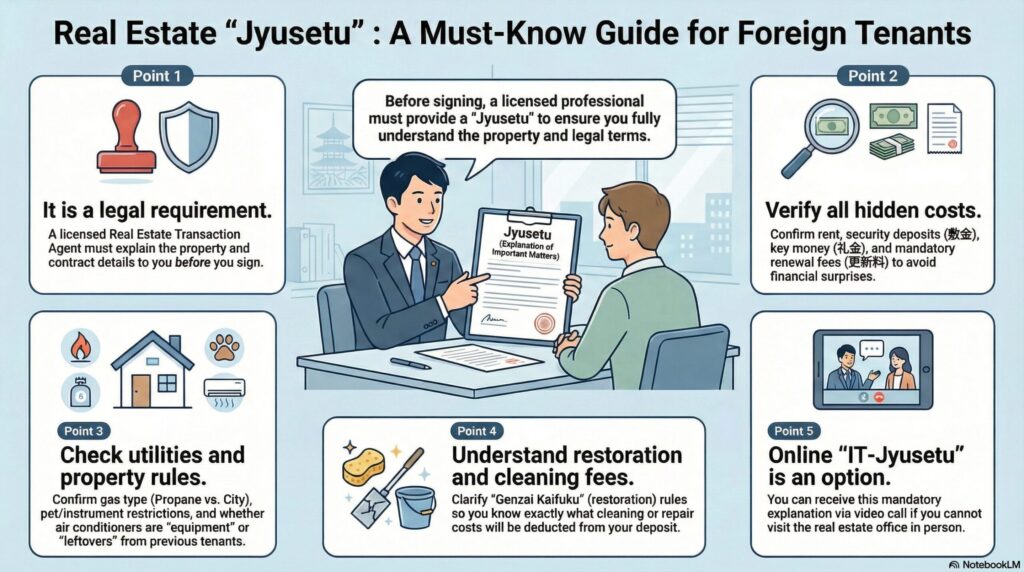
On the contract day, you will first receive a legally required explanation called the Important Matters Explanation (Jūyō Jikō Setsumei).
This explanation is mandated by law and must be given by a licensed real estate agent.

During this explanation, the agent will go through key points such as:

  • Details of the property
  • Rent, management fees, and contract term
  • Rules and restrictions (including prohibited uses)
  • Conditions for renewal and termination
  • Responsibilities for repairs and maintenance
  • Rules regarding deposits and move-out procedures

This step is especially important for foreign residents, as many rental customs and legal concepts in Japan differ from those in other countries.

In particular, garbage disposal rules in Japan are very strict and can easily become a source of trouble with neighbors, so be sure to ask and fully understand the rules.

There are also many things that may be acceptable in your home country but are not allowed in Japan, such as leaving personal items in shared spaces. If you have any questions or uncertainties, do not hesitate to ask and make sure everything is clear.

After the Important Matters Explanation, you will proceed to sign the lease agreement and any related documents.
By this point, the initial costs should already have been paid, and no payment is typically made on the day of the contract.

Once the contract is completed, the agent will explain the next steps, including:

  • When and how to receive the keys
  • The official move-in date
  • Utility arrangements and move-in procedures

Taking the time to fully understand the contract on this day will help prevent misunderstandings and problems later on.


Moving In

You may move in from the contract start date.
Keys are usually collected from the agency on or just before that date.

In Japan, tenants are responsible for arranging their own utilities.
You should complete utility applications before your move-in date. This can usually be done online. Please note that gas activation requires an in-person appointment after move-in.


Furniture and Fixtures

In Japanese rentals, furniture, appliances, curtains, and lighting are generally not provided.

Downlights, bathroom lights, and kitchen lighting are usually installed, so you may be able to manage initially with those.
However, curtains are almost never provided and must be prepared by the tenant. To ensure a smooth start to your new life, you may want to prepare as much as possible before moving in.
Even before your move-in date, you may be allowed to enter the apartment to take measurements, or in some cases, the real estate agency may take measurements for you. If this is necessary, it is a good idea to consult with your agent in advance.

For more details on how to set up your home, please refer to this article.


Move-In Inspection

Upon moving in, you will usually receive a move-in inspection sheet.
To avoid being charged later for damage you did not cause, carefully check and record any scratches or damage that already exist at the time of move-in.


Starting Your Life in Japan

Renting an apartment in Japan requires preparation and understanding of local practices.
I support foreigners who are moving to Japan so they can find a best-fit home without unnecessary stress.
My services are designed not only for those already in Japan, but also for clients who are still overseas and planning their move.

My aim is to help you move directly into your new home from your very first day in Japan. I provide a range of tailor-made services, carefully adapted to each client’s situation and schedule.
My support goes beyond simply finding an apartment and includes assistance with move-in arrangements as well as ongoing support after you begin living in your new home.

From housing consultations to online viewings and contract procedures, full online support is available.
Please feel free to reach out if you have any questions or would like to discuss your housing needs.

I hope this guide helps you feel more confident as you begin your housing search in Japan.

“No Foreigners Allowed?” — Understanding Rental Challenges in Japan

Renting an apartment in Japan can be a frustrating experience for many foreigners.

If you’re an expat working for a major global company, your employer may introduce you to real estate agents, and with corporate backing, high-end or foreigner-friendly properties are often available.

However, if you are moving to Japan independently and searching for housing on your own, the experience can be very different. Many foreigners quickly discover that simply being a “foreigner” can become a major obstacle in the rental process.

Even in 2025, some landlords still refuse non-Japanese tenants outright. There have been reported cases where individuals with permanent residency—working for well-known Japanese companies—were denied housing solely because of their nationality.

While this practice has decreased in recent years, it is still not unheard of to encounter listings that effectively imply “No Foreigners Allowed,” which can be shocking for those unfamiliar with the Japanese housing market.

Legally speaking, rejecting tenants based purely on nationality is considered discrimination and has been ruled illegal in Japanese courts. However, even when it is not stated explicitly, nationality may still influence the tenant screening process behind the scenes.

So why does this situation still exist?
And more importantly—how can foreigners successfully find a place to live in Japan?


Why Do Some Landlords Refuse Foreign Tenants?

1. Strong Tenant Protection Laws in Japan

Japan’s legal system offers very strong protection for tenants. Once a lease begins, it is extremely difficult for landlords to terminate a contract, even when problems arise.

Because of this, landlords tend to be extremely cautious when selecting tenants. For individual owners in particular, the perceived risk is high. In many cases, landlords live in the same building or on the top floor, which makes them especially sensitive to potential issues.

From a landlord’s perspective, choosing the wrong tenant can become a long-term legal and emotional burden.


2. Communication Barriers

Many landlords—especially older ones—struggle with English, let alone other foreign languages. Unlike countries with long histories of immigration, Japan is still relatively new to renting homes to foreign residents.

Landlords often worry about misunderstandings after move-in, such as:

  • Difficulty explaining house rules
  • Challenges responding to emergencies
  • Miscommunication regarding repairs or payments

Even well-intentioned landlords may choose to avoid foreign tenants simply to reduce stress.


3. Cultural Differences in Daily Living

Japanese rental housing comes with detailed expectations regarding daily life, including:

  • Noise levels
  • Garbage separation and disposal schedules
  • Use of shared spaces
  • Lease renewal and cancellation rules

Some landlords fear that foreign tenants—despite their best intentions—may not fully understand these unwritten rules, leading to complaints from neighbors or management companies.


4. Previous Negative Experiences

In some cases, landlords have experienced real problems in the past, such as:

  • Tenants leaving Japan suddenly without notice
  • Unresolved disputes over rent or damages
  • Strong cooking odors lingering in the apartment
  • Units left in extremely poor condition after move-out

Unfortunately, a single negative experience can strongly influence a landlord’s future decisions.


5. Guarantor and Emergency Contact Concerns

Traditionally, Japanese landlords require a Japanese guarantor. While guarantor companies are now common and more foreigner-friendly, they do not eliminate all concerns.

Landlords often feel more secure when tenants have:

  • A reliable emergency contact in Japan
  • Ideally someone with stable status, such as a company representative or senior manager

Simply listing a friend is sometimes not considered sufficient reassurance.


6. Real Estate Agencies That Cannot Support Foreign Clients

Many small, local real estate agencies work closely with individual landlords and assist with property management. Some lack the language skills or experience to handle foreign clients smoothly.

As a result, these agencies may quietly encourage landlords to avoid renting to foreigners to minimize potential complications.

Foreigner Friendly Properties

Certain types of properties are generally much easier for foreigners to rent.
For example, buildings managed by large property management companies, investment-oriented rental properties, or newer condominiums in urban areas tend to accept foreign tenants with far less hesitation. In these cases, screening is usually more standardized, and decisions are based more on income stability and documentation than on nationality itself.

What Landlords and Screening Companies Actually Look At

Many foreigners assume nationality is the main factor.
In reality, landlords are primarily assessing risk.

Here’s what matters most.


Stability of Income

Landlords want reassurance that rent will be paid consistently.

Important factors:

  • Length of employment
  • Type of employer (well-known company vs. unknown startup)
  • Income level relative to rent (typically rent ≤ 30–35% of income)

Providing clear, well-organized income documentation makes a strong impression.


Visa Status and Length of Stay

Contrary to popular belief, permanent residency is not always required—but clarity is.

Landlords look for:

  • A valid visa with sufficient remaining duration
  • A reasonable expectation that the tenant will stay long-term

Short-term or uncertain visa situations increase perceived risk.


Guarantor or Emergency Contact

This is one of the most critical elements.

Even if a landlord is open to foreigners, they often insist on:

  • A reputable guarantor company
  • Or a strong corporate guarantee

The guarantee reduces anxiety about unpaid rent, sudden departure, or disputes. 

Even if an application is approved by a guarantor company, it does not cover every possible situation, which is why the choice of emergency contact is extremely important.

Ideally, the best emergency contact would be a family member residing in Japan, but in reality, this is often difficult.
In most cases, the most suitable emergency contacts are a supervisor or manager at your workplace in Japan, or a representative from your school or educational institution.

Friends, on the other hand, are often not accepted as emergency contacts, and in many cases, may not be considered sufficiently reliable by landlords or management companies.


Attitude and Communication

This point is underestimated but extremely important.

Landlords and agents notice:

  • Whether you respond promptly
  • Whether you ask reasonable questions
  • Whether you appear respectful of rules

A calm, cooperative attitude often makes a stronger impression than perfect paperwork.

Common Mistakes Foreigners Make (and How to Avoid Them)

Even well-qualified applicants can unintentionally hurt their chances. Here are some frequent pitfalls.

Mistake 1: Applying to Too Many “Impossible” Properties

Many foreigners unknowingly apply to properties that are extremely unlikely to accept non-Japanese tenants.

Repeated rejections can:

  • Waste time
  • Lower morale
  • Delay relocation plans

Working with someone who knows which properties are realistic makes a huge difference.

Mistake 2: Underestimating Cultural Expectations

Japan has many unwritten rules around daily living.

Common issues include:

  • Garbage sorting errors
  • Noise complaints
  • Misunderstanding renewal or cancellation terms

Showing that you understand—or are willing to learn—Japanese living norms builds trus

Mistake 3: Poor or Incomplete Documentation

Missing or unclear documents create doubt.

Examples:

  • Untranslated income proof
  • Unclear visa status
  • Inconsistent information across forms

Preparation and clarity are key.

Mistake 4: Treating the Process Like Other Countries

In some countries, renting is fast and informal.
In Japan, it is process-heavy and document-driven.

Trying to rush or push back against standard procedures can raise red flags.

Mistake 5: Assuming Rejection Is Personal

This is important emotionally.

Many rejections have nothing to do with you personally.
They reflect:

  • The landlord’s past experiences
  • Legal fears
  • Advice from managing agents

Understanding this helps keep the process objective and less stressful.

Final Thoughts

Although Tokyo is home to a large and growing foreign population, the reality is that renting an apartment as a foreigner can still be challenging.
Despite gradual improvements, many non-Japanese residents continue to face unnecessary stress and obstacles during the housing search process.

Working with a real estate agent who specializes in supporting foreign tenants can make a significant difference. Successful negotiation often depends on the skill and judgment of the agent representing you. An experienced agent can assess the situation, understand the landlord’s position, and negotiate on your behalf in a way that protects your interests without damaging the application.
With the right expertise and network, it is possible to avoid much of this frustration and find a suitable home smoothly, efficiently, and with confidence.

Air Conditioner Broken in Japan? What Foreign Renters Must Know Before Calling a Repair Service

AC Troubles in Brutal Japanese Weather

When your AC suddenly dies right in the middle of summer or winter, it’s enough to make you panic.
Japan’s summers can be brutally hot, and in some regions, winters can be bitterly cold.

In Japan, air conditioners are usually installed in each room. They are often high-performance, but at the same time, it is not uncommon for them to develop sudden issues during everyday use—more often than many foreign residents might expect. This is partly due to their advanced complexity and the extreme heat and cold they are exposed to.

You naturally want to fix it as quickly as possible. But in that moment, many tenants—especially foreign residents—find themselves wondering:

• What should I do first?
• Who is responsible for the repair cost?
• Can I arrange the repair myself and ask for reimbursement later?

In this article, I’ll walk you through the key points to watch out for, so you can handle the situation calmly, resolve it properly, so you can avoid unnecessary stress and unexpected out-of-pocket expenses.


Key Takeaways

  • Confirm repair responsibility at the time of contract signing, including which equipment is landlord-owned and which is not.
  • Normal aging and wear of landlord-owned equipment → usually the landlord’s responsibility
  • Negligence, misuse, or tenant-installed equipment → often the tenant’s responsibility
  • Always contact the landlord or management company first before arranging any repairs
  • Do not arrange repairs on your own without approval, as reimbursement is never guaranteed
  • Emergency repairs may be possible without prior permission, but only with clear evidence and proper documentation
  • Problems should always be reported early, as neglect can later become the tenant’s financial responsibility
  • If the air conditioner is unusable for a long period, a rent reduction may be negotiable in limited cases, but it is not guaranteed


Troubleshooting Steps When the AC Suddenly Stops

If your air conditioner suddenly stops working, try these simple checks before calling a repair professional. By running through these simple checks, you might be able to fix it yourself instantly:

         StepAction
1. Check the RemoteReplace the batteries and confirm the remote settings (e.g., timer, energy-saving mode).
2. Check the BreakerVerify that the dedicated AC circuit breaker for the room hasn’t tripped; if it has, turn it back on.
3. Check for Error CodesSee if the remote or the main unit’s LED lights are flashing and note down the error code.
4. Power ResetTurn the breaker off for 5 to 10 minutes and then switch it back on.
5. Clean the FilterCheck if the filter is clogged with dust and clean it.
6. Check Outdoor UnitIs anything blocking the airflow? Are there boxes, bicycles, or overgrown plants in front of the unit? Is it exposed to intense direct sunlight all day?  

Improving these conditions can sometimes restore performance and even save on electricity.
However, if there is water leaking from the unit, do not continue to use it or turn the power back on. There is a risk of electric shock. In that case, cut the power and contact the landlord or management company as soon as possible.

If these basic checks don’t work, that’s when you need to contact the landlord.
DO NOT call the technician first.

Japanese rental rules could be different from those in many other countries. This guide explains the key principles, what you need to be careful about, and how to handle air conditioner (and these apply to other equipment troubles as well) in a Japanese rental in a safe and practical way.

To begin, let’s first take a look at the basic framework of rental agreements in Japan.


Legal Principle: Who Is Responsible for Repairs?

Under Japanese law, the landlord has a legal obligation to provide and maintain rental facilities in a usable, livable condition. This principle comes from the Civil Code and is usually reflected in standard lease contracts.

In simple terms:
• You, as the tenant, pay rent in exchange for
• The landlord providing livable conditions, including functioning basic facilities such as the air conditioner, water heater, plumbing, etc.

Therefore, if an air conditioner that is listed as part of the rental facilities breaks down due to normal aging or wear and tear, the repair cost is generally the landlord’s responsibility.


However, this principle is not applied in isolation.

In practice, it is:
• Reflected and sometimes narrowed or clarified in your individual lease contract, and
• Closely connected to the equipment list attached to the contract (what is considered “equipment” vs. something else).

This is why checking your contract and equipment list carefully is essential.


In Tokyo, for example, landlords and agents are required to provide an explanatory document based on the Tokyo Metropolitan Ordinance for the Prevention of Rental Housing Disputes. This document highlights items that often lead to disputes, including who is responsible for certain repairs during the tenancy. When this is explained to you at contract signing, it is very important to listen carefully and make sure you understand:
• Which types of repairs you are expected to pay for, and
• Which types of repairs should properly be borne by the landlord.

Keeping that document and your contract in an accessible place will help you later when something goes wrong.
Even though this legal principle exists, some leases include special clauses that limit the landlord’s responsibility for repairs. These are normally explained at the time of contract, but it is still important for tenants to pay close attention and confirm these points carefully on their own.


First Rule: Contact the Management Company or Landlord Immediately

In Japan, the basic rule is that you should not arrange repairs on your own without permission.

As a matter of practice:
• The landlord has the right to choose the repair contractor, and
• If you hire someone on your own without prior approval, the landlord may later say:
✅the cost is too high,
✅the repair was unnecessary, or
✅they are not responsible for reimbursing you.

So even if the repair itself was necessary, going ahead before getting approval can weaken your reimbursement claim.

Your first step should always be to contact:
• The property management company, if there is one; or
• The landlord (owner), if the property is self-managed.


If there is no management company, it is often easiest to contact the real estate agent who handled your lease or the landlord directly, using the contact information in your contract.

However, there are also situations where there is no management company, the landlord is a private individual who cannot be reached right away, and even the real estate agent who handled the lease isn’t willing to offer immediate help. In such moments, tenants can easily feel completely at a loss.

So that you are not left scrambling in situations like this, you should also confirm at contract signing:
• Who to contact in an emergency,
• Whether there is a 24-hour emergency number, and
• What to do if the landlord is temporarily unreachable.


If you are not sure now, take a moment to look at your lease again. There should always be a contact for the landlord or the agent.


Exception: Truly Urgent Emergency Situations

But what if there is no management company, the agent is not responding, the landlord cannot be reached, and the situation clearly cannot wait?

For example:
• The air conditioner has completely stopped during extreme summer heat or severe winter cold
• Water is leaking and damaging the apartment or the neighbor’s unit
• There is an electrical issue that may pose a safety risk

In such cases, waiting indefinitely for a reply may not be realistic and there is a practical exception to the general rule.
If the situation clearly affects health, safety, or the basic habitability of the unit, and you have made reasonable efforts to contact the landlord or management company, you may proceed with calling a repair service directly, before obtaining prior permission.

In these circumstances, whether you are reimbursed later will depend heavily on:
• How clearly you can show that it was a genuine emergency
• Whether you tried to contact the landlord or management company first
• Whether the repair cost was reasonable and appropriate

In addition, when contacting the landlord, it can be helpful to leave a record stating that if you do not receive a response by a certain deadline, you will proceed with arranging the repair on your own. Keeping this communication on record, such as by email or message, can be helpful later.

Normally, tenants are reimbursed for reasonable repair costs they have temporarily covered. That said, reimbursement is not guaranteed, and each case will depend on the specific circumstances and the landlord’s judgment.


If You Have No Choice But to Repair First: Keep Everything on Record

If you are ever forced to proceed with repairs before obtaining approval, the most important thing you can do to protect yourself is to keep clear records in any form.


You should:
• Keep records of your attempts to contact the landlord or management company (call logs, emails, text messages)
• Leave a message stating that if you do not receive a response by a certain deadline, you will proceed with arranging the repair yourself
• Take photos and videos of the problem before any work is done
• Obtain a detailed invoice from the repair company.

Your choice of contractor also matters. In recent years, many repair companies advertise very cheap, quick services online. While some are reliable, there have also been many reported cases where the final bill turned out to be unreasonably high.

For that reason, if you choose a contractor yourself, it is often safest—though sometimes it may look slightly more expensive—to ask the manufacturer’s official support service to handle the repair.

In my experience, when I compare various options each year, the manufacturer’s official support tends to be the most trustworthy and easiest to justify to the landlord afterward. If the invoice comes from an official service desk, it is much harder for the landlord to argue that the cost is unreasonable.

Once the repair is completed, report everything to the landlord or management company as soon as possible, attaching your photos, communication records, and invoice.
The strength of any reimbursement claim in these situations depends very much on your evidence and documentation.


The Role of Insurance

Even if you take all of these steps carefully, there is unfortunately no guarantee that reimbursement will go smoothly. Some landlords may still hesitate or push back in various ways, so it is important to proceed cautiously.

Another important point that is often overlooked is insurance coverage. In practice, tenants in Japan usually enroll not only in fire insurance, but also in household (contents) insurance at the time of move-in, and landlords themselves are also usually covered by some form of property insurance.

When a repair issue arises, it is well worth checking whether any part of the damage might be covered by insurance—it can be broader than people expect. Landlords, too, often forget the exact scope of their coverage, so gently reminding them by asking, “Would this be covered by insurance?” can sometimes be very effective.


When a Small Problem Can Become a Big Responsibility

On the other hand, if a problem exists but you leave it unattended simply because it does not seem serious or does not bother you at the time, you may later be held responsible if that neglect leads to more significant damage. For example, a small water leak that is ignored can eventually cause damage to floors, walls, or even neighboring units. In such cases, the resulting damage may become the tenant’s financial responsibility.

For this reason, whenever you notice any kind of malfunction or irregularity—whether or not it seems to require immediate repair—it is always wise to report it to the landlord or management company as soon as possible.
However, there is no need to be overly anxious about every small detail.


“Equipment” vs. “Leftover Items” — This Directly Affects Who Pays

While this is less common than it used to be, there is another point that often confuses foreign tenants: the air conditioner (or other appliance) in your unit is not always legally considered the landlord’s equipment.
In Japanese practice, items are often categorized as:
• Facilities / Equipment → Officially provided and owned by the landlord
• Leftover Items → Items left behind by a previous tenant and simply “left in place”

The general rule is:
• If it is official equipment: the landlord usually pays for repairs due to normal aging
• If it is a leftover item: the tenant often bears the repair or replacement cost

In most cases, this information is stated in the Explanation of Important Matters. If the air conditioner is classified as a special case, such as a “leftover item,” this would normally be explained.

Again, it is important to listen carefully and make sure you fully understand the explanation at that stage.
If it is unclear, don’t guess—ask the real estate agent or landlord to confirm.


When the Tenant Must Pay

Even when the air conditioner is clearly landlord-owned equipment, there are cases where the tenant will be expected to pay for repairs. This usually happens when the damage is linked to negligence or misuse, for example:
• Never cleaning the filters, causing the unit to fail
• Ignoring clear signs of malfunction and continuing to use the unit
• Causing water damage through incorrect use
• Using the wrong voltage or doing unsafe DIY wiring

In broad terms:
• Natural aging and normal wear → Landlord responsibility
• Tenant negligence or misuse → Tenant responsibility


If you installed your own air conditioner, or if the unit is categorized as a leftover item, you should assume that you will be responsible for repair or replacement.


Standard Repair Process in Japan

In a normal, non-emergency case, the process generally follows these steps:

  1. You contact the landlord or management company.
  2. You explain the symptoms and, if possible, provide the manufacturer and model number.
  3. The landlord or management company arranges a repair visit with their contractor.
  4. In most cases, you are asked to be present for the visit. If you cannot take time off work, you can ask whether the landlord or management company might attend on your behalf.
  5. If parts need to be ordered, a follow-up visit is scheduled.

Even when the landlord is paying, it is important to confirm the expected schedule, especially in extreme weather. During busy seasons, it may take some time before a technician can come.


Can Rent Be Reduced If the Air Conditioner Is Unusable?

If the air conditioner is unusable for a longer period and your daily life is clearly affected, it may be possible to request a temporary rent reduction.

However, there is no fixed amount set by law, and in reality:
• It is a relatively rare remedy,
• The outcome depends heavily on the landlord, the length of the problem, and how clearly the impact on your living conditions can be shown.

It is something you can discuss, but it is better to approach it as a negotiation, not a guaranteed right.


What If Only the Remote Control Breaks?

If only the remote control stops working and the cause is natural wear and tear, the landlord will usually cover the cost of repair or replacement, as it is part of the overall air conditioning system.
If the problem is simply that the batteries are dead, of course, that is the tenant’s responsibility—so always try replacing the batteries first.


Can You Request Professional Air Conditioner Cleaning?

As a tenant, you are expected to clean the filters and accessible dust on a regular basis yourself.
This not only helps the unit run more efficiently but can also reduce your electricity bills.

If you want professional deep cleaning by a specialist company, you should always ask the landlord or management company first. Legally, the air conditioner is usually the landlord’s property, and if a cleaning company causes damage, the situation can become complicated. In some cases, the tenant may be held responsible for repair or replacement costs if the landlord did not approve deep cleaning.
Most landlords arrange professional cleaning after tenants move out, using contractors they already trust. If you feel that deep cleaning is needed, it is best to ask the landlord to introduce their usual service provider. Since the landlord usually works with the same cleaning company, the cost is often quite reasonable.


Final Check at the Time of Contract (Summary Checklist)

As discussed throughout this article, many problems can be avoided simply by clarifying a few key points at the time of contract signing. However, when you are signing a lease, you are often busy with moving arrangements and may not have the time or energy to think about “what if something breaks later?”.

So, to summarize, here is a simple final checklist you should confirm at the time of contract:
• Which facilities are landlord-owned equipment and which are not
• Who is responsible for which kinds of repairs
• Which contact numbers to use in normal situations and in emergencies

The explanation may be long, and there may be a lot of paperwork, but taking the time to understand these points calmly at the beginning can save you from much greater stress later.

I always make a special effort to explain these important points in a way that is easy for foreign residents to understand. After move-in, I also support my clients by standing between them and the landlord or management company when negotiations or detailed explanations are needed, so that they can live in Japan with more peace of mind.


Support for Foreign Residents Renting in Japan

I provide full rental support for foreign residents in Japan, including:
• English communication with landlords and management companies
• Ongoing support so you can feel secure living in Japan
• Contract reviews and explanation of key clauses
• Move-in and move-out assistance

If you ever feel unsure or stressed about a rental issue in Japan,
please feel free to contact me anytime.

References: Ordinance for the Prevention of Residential Rental Disputes in Tokyo & Guidelines for Preventing Tenant-Landlord Disputes

How to Rent an Apartment in Japan as a Foreigner: Step-by-Step Guide

Renting an apartment in Japan can feel overwhelming, especially if you’re new to Japan. But don’t worry. With the right information and support, it’s absolutely possible to find a comfortable, foreigner-friendly home.

This step-by-step guide will walk you through how the rental process works and how to prepare.

Step 1: Understand the Japanese Rental System

Japan’s rental system has some unique features that may differ from what you’re used to:

  • Key Money (礼金): A non-refundable “gift” to the landlord, typically equal to one month’s rent.
  • Security Deposit (敷金): Usually 1–2 months’ rent; refundable minus cleaning or damage charges.
  • Agency Fee: Typically one month’s rent, paid to the real estate agent.
  • Guarantor Requirement: Most landlords require a guarantor or guarantor company.
  • Upfront Costs: Initial costs can amount to 4–6 months’ rent.

Step 2: Define Your Priorities

Ask yourself the following:

  • What is your budget (including move-in costs)?
  • What are your must-haves? (e.g., close to the station, upper floor, parking, English-speaking landlord, pet-friendly, furnished, etc.)
  • Which neighborhoods fit your lifestyle? (proximity to work or school, access to specific train lines, quiet neighborhoods, green neighborhood, etc.)

Step 3: Start Your Apartment Search

There are several ways to find properties:

  • Online Platforms: (e.g., RealEstate Japan, Suumo, GaijinPot Housing)
  • Real Estate Agents: Look for agents with experience helping foreigners.
  • Word of Mouth: Expats in Tokyo often share recommendations.

Tips:

  • Good listings move quickly, especially in desirable areas—so be ready to act when you find something that fits.
  • Find a reliable agent who not only understands the local area and is an expert in the Japanese real estate market, but is also experienced in working with international clients.

Step 4: Prepare Your Documents

You’ll usually need:

  • Passport & Residence Card (or COE if you haven’t arrived yet)
  • Certificate of Employment or Student ID
  • Proof of income (salary slips or tax return)
  • Emergency contact (preferably a Japanese speaker)
  • A Japanese bank account (if available)

Some landlords may also require a local phone number or a personal guarantor, even for short-term stays.

Step 5: Visit the Property (If Possible)

If you’re already in Japan, try to view the apartment in person. If not, request a video tour. Pay attention to:

  • Whether you like the feel of the neighborhood and the convenience
  • Noise levels, safety, and proximity to amenities
  • Sunlight, air flow, and layout
  • Condition and maintenance of the building and shared areas (like the trash area and bicycle parking.) These often reflect how residents take care of the place.

Step 6: Apply and Pass Screening

Once you’ve decided, your agent will help you submit the application. The screening process usually includes:

  • Proof of income
  • Planned length of stay
  • Guarantor company approval

This takes 2–5 business days. Even if you pass the guarantor screening, the landlord has the final say in whether to accept your application.

Step 7: Sign the Contract and Pay Initial Costs

Once approved, you’ll sign the lease agreement and pay:

  • 1–2 months’ rent
  • Key money and security deposit
  • Agency fee
  • Guarantor company fee
  • Insurance

Make sure you understand the terms for renewal and cancellation before signing.

Step 8: Move In and Register

  • Furnish your new home: Most apartments in Japan are unfurnished. You may be allowed to measure the space before moving in—or I can do it on your behalf.
  • Set up utilities: Contact providers for electricity, water, gas, and internet.
  • Register your address at the local city/ward office within 14 days of moving in.
  • Take photos upon move-in to document the condition.

Bonus Tips

  • Repairs: Tenants are often responsible for small repairs.
  • Moving: Book movers early, especially around March and April (peak season).
  • Language: If you don’t speak Japanese, work with a bilingual agent or bring a Japanese-speaking friend when signing.

What If You Don’t Have a Japanese Bank Account?

One of the most frequently asked questions by foreigners moving to Japan is how to open a bank account.

In Japan, most rent payments are made via automatic bank transfer. You’ll be required to set this up at the time of contract signing.

However, new arrivals often face difficulty opening a standard resident bank account immediately, as most banks require at least 6 months of residence. Some allow earlier setup with proof of long-term employment or student status.

✅Can You Rent Without a Bank Account?

In many cases—yes.

Option 1: Temporary Cash Payments

  • Initial fees can usually be paid by bank transfer, ATM, or at a convenience store.
  • Monthly rent can sometimes be paid by bank transfer or using payment slips (払込票) until you open a local account.

Option 2: Use a Foreigner-Friendly Guarantor Company

  • Many offer plans that don’t require a Japanese bank account.
  • Some even accept international transfers or credit card payments.

✅Things to Keep in Mind:

  • Some landlords or agencies may still require a bank account.
  • Foreign bank accounts typically cannot be used—so open a Japanese account as soon as possible after signing.

Can I Sign a Rental Contract Before Arriving in Japan?

Yes, it’s often possible—but it depends on the landlord and the property.

What You’ll Need:

  • Work with a real estate agent who can facilitate remote contracts
  • Use a guarantor company (instead of a personal guarantor)
  • Submit scans of your passport, visa (or Certificate of Eligibility), and proof of income
  • Pay initial costs via international wire transfer

Some landlords allow remote signing via email, courier, or even e-signature—especially if the property is furnished or intended for international tenants.

Guarantor companies used by foreigners are typically flexible. Even if you haven’t received your residence card yet, they can evaluate your documents and confirm that your visa status is valid. However, as noted earlier, the final decision always rests with the landlord.

Final Thoughts

Renting a home in Japan can be challenging for non-Japanese residents due to unfamiliar systems and occasional resistance from landlords unfamiliar with foreigners. Although things are improving, many landlords still hesitate to rent to foreigners unless it’s a high-end or international-targeted property.

But don’t be discouraged.

With patience, clear communication, and the support of an experienced, foreigner-friendly agent, you’ll find the right place to call home in Japan.

Need help navigating your rental search?
📩 Feel free to contact me — I specialize in helping international clients find homes with confidence and ease.