Rising Prices, Falling Transactions — and What It Really Means
(January 2026 Latest Report)
“Should I sell my home now, or wait?” “I want to buy in Tokyo, but prices feel too high.”
These are questions I hear frequently from both foreign residents and international investors.
According to the January 2026 data, the Greater Tokyo existing home market has entered an unusual phase—one that requires careful interpretation.
In simple terms:
Fewer homes are selling, yet prices continue to rise.
This growing mismatch between supply and demand is becoming increasingly clear. Let’s look at what’s actually happening—and how to read the market correctly.
1. Existing Condominiums: Prices Above Bubble Levels, Oversupply at 4.6x
On the surface, the condominium market looks exceptionally strong.
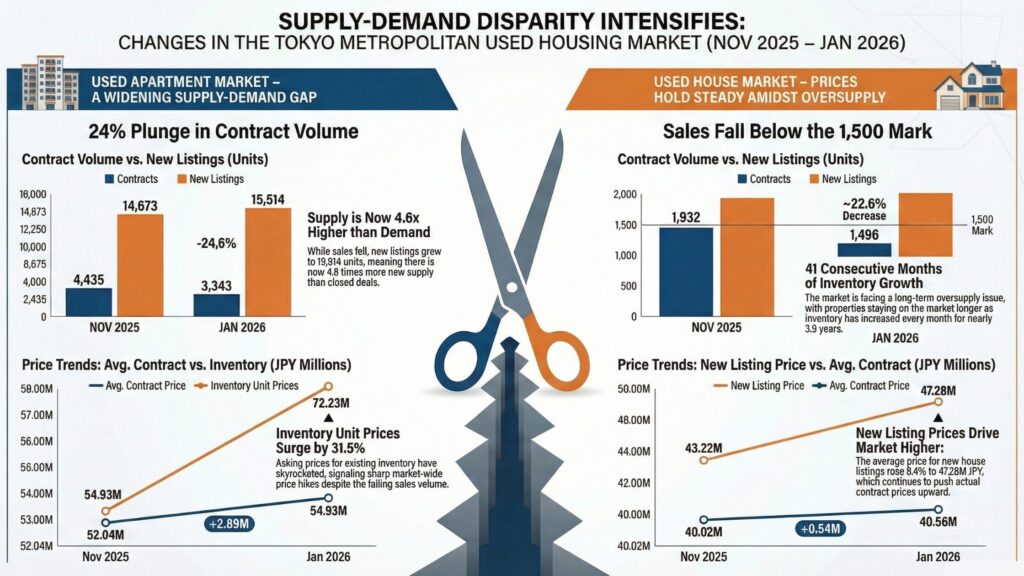
Prices beyond the bubble era The average transaction price per square meter in January 2026 reached ¥869,900, exceeding the previous all-time high recorded in September 1990 during Japan’s asset bubble.
69 consecutive months of price growth Prices have risen continuously since May 2020—more than five and a half years without interruption.
However, beneath these headline numbers lies a clear imbalance.
Oversupply is widening In January, 15,514 properties were newly listed, while only 3,343 transactions were completed. This means the market supplied approximately 4.6 times more properties than were actually sold.
While year-on-year transaction volume shows a slight increase, sales have dropped sharply over the past two months, which could be interpreted as a sign that buyers are becoming increasingly cautious. However, my sense on the ground is somewhat different. Given that the market remains relatively strong, a sizable group of sellers is listing their properties at higher prices to test the market. Many are not under pressure to sell, which is why prices are not breaking down easily. At the same time, buyer interest remains strong, but current pricing levels are making it difficult for many to move forward with transactions.
The same pattern appears even more clearly in the detached housing market.
Transaction volumes declining January 2026 recorded 1,496 completed transactions, down from 1,932 in November 2025—a decline of about 22% in just two months.
Inventory rising for 41 consecutive months Homes are taking longer to sell, and excess supply has become structural rather than temporary.
Prices remain elevated Despite weaker demand, the average transaction price rose to ¥40.56 million, up 7.1% year-on-year.
3. Why Are Prices Rising When Homes Aren’t Selling?
Under normal market conditions, falling demand leads to lower prices. But today’s existing home market in Greater Tokyo is behaving differently.
The key driver is listing prices.
Condominiums: New listing prices are up 30.0% year-on-year
Detached houses: New listings are up 9.4% year-on-year, averaging ¥47.28 million
As I mentioned above, this means that sellers across the market are raising their asking prices. As a result, the limited number of transactions that do occur are pulled upward by these higher expectations—keeping average prices elevated even as liquidity declines.
4. What This Means for Foreign Buyers
For foreigners unfamiliar with Japan’s market dynamics, this environment can feel confusing.
The key takeaway: Headline prices alone do not tell the full story.
Inventory is abundant
Properties are staying on the market longer
Negotiation opportunities are increasing, especially for long-listed homes
This is particularly true outside Tokyo’s central wards, including parts of Chiba, Saitama, Yokohama, and Kawasaki.
5. Investor View: Yield, Liquidity, and Negotiation
From an investment perspective, the current market shows clear warning signals:
Liquidity is declining
Oversupply is persistent
Price inflation is seller-driven, not demand-driven
At the same time:
Acquisition prices are compressing yields
Rent growth has not kept pace with listing price increases
Cap rate expansion risk must be considered, especially if interest rates rise further
This is not a uniform seller’s market—it is a market with pricing inefficiencies.
For disciplined investors, opportunities may exist in:
Long-listed or overpriced assets
Motivated sellers adjusting expectations
Non-prime but well-connected locations
Selective underwriting and negotiation strategy are essential.
Final Insight: Expensive Locally, But Still Affordable Globally
Despite these cautionary signals, one critical point should not be overlooked:
Compared to many major global cities, Greater Tokyo remains relatively affordable.
When viewed against markets such as New York, London, Hong Kong, or Singapore, Tokyo still offers:
Lower price per square meter
Clear and stable ownership rights
A large, liquid metropolitan market
Consistent rental demand in central and commuter-accessible areas
This is why many international buyers and investors continue to see Tokyo not as an overheated market, but as a long-term, structurally sound market with reasonable entry pricing.
The key is not perfect market timing—but choosing the right property, in the right location, at the right price.
📺 YouTube Video Available I also explain this market situation in detail in my YouTube video.
If you’re considering buying or selling property in Tokyo, understanding these market dynamics is key. Feel free to reach out if you’d like a personalized view of how current pricing and demand may affect your specific situation.
When buying real estate, the way ownership rights are protected differs greatly from country to country. Each nation has its own legal framework for recording and securing property ownership — and for many buyers, closing on a property is often a moment of both relief and excitement.
In Japan, this key step is known as real estate registration (fudōsan tōki, 不動産登記). It plays a central role in confirming and protecting ownership, ensuring that your rights are legally recognized and transparent.
Registration in Japan is not merely a formality; it is what gives ownership its legal power against third parties. Without registration, ownership may exist in theory, but not in practice.
Even if you have acquired ownership through a legitimate transaction, failure to complete registration means you cannot assert your ownership against a third party who has properly registered their rights, and in the worst case, you may be forced to hand over the property despite having paid for it.
A Little Bit of History Behind Japan’s Real Estate Registration System
While many countries have some form of property registration, Japan has developed its own version of real estate registration: a system rooted in continental European civil law but refined through Japan’s legal and cultural evolution.
During the Meiji era, Japan was modernizing its legal infrastructure by adopting Western legal concepts, and it drew heavily on civil law systems from continental Europe. However, Japanese society was distinct in many ways:
Private land transactions were already common.
The land title system (chiken seido) was immature.
Legal culture emphasized actual possession and private contracts over state authority.
Legal culture emphasized actual possession and private contracts over state authority.
As a result, Japan gradually formed its own model—one that evolved from European civil law principles but adapted to Japan’s social and economic realities.
Thus, Japan’s system shifted from “state-guaranteed ownership creation” to “public registration of private agreements.” The government acts as a neutral recorder, not the guarantor, of ownership.
Situations Where Real Estate Registration Is Done
In Japan, registration of a newly built property is legally mandatory; this is called the Building Description Registration (tatemono hyōdai tōki).
However, registration after purchasing an existing property is not strictly required by law. That said, it is almost always carried out in practice, because without registration, your ownership rights may not be legally protected against third parties.
From April 2024, one specific type of registration — inheritance (succession) registration — has become legally mandatory.
Even when registration itself is not an obligation, it is considered an essential step for protecting your ownership and ensuring the transaction is properly recorded.
The following are the typical situations where real estate registration is carried out in Japan:
1. When You Acquire Property
For purchases, inheritance, or construction of a new building:
Transfer of Ownership Registration (shoyūken iten tōki)
After moving or changing your surname, file a Change of Address/Name Registration so your information stays accurate.
3. When the Owner Passes Away
Heirs register the Transfer of Ownership by Inheritance to show succession of title. (This type of registration became mandatory in April 2024.)
4. When a Mortgage Is Paid Off
After full repayment, the Mortgage Cancellation Registration (teitōken masshō tōki) is filed to remove the lien.
5. When a Building Is Demolished
A Building Demolition Registration (tesshitsu tōki) is filed to remove the building from the record.
How the Registration Process Works
In Japan, it is not legally required to hire a Judicial Scrivener (Shiho-shoshi, 司法書士) to complete real estate registration. Anyone — including the property owner — can technically file the application on their own.
Staff at the Legal Affairs Bureau (Hōmukyoku) are generally helpful and will explain the procedures or advise how to correct any mistakes if the application is incomplete. So, if you are patient and careful, it is entirely possible to complete the registration yourself.
However, in real estate transactions involving large sums of money, there is always a risk if the registration is not completed properly or promptly. Unless the registration is completed in your name, your ownership is not legally protected, and unexpected problems could occur. For this reason, it is standard practice to ask a Judicial Scrivener to handle the registration, ensuring that ownership is accurately and safely recorded at the same time the payment is made.
Step-by-Step Process
Application The application form and required documents are submitted to the Legal Affairs Bureau that has jurisdiction over the property.
Examination The Bureau reviews and verifies the documents. This review period typically takes about 1–2 weeks, depending on complexity and regional workload.
Completion of Registration Once the examination is finished, the new ownership or rights are officially entered into the registry. When the new owner’s information is registered, a Registration Identification Notice is issued. This document replaces the old Title Deed and consists of a 12-digit alphanumeric code identifying the registered owner. It is an important document required when selling the property, so it should be kept in a safe place. Although the Registration Identification Notice cannot be reissued, alternative procedures are available if it is lost — such as verification through a judicial scrivener or identification affidavit during future transactions. In addition, once the registration is completed, a Certificate of Completion of Registration is also issued. While this certificate cannot be reissued, it is not as critical as the Registration Identification Notice, so losing or disposing of it does not cause legal problems.
Issuance or Delivery of Documents
In-person pickup: After the expected completion date, you can collect the documents at the Legal Affairs Bureau counter.
By mail: If you opted for postal delivery, the Registration Identification Notice or Certificate of Completion will be sent, usually by registered mail. In this case, allow an additional few days — the entire process from application to document arrival may take about 2–3 weeks in total.
Documents Commonly Required
The documents required for registration vary depending on the cause of registration — such as sale, inheritance, gift, or mortgage cancellation. Always confirm the specific requirements with your Judicial Scrivener or the Legal Affairs Bureau (Hōmukyoku) before submission.
Common documents include:
Power of Attorney (if a scrivener acts for you)
Application Form (available on the Ministry of Justice website)
ID Verification (passport, residence card, or My Number card)
Supporting Documents such as:
Deed of sale or inheritance certificate
Mortgage discharge documents
Reading and Understanding the Real Estate Register in Japan
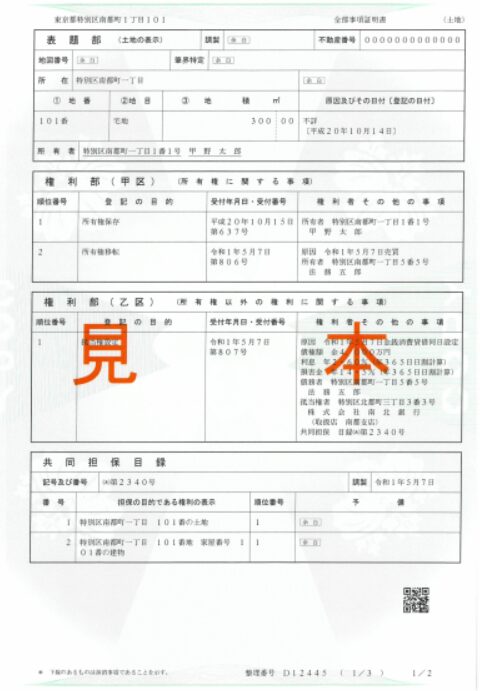
In Japan, land and building registry records are publicly accessible. Anyone can obtain a copy of a property’s Real Estate Register (登記事項証明書, tōkijikō shōmeisho) by paying a small administrative fee at the Legal Affairs Bureau or online.
From this record, you can find who owns a property, what rights or mortgages are attached, and even trace how ownership has changed over time — sometimes revealing the unique “story” of a property’s history.
Before purchasing, the seller or agent usually provides a copy, but buyers should always review it themselves carefully. Below are the key sections and what to look for when reading a Japanese property registry:
1. Title Section (Hyōdaibu): Physical Details of the Property
Lists the basic physical information about the property. Be sure all entries match the property you intend to purchase.
Location (Address, Lot Number, Building Number) – Confirm that it matches the actual site.
Land Category / Building Type and Structure – Ensure the registered use (e.g., residential land, farmland) matches current use. Note: Using farmland as residential land requires special permission.
Land Area / Floor Area – Compare with your sales contract and property summary; if different, ask why.
Construction Date and Cause – Check the building’s year and registration basis.
2. Rights Section A (Kōku – 甲区): Ownership Information
Shows who legally owns the property and any limits on that ownership.
Current Owner: Confirm that the seller’s name and address match the registry.
Ownership History: Review for frequent transfers or complex inheritance chains.
Seizure or Provisional Disposition: Avoid properties with these legal claims.
3. Rights Section B (Otsuku – 乙区): Other Rights and Encumbrances
Lists non-ownership rights, such as loans, mortgages, or easements.
Mortgages / Revolving Mortgages: Identify any collateral rights.
Mortgage Cancellation: Confirm that repayment and release will be done at transfer.
Easements / Lease Rights: Check for usage restrictions or long-term leases.
Provisional Registration: Look for kari-tōki, indicating pending claims.
Why Reviewing the Register Matters
Reading the registry helps confirm true ownership, debt-free status, and legal security of the property, which are essential for a safe and transparent transaction.
Registration and Professional Fees in Japan
Registration and License Tax (Tōroku Menkyozei)
This is a national tax imposed when registration is made. In general, the tax base for the registration and license tax is the assessed value (valuation) recorded in the Fixed Asset Tax Ledger or the Fixed Asset Tax Statement. If no such value is registered, the Legal Affairs Bureau (registrar) determines the valuation to be used as the tax base.
For a transfer of ownership, the registration and license tax is calculated as 2% of the property’s appraised value. However, tax reduction measures are available under certain conditions, so the actual amount payable is often lower than this standard rate.
Professional Fees for Judicial Scriveners (Shiho-shoshi) and Land & House Surveyors
Real estate registrations are generally handled by Judicial Scriveners (Shiho-shoshi), while Land & House Surveyors (Tochi-kōka-chōsa-shi) manage “title description” registrations, such as for newly built houses.
Fees vary widely depending on region and office, but the typical cost for a transfer of ownership registration in Japan ranges from approximately ¥50,000 to ¥100,000.
Additional costs may apply:
Travel fees if the scrivener attends settlement at a bank or seller’s office.
Identification report fee when the seller is not personally known to the scrivener.
Why Japan’s System Is So Reliable
As mentioned above, Japan’s real estate registration is based on a paper examination system, in which registrars review submitted documents rather than conduct on-site inspections. While the government ensures procedural integrity, it does not guarantee the factual accuracy of the registered information.
Even so, Japan’s registration system has earned a reputation for remarkable reliability, thanks to its precision, consistency, and openness. This trust is supported by several key features:
Administered nationwide by the Ministry of Justice
Digitized and standardized across all regions
Fraud or clerical errors are extremely rare and legally correctable
Public access to records, promoting transparency and market confidence
Final Thoughts
Legal systems can be complex, and even more so when you’re dealing with it in a foreign country. I hope this article has helped you better understand how Japan’s real estate registration system works. With the guidance of qualified professionals such as judicial scriveners and real estate agents, you can feel confident that your property transaction in Japan will be handled safely and smoothly.
Disclaimer: The information in this article is provided for general informational purposes only and does not constitute legal advice. While every effort has been made to ensure accuracy, the content may not reflect the most current legal developments. Readers should consult a qualified professional for advice on their specific situation.
Note:
In December 2025, the Ministry of Justice announced that individuals acquiring real estate in Japan will be required to disclose their nationality when registering ownership.
If you are considering a property purchase in Japan, I’d be happy to assist you. I specialize in serving international clients and provide clear, detailed explanations of Japan’s real estate system and local practices for those unfamiliar with the market. By leveraging the strengths and global network of RE/MAX, I offer reliable, well-informed support throughout the entire process. Initial consultations are completely.