Moving to Japan often feels like being trapped in a “residency catch-22.” To secure an apartment or a mobile phone plan, you frequently need a local bank account—but to open that account, most traditional institutions require a stable address and a local phone number. For many, onboarding into the Japanese financial ecosystem becomes a source of immense frustration rather than a simple administrative task.
While the system is defined by a certain compliance-driven rigidity, the landscape is shifting. Beneath the surface of traditional bureaucracy, there are modern shortcuts and counter-intuitive rules that can save a newcomer weeks of stress. As a strategist helping expats navigate these waters, I’ve seen that understanding these specific nuances is the key to bypassing the gatekeepers and securing your financial footing on day one.
Bank
Min. Residency Requirement
English Support
Key Documents
Notes (Foreigner Friendliness)
Megabanks (MUFG, SMBC, Mizuho, etc)
Usually 6 months+ OR proof of employment
Limited
Residence Card, Address, Employment proof, Phone number
Generally strict screening. Not ideal for newcomers
How to choose the Right Bank in Japan as a Foreigner
Today, many banks in Japan allow you to apply for an account online, making the initial process much more convenient than before. However, in some cases, your employer or school may designate a specific bank for salary payments or administrative purposes.
If no specific bank is required, the key consideration becomes which bank will be the easiest to use after opening your account.
Megabanks: Reliability and Accessibility
Among Japan’s major banks (megabanks), Sumitomo Mitsui Banking Corporation (SMBC) stands out as a particularly strong option.
One of the main advantages of megabanks is their extensive branch network. If any issues arise, you can visit a branch and receive in-person assistance. While English support may not always be available, the level of service is generally attentive and thorough.
Another benefit is the wide availability of ATMs. If you hold an account with the bank, you can often withdraw cash without fees at their ATMs, which are located throughout the city.
That said, megabanks can sometimes be less flexible, and fees may be higher compared to online-focused banks. Another drawback is that individual inquiries cannot always be handled over the phone, and in many cases, issues can only be resolved by visiting a branch in person.
Even so, SMBC offers a well-balanced service, including:
A user-friendly online banking system
Several free domestic transfers per month (depending on conditions)
A relatively smooth overall user experience
Banks with Strong English Support
If English-language support is important, the following banks are highly recommended:
SMBC Trust Bank (Prestia)
SBI Shinsei Bank
Sony Bank
These banks offer English customer support, which can be extremely helpful when navigating Japan’s banking system. English support is also available by phone.
They are also well-suited for:
International transfers
Foreign currency transactions
However, a common drawback is that they have fewer physical branches, which may make in-person assistance or immediate cash access slightly less convenient.
That said, many of these banks offer:
Free withdrawals from partner ATMs a few times per month
Flexible international banking features
Online & Ecosystem-Based Banks
There are also many banks operated by major corporate groups, such as:
Rakuten Bank
Seven Bank
PayPay Bank
au Jibun Bank
These can be convenient if you already use services within their ecosystem (e.g., Rakuten, Seven & i, SoftBank, etc.).
However, there are a few practical considerations:
Depositing cash can sometimes be inconvenient unless your salary is directly paid into the account
ATM withdrawals may have limits or fees depending on usage
International transfer capabilities vary and should be checked in advance
The Digital vs. Traditional Divide (The Ticking Clock)
Choosing a bank in Japan requires balancing digital convenience, language support, and the “Hanko” (personal seal) requirement. Traditionally, the digital-first banks allowed expats to bypass the need for a physical Hanko, which is still a mainstay at traditional major banks.
Sony Bank:
Sony Bank offers a dedicated mobile app that allows foreign residents to open an account in English. Customer support is also available in English, and you can speak directly with a representative, which makes it very convenient. In addition, my impression is their foreign exchange rates are generally more competitive compared to many other banks, making Sony Bank a strong option for those who frequently make international transfers.
Rakuten Bank:
While Rakuten Bank allows you to apply for an account in English, customer support is generally available only in Japanese. As it is an online bank, the need for inquiries is relatively limited; however, if any issues arise after opening the account, communication may become somewhat challenging.
The “Six-Month Rule”
The most significant roadblock for new arrivals is the Foreign Exchange and Foreign Trade Act. Under these regulations, many major institutions require a foreign national to have resided in Japan for at least six months before they are legally considered a “resident” eligible for a standard account.
However, this rule is not the absolute wall it appears to be. There are two exceptions that every newcomer should know:
Japan Post Bank (Yucho): Often the first stop for expats because they accept applications from those in the country for less than half a year.
Seven Bank: Provides a much more accessible threshold, allowing applications for those who have been in the country for at least three months.
While Japan Post Bank is accessible, accounts opened before the six-month mark are often designated as “Non-resident Yen Deposit” accounts. These are “starter” accounts with restricted utility; you generally cannot perform international remittances or receive certain types of foreign transfers until you hit the six-month milestone. Japan Post Bank also offers a mobile app that allows you to open an account without visiting a branch.
The “Three-Month Buffer” Deadline
A counter-intuitive administrative hurdle is the expiration date on your Residence Card. Even if you have been in Japan for years, banks like Seven Bank, Rakuten Bank, and SMBC Trust Bank Prestia will reject an application if your current visa expires in less than three months.
SMBC Trust Bank Prestia, in particular, lists “3 months or more” remaining on the visa as a hard requirement for all internet-based applications. The logic is simple: banks want to avoid the administrative burden of restricting an account or demanding updated documentation only weeks after the relationship begins.
Pro-Tip: If your visa is close to the 90-day mark, do not waste time applying. Renew your visa first. Once you have your new Residence Card in hand, you can apply without the risk of immediate “transaction restrictions” or a flat-out rejection.
Your Account is Not Permanent: The “Clean Break” Requirement
In Japan, a bank account is tied strictly to your residency status. If you leave the country permanently, you are legally required to close your accounts. Failure to do so isn’t just a clerical oversight; it carries criminal risks.
Abandoned accounts are frequently targeted by criminal syndicates for “account selling” (transferring your card/PIN to a third party). The Japanese authorities have a zero-tolerance policy here; being found involved in account selling—even inadvertently by leaving an account open—can lead to criminal charges, future entry bans, and being blacklisted from the Japanese financial system for life. As Rakuten Bank warns:
“There have been many instances where foreigners are often found selling their Personal Savings account before returning to their homeland. This is also considered as a crime so please be aware of your actions.”
Final Recommendation
If you have been in Japan for less than 6 months → Japan Post Bank (Yucho) is often the most practical option
After 6 months of residency → Choose a bank based on your needs:
Daily convenience → SMBC or another megabank
English support → Prestia / Shinsei / Sony Bank
Digital convenience → Online banks (Rakuten, Seven, etc.)
Choosing the right bank is not just about opening an account—it’s about how smoothly you can manage your daily life and finances in Japan. Taking a moment to select the right option based on your lifestyle can make a significant difference.
Why Renting in Japan Can Feel So Hard for Foreigners—and How to Improve Your Chances
For many people planning a new life in Japan, the apartment search becomes the first real culture shock.
On social media, Tokyo looks sleek, efficient, and exciting. But once you actually start looking for a place to live, the process can feel confusing, exhausting, and at times deeply discouraging. You find a listing you love, ask to view it, and hear that it is “not available.” Sometimes the reason is vague. Sometimes it is more direct: the owner does not want to rent to foreigners.
That experience is so common that many foreign residents describe it as an unofficial “foreigner’s tax.” It is not always a financial cost. Often, it is a cost in time, energy, and repeated rejection.
The important thing to understand is this: while the experience can feel personal, the Japanese rental market usually operates according to a rigid internal logic. In many cases, the issue is not simple personal hostility. It is a conservative screening culture centered on predictability, communication, and perceived risk. Landlords and management companies tend to prefer applicants who look easy to manage, easy to contact, and easy to trust.
Once you understand that logic, the process becomes easier to navigate.
This article breaks down the six most important realities behind the “No Foreigners” problem in Japan, and explains what foreign tenants can do to improve their odds.
For a step-by-step guide to the rental process in Japan, please refer to this article.
The 39% Reality: “Foreigner Rejection” Is Not Just a Rumor
Many foreign renters arrive in Japan assuming that stories about discrimination are exaggerated. Unfortunately, the data shows that the problem is real.
A Ministry of Justice survey found that about 39.3% of foreign residents who had looked for housing in the previous five years said they had experienced being refused housing because they were foreign, and about 26.8% said they had given up on a property after encountering a notice or explanation that foreigners were not accepted. Reuters and other coverage of the survey reported the same broad finding: nearly 40% of respondents who sought housing had been turned down.
That matters because it confirms something many renters already know from experience: the phrase “No Foreigners” is not an urban myth. It is a structural feature of parts of the market.
At the same time, it is important to describe the legal situation accurately. Japan does not currently have a single comprehensive nationwide housing anti-discrimination law that clearly and directly bans refusal by nationality in the private rental market. In practice, this means that challenging these refusals can be difficult, even if the result feels plainly discriminatory.
So why does this happen?
In many cases, small private landlords are not thinking in terms of diversity policy or fair housing principles. They are thinking in terms of risk. They worry about what happens if there is a plumbing leak, a fire, a noise complaint, an unpaid utility bill, or a sudden departure from Japan. If they believe communication or enforcement may be difficult, they may simply reject the application at the start.
That does not make the system fair. But it does explain why so many decisions are made before a foreign applicant is evaluated as an individual.
Language Is Not Just Helpful—It Is Part of the Screening
One of the biggest misunderstandings among foreign renters is assuming that Japanese ability is merely a “nice bonus.” In reality, it often functions as a key screening factor.
Japan’s Ministry of Land, Infrastructure, Transport and Tourism provides guidance for foreign nationals looking for rental housing, and its materials make clear that language and communication are central to the leasing process. The official guide explains that a real estate agent may ask about your Japanese language capability during the housing search, alongside your occupation, income, co-occupants, and reasons for moving. The same guide also advises applicants who do not speak Japanese well to bring someone who does.
That tells you something important about how the system works.
For many management companies, Japanese proficiency is not viewed as a lifestyle advantage. It is viewed as an operational requirement. They need to know whether a tenant can understand building rules, lease terms, garbage separation rules, emergency notices, repair instructions, and neighborhood expectations. MLIT’s support materials for foreign renters also emphasize that foreign-language support, explanatory videos, and multilingual resources are used specifically to reduce disputes and misunderstandings.
In practice, this means that even basic Japanese ability can materially widen your options. Not because there is a formal rule that says “speak Japanese and you qualify,” but because it reduces the most common fear landlords have: “What happens if something goes wrong?”
That is why showing basic communication ability can make a real difference. Even a simple self-introduction, polite greetings, and the ability to understand building rules can shift an applicant from “high-risk unknown” to “manageable.”
Your Japanese Friends Usually Cannot “Save” the Deal Anymore
Many newcomers assume they can solve the rental problem by asking a Japanese friend, coworker, or relative to act as guarantor.
That used to be more realistic than it is today.
Traditionally, Japanese rentals often relied on a human guarantor, known as a rentai hoshonin. This person could be held legally responsible if the tenant failed to pay rent or caused other financial loss. For foreign residents, this system was a major barrier because finding someone willing and legally able to take on that responsibility was often very difficult.
Over time, however, the market has shifted heavily toward guarantor companies. MLIT’s English-language rental guide now states plainly that when renting housing in Japan, the use of a rental guarantee company or providing a guarantor is necessary in case the tenant cannot pay rent. In other words, some form of guarantee remains a standard expectation in the market.
The legal background also changed. Japan’s Civil Code provides that for certain individual revolving guarantee arrangements, liability must be capped at a specified maximum amount. The official Japanese Law Translation text sets this out in Article 465-2, which states that the guarantor is liable only up to a certain maximum amount.
This reform did not eliminate personal guarantors. But it did make the risk more explicit and more formalized. As a result, many landlords and agents now prefer guarantor companies because they are standardized, commercial, and easier to process.
For foreign applicants, that is often better news than it sounds.
A guarantor company may feel like an extra hurdle, but in many cases it is actually what makes the transaction possible. Instead of needing a Japanese relative willing to accept serious legal liability, you pay a fee and go through a structured screening process. That is much more realistic for most international tenants.
4. The Real Wall Is Usually Financial Screening, Not Just Nationality
Many renters focus only on the nationality issue, but in actual screening, income stability is often just as important.
Japanese landlords and guarantor companies want to see not only that you have money, but that your income is regular, documentable, and likely to continue. That is why employment type matters so much. A full-time employee at a known company often has a smoother path than a freelancer, contract worker, entrepreneur, or recent arrival with irregular income.
While there is no single nationwide legal rule stating that rent must be below exactly 30% of income, that benchmark is widely used in practice as a risk-screening guideline. It reflects the market’s preference for conservative rent-to-income ratios, especially when a guarantor company is involved. This is why applicants with unstable or hard-to-prove income often face stricter scrutiny even when they have substantial savings.
For renters without conventional employment income, documentation becomes even more important. In practice, students may need proof of savings or financial support; freelancers may need tax returns, bank statements, or contracts; and applicants changing jobs may need offer letters or proof of future employment.
The key point is that screening in Japan is heavily document-driven. If you want to be treated as a low-risk applicant, you need to prepare your paperwork before you fall in love with a property.
That usually means having the following ready:
passport or residence card
proof of employment or offer letter
recent pay slips or tax documents
bank statements or proof of savings
emergency contact details
information about who will live in the unit
The stronger and cleaner your file looks, the less room there is for subjective hesitation.
5. Many “No Foreigners” Decisions Are Really About Building Management and Daily Rules
This is the part many foreign renters hear about only after moving in.
Landlords in Japan are not screening only for payment risk. They are also screening for day-to-day management risk. This includes garbage disposal, noise, smoking, guest policies, subletting, and communication with neighbors.
That concern is not imaginary. Official materials aimed at residents of UR housing, for example, devote substantial space to rules around garbage disposal, fire prevention, subletting or unauthorized use, bicycle parking, smoking, and community restrictions. UR’s resident guide specifically lists “Prohibition of Subletting or Unauthorized Use” and “Garbage Disposal” among important restrictions.
MLIT’s support page for foreign renters also explains that multilingual videos and materials are intended to help prevent disputes by clearly explaining rental rules and manners in Japan.
This matters because what a foreign renter may see as a minor lifestyle issue can be viewed in Japan as a building-management problem.
A few examples:
Garbage sorting
In many areas, garbage must be separated very precisely and disposed of on specific days. Failure to do so can create tension with neighbors and complaints to the management company.
Noise
Thin walls and close living quarters make noise one of the most common sources of conflict. This is especially important in older or lighter construction, including some wooden buildings.
Unauthorized occupants
Long-term guests, unofficial roommates, or partner move-ins can be treated as serious contract violations if they were not declared.
Communication in emergencies
A tenant who cannot understand building notices or respond quickly to management may be viewed as harder to manage, even if they are otherwise responsible.
This is why behavior during the viewing and application stage matters more than many people realize. In Japan, agents are often evaluating not just whether you can pay, but whether you seem likely to fit the building culture.
Showing up on time, dressing neatly, responding politely, and asking practical questions about building rules can all help.
How to Improve Your Chances of Renting in Japan as a Foreigner
Once you understand the logic behind the system, the next step is strategy.
Here are the most effective ways to improve approval odds:
Prepare your documents before you start viewing
Do not wait until you find your dream apartment. In competitive areas, desirable units move quickly, and MLIT notes that it often takes one to two weeks from application to move-in even when things go smoothly.
Show that communication will not be a problem
If your Japanese is limited, bring a Japanese-speaking friend, interpreter, or agent who can support the process. Official guidance specifically recommends this for applicants who do not speak Japanese well.
Be realistic about budget
Even if you have savings, screening is easier when your rent looks conservative compared with your income. A lower-risk profile opens more doors.
Use agencies experienced with international clients
The wrong agent may give up after a few rejections. The right one already knows which landlords, management companies, and guarantor companies are open to foreign applicants.
Understand the rules before applying
If you show that you already understand garbage sorting, occupancy rules, noise expectations, and move-out obligations, you immediately reduce perceived risk.
Consider UR if you are struggling in the private market
For many renters, UR is not the second-best option. It is the smart option.
Final Thoughts: The System Is Hard, but It Is Not Random
Renting in Japan as a foreigner can be frustrating, and sometimes unfair. The statistics are sobering, and many renters do face rejection that they would not face if they were Japanese.
But the process is not random.
Most landlords and management companies are looking for the same things: stable income, clear communication, predictable behavior, and low management risk. Once you understand that, you can position yourself much more effectively.
That means the goal is not simply “find a landlord who accepts foreigners.” The real goal is to present yourself as a tenant who feels easy to approve.
When you do that—through paperwork, communication, realistic budgeting, and cultural awareness—you move from outsider to credible applicant. And that shift can make all the difference.
If mastering just a handful of key Japanese phrases, preparing your documents properly, and understanding the rules could significantly improve your chances of finding a home in Japan, wouldn’t that be worth doing before your next viewing?
Ready to Find a Foreigner-Friendly Apartment in Tokyo?
Finding a rental in Japan as a foreigner can feel overwhelming — but you don’t have to navigate it alone.
I specialize in helping international clients secure apartments in Tokyo, even in challenging situations where many listings say “No Foreigners.”
From property search to application support and contract explanation, I’ll guide you through every step.
A Complete Guide to Initial Rental Fees and Move-In Costs When Renting an Apartment in Japan
Renting an apartment in Japan often surprises newcomers—not because of the monthly rent itself, but because of the significant initial move-in costs required before receiving the keys.
For anyone planning to relocate to Japan or especially, move within cities like Tokyo, Osaka, or Yokohama, understanding initial rental costs is essential for budgeting and avoiding unpleasant surprises.
Imagine finding a modern apartment in Tokyo with a monthly rent of 120,000 yen.
The rent seems reasonable, especially compared with major global cities like London, New York, or Singapore. You begin calculating your housing budget based on that number.
Then the real estate agent sends the initial cost estimate required before moving in.
Total initial payment: approximately 800,000 yen.
At first glance, this seems impossible.
How can renting a 120,000-yen apartment require nearly seven months of rent upfront?
Yet this situation is extremely common in Japan’s rental market.
While tenants tend to focus on the monthly rent, the real financial hurdle lies in the initial move-in costs, which include a combination of deposits, fees, and administrative charges.
In Japan’s real estate industry, agents often use a simple rule of thumb:
Initial move-in costs typically range from 4 to 6 times the monthly rent.
However, depending on the property and contract conditions, the total can easily exceed 6–7 months of rent.
For foreign tenants, the process can become even more complicated because landlords often require tenants to sign with a guarantee company instead of a personal guarantor.
Common guarantee companies include:
GTN (Global Trust Networks)
Casa
Nihon Safety
Zenhoren
JID
These companies function as financial guarantors and charge additional fees, which become part of the initial move-in cost.
Understanding how these costs are structured is essential for anyone planning to rent an apartment in Japan.
The “4 to 6 Times Rent” Rule Is Only a Starting Point
When calculating the cost of renting an apartment in Japan, the monthly rent is only the beginning of the calculation.
Initial move-in costs generally include multiple components required by the landlord, the real estate agent, and service providers involved in the contract.
Typical costs include:
Security deposit (敷金 / Shikikin)
Key money (礼金 / Reikin)
Brokerage fee (仲介手数料 / Chukai Tesuryo)
Advance rent
Prorated rent (日割り家賃 / Hiwari rent)
Guarantee company fee
Fire insurance
Lock exchange
Cleaning fees
Administrative costs
For an apartment with monthly rent of 120,000 yen, a typical example might look like this:
Item
Example Amount
Security Deposit (1 month)
120,000 yen
Key Money (1 month)
120,000 yen
Brokerage Fee (1 month + tax)
132,000 yen
Advance Rent + Prorated Rent
~180,000 yen
Guarantee Company Fee
~60,000 yen
Insurance / Lock Exchange / Misc Fees
~70,000 yen
Total Initial Cost
≈ 682,000 yen (about 5.7× rent)
In more competitive markets or premium locations such as central Tokyo, the breakdown may look like this:
Deposit: 2 months
Key money: 2 months
Brokerage fee: 1 month
This alone already equals 5 months of rent, even before other costs are added.
Compared with many Western countries—where tenants often pay only one month deposit and one month rent—Japan’s rental system can feel unusually complicated.
This structure developed historically as a way for landlords to reduce financial risk and cover potential vacancy periods.
Key Money: A Unique Feature of the Japanese Rental Market
One of the most confusing aspects of renting in Japan is the difference between security deposit (敷金) and key money (礼金).
Security Deposit (Shikikin)
The security deposit is a refundable payment held by the landlord.
It functions similarly to security deposits in other countries and is used to cover:
unpaid rent
repair costs
cleaning fees
After the 2020 revision of the Japanese Civil Code, the legal definition of deposits became clearer.
The law states that landlords must:
return the remaining deposit after deducting legitimate expenses
clearly explain the deductions made
In practice, deductions often include:
professional cleaning fees
repair of tenant-caused damage
replacement of damaged fixtures
Key Money (Reikin)
Key money, by contrast, is non-refundable.
It is traditionally described as a gesture of gratitude to the landlord for accepting the tenant.
Although this concept may seem unusual internationally, it has historical roots.
After World War II, Japan experienced a severe housing shortage. Tenants competed for limited housing, and key money emerged as a way to express appreciation to landlords.
Today, the housing shortage has largely disappeared, yet the custom remains common in urban areas.
Key money is especially prevalent in:
Tokyo metropolitan area
Yokohama
Saitama
Chiba
However, in many newer properties or suburban areas, key money is gradually disappearing.
Kansai Rental System: Hoshokin and Shikibiki
In the Kansai region (including Osaka and Kyoto), rental contracts may use a different system.
Instead of deposit and key money, tenants may encounter:
Hoshokin (保証金) Shikibiki (敷引き)
Shikibiki refers to a pre-determined deduction from the deposit when moving out.
Example:
Deposit: 300,000 yen Shikibiki: 200,000 yen
Even if the tenant returns the apartment in excellent condition, 200,000 yen will not be refunded.
This system essentially combines deposit and key money into a single structure.
The Rise of “Zero-Zero Properties”
To reduce the burden of high initial costs, some landlords now advertise Zero-Zero properties.
These apartments offer:
Zero deposit
Zero key money
While this significantly lowers the initial payment, these properties often compensate with:
higher monthly rent
mandatory cleaning fees
strict cancellation penalties
Tenants should carefully review the special clauses in the contract before signing.
Brokerage Fees and Legal Limits
Another major component of move-in costs is the brokerage fee charged by the real estate agent.
Under the Building Lots and Buildings Transaction Business Act, brokerage fees are capped by law.
The legal maximum is:
1 month of rent + consumption tax (1.1× rent)
For a property with monthly rent of 120,000 yen, the maximum brokerage fee is:
132,000 yen
However, many tenants do not realize that this 1.1× cap refers to the total commission received by the agent, not necessarily the amount paid by the tenant alone.
In principle, the commission should be divided between:
tenant (0.55 months rent)
landlord (0.55 months rent)
In practice, however, the tenant often pays the entire fee.
This means tenants may sometimes be able to negotiate a lower brokerage fee depending on market conditions.
Administrative Fees and Hidden Charges
Some agencies also charge additional fees such as:
administrative fees
document preparation fees
contract handling fees
These charges may appear under names like:
Jimu Tesuryo (事務手数料).
Although such fees are not necessarily illegal, tenants should confirm whether they duplicate the brokerage fee.
Timing Can Significantly Change the Initial Cost
The timing of your move can dramatically affect the cost of renting an apartment in Japan.
Busy Season: January to March
This period corresponds with:
university entrance
company relocations
new job placements
Demand for housing increases dramatically.
During this period:
properties are taken quickly
negotiation is difficult
landlords rarely reduce fees
Off-Season: April to December
Outside the busy season, landlords often become more flexible.
Possible incentives include:
reduced key money
free rent
discounted brokerage fees
This can reduce the initial cost by one or two months of rent.
The Double Rent Trap
Another cost factor many tenants overlook is hiwari rent (prorated rent).
When signing a lease, tenants usually pay:
prorated rent for the remaining days of the current month
plus the next full month’s rent
Example:
Move-in date: January 25
Payment required:
6 days prorated rent
full February rent
This can significantly increase the initial payment.
Moving closer to the first day of the month can reduce the initial cost substantially.
Free Rent and Contract Clauses
Many landlords offer Free Rent (フリーレント) to attract tenants.
This means tenants do not pay rent for the first one or two months.
Example:
Monthly rent: 120,000 yen Free rent: 1 month
The tenant saves 120,000 yen upfront.
However, these promotions almost always include short-term cancellation penalties.
Common conditions include:
If the tenant moves out within 12 months, the free rent must be repaid.
If the tenant moves out within 24 months, an additional penalty may apply.
Tenants should carefully review the special clauses section of the lease agreement.
Paying Initial Costs with Credit Cards
Traditionally, rental payments in Japan were made via bank transfers.
However, some agencies now allow credit card payments for initial costs.
This allows tenants to:
earn reward points
manage cash flow
spread payments through installments
Some financial services such as SMBC Olive accounts integrate banking and credit functions.
Benefits may include:
reward points (V-Points)
reduced transfer fees
simplified financial management
However, installment payments can increase the total cost due to interest rates.
Optional Fees and Additional Services
The final estimate may include various ancillary fees.
Common examples include:
lock exchange (10,000–30,000 yen)
disinfection services
pest control
24-hour support services
pre-move-in cleaning
According to MLIT guidelines on restoration costs, some of these services may not necessarily be mandatory.
For example, basic cleaning for the next tenant is often considered the landlord’s responsibility.
However, many rental contracts require tenants to pay cleaning fees regardless of the condition of the property.
Tenants should carefully review whether such services are:
mandatory
optional
negotiable
Planning to Rent an Apartment in Tokyo?
If you are planning to move to Tokyo and are unsure about the initial costs, rental process, or available properties, I’d be happy to help.
As a licensed real estate agent based in Tokyo, I regularly assist international residents with:
Finding apartments in Tokyo
Understanding rental contracts and initial fees
Navigating the Japanese application and screening process
Communicating with landlords and property managers
If you’d like personalized advice or help finding an apartment, feel free to reach out.
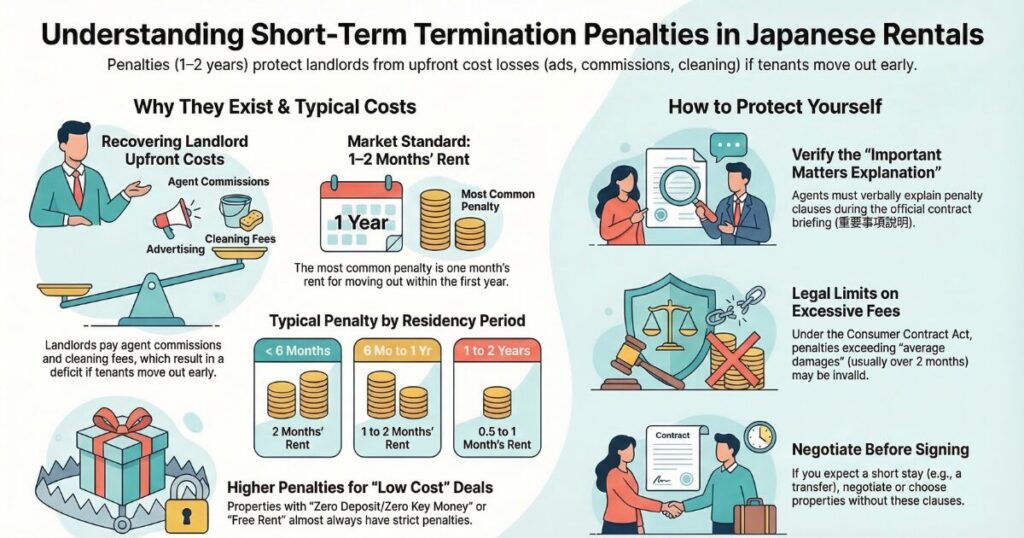
Here is a scenario your real estate agent rarely highlights: You’ve just spent a fortune moving into a trendy new Tokyo apartment, attracted by “Zero Deposit” and “Free Rent” signs. Six months later, your company announces a sudden transfer, or perhaps a family emergency requires you to move back home. You pull out your lease, expecting a standard exit, only to find a demand for two months’ rent as a “Short-Term Cancellation Penalty” (短期解約違約金 / Tanki Kaiyaku Iyaku-kin).
This isn’t just a minor fee; it’s a financial hurdle that can wipe out every yen you saved on initial costs. As a consumer advocate, I want you to look past the “free” marketing and understand the strategic debt you’re actually signing into.
For many foreign tenants renting an apartment in Japan for the first time, this penalty comes as a shock. In many countries, tenants can usually terminate a lease with a standard notice period (often 30 or 60 days). In Japan, however, leases often include contractual penalties for leaving early, even if proper notice is given.
Understanding these clauses before signing the lease is particularly important for foreign residents, who may unexpectedly need to return to their home country due to job changes, visa issues, or personal circumstances.
The Basic Rule: How Lease Termination Normally Works in Japan
Before discussing penalties, it is important to understand the basic rule of residential lease contracts in Japan.
Most rental apartments in Japan use what is called a Standard Lease Agreement (普通賃貸借契約 / Futsu Chintai Shaku Keiyaku).
Under this type of contract, tenants generally have the legal right to terminate the lease by giving advance notice to the landlord.
In practice, most contracts require one month’s notice, although some leases specify two months’ notice. As long as the tenant provides the required notice period, they are normally free to move out.
In other words, the basic legal principle is that tenants are allowed to terminate a lease early as long as they provide proper notice.
However, this is where many tenants misunderstand the system.
Even if the tenant gives the required notice, a separate contractual clause may still impose a short-term cancellation penalty if the tenant moves out within a certain period after moving in.
For example, a lease may state:
“If the tenant terminates the contract within one year, one month’s rent will be charged as a short-term cancellation penalty.”
This means the tenant is still allowed to terminate the lease, but the contract requires compensation if the termination occurs too early.
The “Invisible Red Ink”: Why Owners Aren’t Just Being Greedy
It is easy to view landlords as predatory when they demand penalties, but there is a harsh economic logic behind the “red ink.” To get you into that room, the owner also pays upfront costs that you never see: advertising fees (広告宣伝費 / AD), cleaning expenses, and even minor renovations.
The advertising fee (AD) is the real kicker. In Japan’s rental market, landlords often pay advertisement fee in addition to a commission to real estate agents to secure tenants. In competitive markets, this advertising fee can sometimes reach two to three months’ rent.
If a tenant leaves quickly, the owner has not had enough time to recover these costs.
In other words, short-term cancellation penalties were partly developed as a defensive mechanism in the Japanese rental market.
The “Zero-Zero” Trap: The High Price of Low Upfront Costs
Here’s the insider truth: “Free Rent” is almost never a gift; it is a deferred cost.
When a landlord waives initial fees, they are effectively making an investment in acquiring a tenant. They are betting that you will stay long enough to make the investment worthwhile.
To hedge that risk, they often include strict cancellation penalties in the lease contract.
“Red Flag” Property Types
Certain types of properties are much more likely to include these clauses:
Free Rent Properties Units offering 1–2 months of rent-free living
Zero-Zero Properties Apartments with zero deposit (敷金) and zero key money (礼金)
Campaign Properties Units with temporary rent discounts or reduced move-in costs
In these cases, the penalty often functions as a delayed key money payment.
If you didn’t pay it at the beginning, you may effectively pay it when you leave.
From the landlord’s perspective, these incentives are marketing tools, not gifts. The rental market in major cities like Tokyo is extremely competitive, and landlords frequently use these promotions to attract tenants quickly.
The “One-Month” Benchmark: Knowing the Legal Ceiling
While landlords use these clauses to protect their margins, they do not have unlimited freedom to impose penalties. Japanese law and court precedents provide guidance on what is considered reasonable compensation for damages.
Typical Penalty Structure
Under 6 months: often 2 months’ rent
6 months to 1 year: typically 1 month’s rent
Less than 2 years: occasionally 0.5 months’ rent
In many contracts today, the most common clause is:
“If the tenant cancels the lease within one year, one month’s rent will be charged as a penalty.”
However, not all contracts include such penalties, and the conditions can vary depending on the landlord and the property.
Before signing a lease, read your contract carefully. Also, Japanese law also requires a formal explanation called Important Matters Explanation (Juyo Jiko Setsumei). make sure that if there is a penalty clause for short-term cancellation.
Legal Insight
The Consumer Contract Act (消費者契約法) protects tenants from excessive penalty clauses.
Japanese courts often evaluate whether the penalty exceeds the landlord’s “average damages.”
Historically, courts—including decisions by the Tokyo District Court—have frequently viewed one month’s rent as a reasonable benchmark for damages.
However, courts may allow two months’ rent if the tenant received significant benefits such as:
Free rent campaigns
Waived key money
Discounted move-in costs
According to industry guidance such as LIFULL HOME’S legal commentary, once a penalty reaches three months’ rent, it enters a legal “danger zone.”
Clauses demanding four months or more may be deemed excessive and therefore invalid.
This means that while penalties are legal, they must remain proportionate.
The Neighbor Dilemma: Why “It’s Not My Fault” Rarely Works
One of the most frustrating calls I receive is from tenants moving out due to neighbor noise or deteriorating living conditions.
Tenants often argue that because the move is unavoidable, the penalty should not apply.
Unfortunately, the law rarely agrees.
Unless the tenant can demonstrate landlord negligence, such as:
Ignoring documented noise complaints
Failing to repair serious structural problems
Leaving major defects unresolved (for example, severe leaks)
the cancellation penalty generally remains enforceable.
From a legal standpoint, personal circumstances—such as job relocation, family issues, or conflicts with neighbors—are usually considered tenant-side decisions.
To the landlord, the financial loss caused by early departure remains the same regardless of the reason.
The “Important Matters” Safety Net: Your Paper Trail Defense
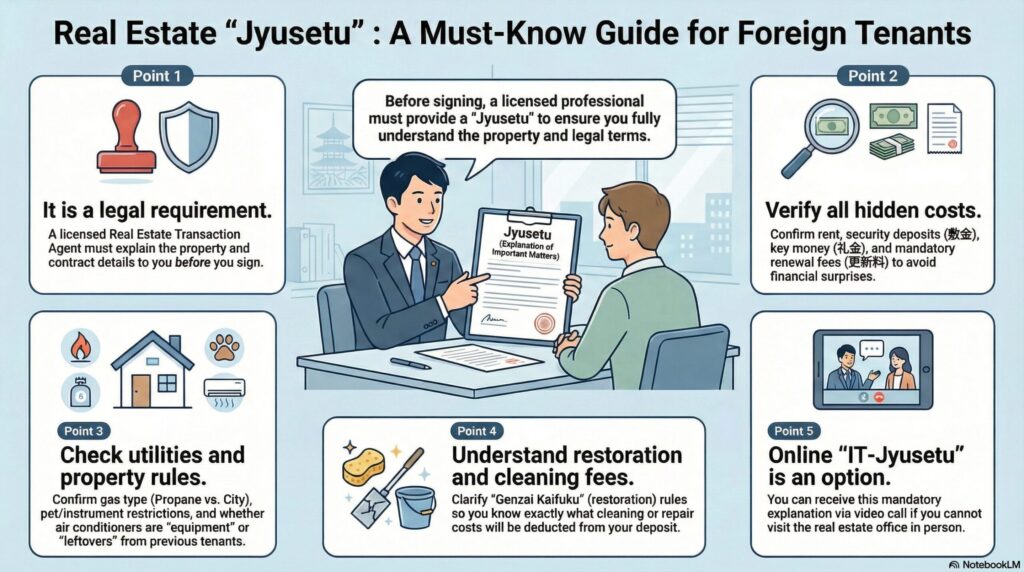
Your strongest defense isn’t a handshake; it’s the Important Matters Explanation (重要事項説明 / Juyo Jiko Setsumei).
Under Japanese law, a licensed real estate agent (宅地建物取引士 / Takken-shi) must explain key contract conditions before you sign.
This includes short-term cancellation penalties.
Expert Strategy Tips
The “Tokuyaku” Hunt
Don’t just read the main lease agreement.
Always check the Special Provisions section (特約 / Tokuyaku) at the end of the contract. This is where penalty clauses are typically written.
Special provisions override general contract terms.
Verify the Verbal Record
During the Important Matters Explanation, the agent must explain important clauses verbally.
If a penalty clause exists in the contract but was never explained, its enforceability may be questioned.
Negotiate Before Signing
If your job situation is uncertain, ask the agent whether the clause can be modified.
Possible negotiations include:
Reducing the penalty period
Removing the clause entirely
Shortening the restriction period
Once the contract is signed and the keys are handed over, negotiation becomes extremely difficult.
Conclusion: Beyond the Fine Print
Short-term cancellation penalties are part of the modern low-cost rental model in Japan.
They help landlords manage financial risk in a competitive market, but for tenants, they represent a hidden financial obligation.
Understanding these clauses is essential for anyone renting an apartment in Japan, especially for foreign residents relocating to Tokyo.
When you see advertisements promoting:
Free Rent
Zero Deposit
Zero Key Money
take a moment to ask the critical question:
What happens if I need to move out early?
The initial savings may look attractive, but the real cost may only appear when life changes unexpectedly.
Before signing any lease, always confirm:
The short-term cancellation clause
The penalty amount
The length of the restriction period
True transparency in contracts is the foundation of a healthy rental market—one where both landlords and tenants understand the real costs involved.
Where to Seek Help for Rental Disputes in Japan
If you encounter problems during your tenancy, the first step is usually to contact the real estate company or property management company handling your apartment. In many cases, they can act as an intermediary between you and the landlord and help resolve the issue.
However, the level of support can vary. Some agencies may not respond very proactively after the tenant has already moved in, or they may simply state that “the contract says so” and be reluctant to address the problem further.
If this happens and the situation remains unresolved, it may be helpful to seek advice from a Consumer Affairs Center (Shōhi Seikatsu Center). In Japan, tenants can call 188, a national consumer hotline, which connects them to the nearest consultation office.
For disputes specifically related to real estate transactions, tenants may also consult real estate industry associations or local government housing consultation services, and in more serious cases, consider seeking advice from a lawyer specializing in real estate law.
Need Help Renting an Apartment in Tokyo?
Relocating to Japan and navigating the rental market can be complicated—especially when contracts, fees, and legal terms differ significantly from what many international residents are used to.
I am a licensed real estate agent based in Tokyo, specializing in helping foreign residents and international clients find housing and understand the Japanese real estate system. My work focuses on making the rental and purchase process clearer and more transparent for people moving to Japan.
If you are planning to rent an apartment in Tokyo or have questions about rental contracts, fees, or negotiations with landlords, feel free to reach out.
👉Contact me for guidance on renting or buying property in Tokyo.
Moving to Japan is exciting, but for many expats, the apartment-hunting process quickly turns into “sticker shock.” Unlike many Western countries where you simply pay a deposit and the first month’s rent, renting in Japan often requires upfront costs equal to four to six months of rent.
The two most confusing and misunderstood fees are Shikikin (security deposit) and Reikin (key money).
Understanding the technical, legal, and practical differences between them is essential — especially if you want to reduce your initial rental costs.
Shikikin (敷金) is a refundable security deposit paid to the landlord at the beginning of your lease. It is legally recognized under Japan’s Civil Code as a guarantee fund designed to protect the landlord.
Its primary purposes are:
Covering unpaid rent
Covering repair costs beyond normal wear and tear
Covering cleaning expenses at move-out
When you move out, restoration costs are deducted from the shikikin. Any remaining balance must be returned to you.
The standard amount is usually 1 to 2 months of rent, although high-end properties may require more.
Importantly, because shikikin has a clear legal basis, landlords must handle it according to law. It cannot simply be kept arbitrarily.
To better understand what counts as repair costs and what falls under normal wear, I will explain more detail in a separate article.
What Is Reikin (Key Money)?
Reikin (礼金), literally translated as “gratitude money,” is completely different.
It is a non-refundable payment made to the landlord when you sign the lease. Unlike shikikin, it is not a deposit and is never returned.
It is typically 0 to 2 months of rent, though in central Tokyo or new luxury buildings it may be higher.
Unlike shikikin, reikin:
Is not used for cleaning or repairs
Is not deducted at move-out
Is never refunded under any circumstances
For many foreigners, this feels like paying money “for nothing.” And legally speaking, that feeling is not entirely wrong.
Is Key Money Required by Law in Japan?
No. There is no Japanese law that requires tenants to pay key money.
Shikikin has a legal foundation under the Civil Code. Reikin does not.
Reikin exists purely as a contractual condition based on custom.
Because Japan follows the principle of freedom of contract, landlords are free to set rental conditions. If the contract states that reikin is required and you agree to it, it becomes enforceable.
However, the absence of legal obligation is what makes negotiation possible.
Understanding this distinction is essential for anyone researching tenant rights in Japan.
For your reference, the Tokyo Metropolitan Government’s official housing FAQ, key money is described as a unique Japanese custom rather than a legal requirement. (Source: Tokyo Metropolitan Government)
Why Does Key Money Still Exist?
To understand reikin, you must understand its historical roots.
After the 1923 Great Kanto Earthquake and again after World War II, housing in Japan was extremely scarce. Tenants competed fiercely for available units. Offering “gratitude money” to landlords became a way to secure a place.
In the 1960s and 1970s, when students moved from rural areas to major cities, parents would often give extra money to landlords as a way of asking them to “look after” their child.
Although housing shortages are no longer severe in most areas, the practice remains in high-demand neighborhoods such as central Tokyo. In premium buildings or newly constructed properties, landlords often maintain reikin as a standard condition simply because market demand allows them to.
If you are still deciding where to live, comparing the best areas in Tokyo for expats may help you understand where reikin is more common. 👉 【Best Areas to Live in Tokyo for Foreigners】
Regional Differences in Japan
Japan is not uniform when it comes to rental customs.
In Tokyo and most of the Kanto region, the standard model includes shikikin and reikin.
In Kansai (Osaka, Kyoto) and parts of Kyushu, the “shikibiki” system is common. Under this system, a non-refundable portion of the deposit is automatically withheld when you move out.
Interestingly, Hokkaido largely avoided the reikin tradition.
Understanding regional variation can open opportunities to reduce costs.
Shikikin vs Reikin: The Real Difference
Although both payments are made upfront, they serve entirely different legal and financial purposes.
Shikikin is legally grounded collateral, refundable after deducting repair and cleaning costs. Reikin is a non-refundable gratitude payment with no legal basis beyond contract.
Shikikin protects the landlord against risk. Reikin rewards the landlord for granting access to the property.
Shikikin is reconciled at move-out. Reikin disappears on day one.
This distinction is critical when calculating your true initial rental cost in Japan.
Summary Table for Renters
Feature
Shikikin (Security Deposit)
Reikin (Key Money)
Legal Basis
Yes (Civil Code)
No (Custom only)
Refundable?
Yes (minus cleaning/repairs)
No
Main Purpose
Collateral for damages/rent
“Thank you” gift to landlord
Standard Amount
1–2 months of rent
0–2 months of rent
Can You Negotiate Reikin (Key Money)?
Yes — and this is where strategy matters.
Because reikin is not legally required, it is purely a contractual condition. That means it can be negotiated.
Landlords are more likely to reduce or waive reikin when:
The property has been vacant for some time
The move-in date is during the off-season (April to August)
The building is older
You show strong intent to sign immediately
The rental market in that area is competitive
In contrast, brand-new buildings, luxury apartments, and properties near major stations in central Tokyo are much less flexible.
Your real estate agent plays a critical role here.
Some apartments advertise “zero-zero” conditions, meaning zero deposit and zero key money. Landlords may have a specific reason for setting the key money to zero, and in some cases, they may be compensating for it in other ways.
For example, they sometimes come with:
Higher monthly rent
Short-term cancellation penalties
Strict renewal fees
Higher restoration charges
Zero reikin does not always mean cheaper in the long run.
How Much Does It Really Cost to Move In?
In central Tokyo, upfront costs may include:
First month’s rent
Shikikin (1–2 months)
Reikin (0–2 months)
Agency fee
Fire insurance
Lock exchange fee
Guarantor company fee
This is how total initial costs often reach four to six months of rent.
FAQ: Key Money and Rental Costs in Japan
Is key money mandatory in Japan?
No. There is no law requiring it. It is a contractual condition set by landlords.
Can foreigners avoid paying reikin?
Yes. By searching for “No Reikin” listings, negotiating, or targeting older buildings, many foreign tenants reduce or eliminate it.
Why is key money still common in Tokyo?
Because landlords in high-demand areas maintain leverage and can set stronger conditions.
Is shikikin refundable?
Yes. It must be returned minus legitimate repair and cleaning costs.
Can I dispute key money after signing?
No. Once agreed in a signed contract, it becomes enforceable.
Professional Insight from a Tokyo Real Estate Agent
As a licensed real estate agent based in Tokyo, I regularly see foreign tenants misunderstand Japan’s initial rental structure.
The biggest mistake? Assuming all upfront fees are legally required.
They are not.
Shikikin is legally grounded. Reikin is contractual custom.
Negotiation is possible, but it largely depends on the property’s level of demand and overall market conditions. In many cases, you should be prepared for the possibility that the landlord may not respond positively to the request.
However, understanding how the system works is essential if you want to avoid paying unnecessary costs. Understanding the system is not just about culture — it is about leverage.
If you’re unsure whether certain fees are reasonable or negotiable, feel free to reach out before signing a lease. A quick consultation can help you make informed decisions and potentially save a significant amount on your upfront expenses.
If you are relocating to Japan and planning to rent an apartment in Tokyo, one of the most important steps in the rental process is something called the “Explanation of Important Matters” (重要事項説明), known in Japanese as Jūyō Jikō Setsumei or simply Jusetsu.
For many foreigners moving to Japan, this step can feel confusing or overly formal. However, it is not just paperwork. It is a legally required procedure designed to protect tenants and prevent disputes. Understanding this process is essential for anyone renting property in Japan for the first time.
This article explains what Jusetsu is, why it matters, what you must check carefully, and how to avoid costly misunderstandings when signing a Japanese rental contract.
What Is the Explanation of Important Matters in Japan?
The Explanation of Important Matters is a mandatory pre-contract session required under Japan’s Building Lots and Buildings Transaction Business Act. Before you sign a rental agreement, a licensed real estate professional called a Takuchi Tatemono Torihikishi (宅地建物取引士) must explain the legal and contractual details of the property.
This explanation must include:
The legal status of the property
The contract terms and duration
Renewal conditions and fees
Repair responsibilities
Restrictions and usage rules
Financial obligations beyond rent
The person conducting the session must show their official license card. If they do not, it is a violation of Japanese law.
For foreign residents, this session is especially important because Japanese lease contracts often contain clauses that may not exist in other countries. The Jusetsu is your final opportunity to understand every obligation before you become legally bound.
Most importantly, you are not required to sign the lease after the Jusetsu. If something is unclear or unacceptable, you have the right to walk away.
Why Jusetsu Is Critical for Foreigners Moving to Japan
Many disputes between landlords and foreign tenants occur not because of bad intentions, but because of misunderstandings about responsibility.
In Japan:
Rental contracts are typically two years.
Upfront costs are high.
Renewal fees are common.
Move-out charges follow specific legal standards.
Guarantee companies often replace personal guarantors.
If you do not fully understand the terms during Jusetsu, problems may only appear later — when moving out or renewing.
Taking the Explanation of Important Matters seriously protects your finances and your peace of mind.
Lifelines: Gas, Utilities, and Internet Setup
Infrastructure details can significantly impact your monthly expenses and daily comfort.
One major distinction is City Gas vs. Propane (LP) Gas. In Tokyo, propane gas is generally 1.5 to 2 times more expensive than city gas. This difference can noticeably affect monthly utility costs, especially in winter.
You should also confirm whether utilities use individual meters or shared billing systems. In older buildings, water charges may be collected as a fixed monthly amount by the landlord rather than billed directly by the utility company.
Internet setup is another area where foreign residents often face unexpected delays. Confirm whether the building is:
“Internet complete” (connection ready for use)
“Internet compatible” (you must contract and install service yourself)
Some buildings restrict which providers you may use, and installation appointments can take weeks. If you work remotely, this detail is critical.
Fixtures vs. Leftover Items (Zanchibutsu)
One of the most common misunderstandings in Japanese rentals concerns equipment classification.
During Jusetsu, confirm whether items such as air conditioners, lighting, or stoves are:
Fixtures (設備 / setsubi) – The landlord must repair or replace them if they fail under normal use.
Leftover items (残置物 / zanchibutsu) – The landlord has no repair obligation. If they break, you may bear the cost.
Many foreigners assume that anything inside the apartment is covered by the landlord. This is not always the case in Japan.
If an air conditioner is categorized as a leftover item and stops working in summer, you could be responsible for replacement costs. Always ask for clarification in writing.
Restoration Costs and the Tokyo Ordinance
Tokyo has a specific rule called the Tokyo Rental Housing Dispute Prevention Ordinance, which defines responsibility at move-out.
Under this ordinance:
Natural aging and normal wear — such as wallpaper fading from sunlight or minor floor dents from furniture — are the landlord’s responsibility.
Damage caused by negligence — such as cigarette burns, scratches from dragging furniture, or mold caused by poor ventilation — is the tenant’s responsibility.
However, many contracts include special clauses requiring professional cleaning fees regardless of room condition. These cleaning fees are extremely common in Tokyo and should be clearly explained during Jusetsu.
Before signing, confirm:
The exact cleaning fee amount
Whether it is fixed or variable
Any additional restoration obligations beyond standard wear and tear
Understanding this now prevents disputes later.
Financial Obligations Beyond Monthly Rent
Rent is only part of the total cost of renting in Japan.
During Jusetsu, carefully review:
Renewal fee (often one month’s rent every two years)
Renewal administrative fees
Short-term cancellation penalties
Guarantee company initial and renewal fees
Fire insurance costs
Lock exchange fees
In Tokyo, renewal fees are standard practice and may surprise foreigners who are unfamiliar with this system. If you plan to stay long-term, this should be factored into your total housing cost calculation.
Short-term cancellation penalties are especially common in properties offering “zero deposit” or “free rent.” If you leave within one year, you may owe one or two months’ rent as a penalty.
Rules, Restrictions, and Mandatory Disclosures
Building rules in Japan are often stricter than in Western countries.
Confirm restrictions on pets, musical instruments, smoking, and business use. “Pet-friendly” may still limit size, breed, or number.
The broker must also disclose negative information (告知事項), such as prior incidents in the unit or significant nearby environmental issues. If you have concerns, ask directly whether any disclosure items apply to the property.
Hazard Maps and Disaster Explanation
Real estate agents in Japan are legally required to explain a property’s location on official hazard maps during the Explanation of Important Matters (Jusetsu).
This means the agent must show you the relevant government-issued hazard map (such as flood or storm surge maps) and clearly explain whether the property is located within a designated risk zone. If it is, they should also clarify the type of risk involved — for example, river flooding or heavy rainfall — and indicate the expected inundation depth based on municipal data.
Under the law, the agent’s obligation is specifically to show the relevant hazard map and indicate where the property is situated within it. The legal requirement does not extend to providing a detailed risk analysis beyond identifying the location.
However, if the property falls within a designated flood zone, it is advisable to ask about the type of flood risk, the expected inundation depth, and the location of nearby evacuation areas. While these additional explanations may not all be strictly mandated, understanding them is essential for making an informed rental decision in Tokyo.
If you are relocating to Japan, do not hesitate to ask where the nearest evacuation area is and how the local government defines the hazard zone. Understanding this information is an essential part of making an informed rental decision in Tokyo.
IT Jusetsu: Completing the Process from Overseas
If you are relocating to Japan and have not yet arrived, you may complete Jusetsu via video conference.
You must:
Clearly see the broker and their license
Receive documents in advance
Have stable internet access
It is strongly recommended to print the documents before the session so you can review details carefully.
Final Advice for Foreigners Renting in Japan
Never rush the Jusetsu simply because the market is competitive. A good apartment is important, but a clear contract is more important.
Ask practical questions such as who to contact in emergencies, how maintenance is handled, and what happens if you need to terminate early.
If you pay a holding deposit before signing, confirm in writing that it is refundable if you cancel before contract execution.
By understanding the Explanation of Important Matters in Japan, you are not just completing a legal formality. You are protecting yourself financially and ensuring that your new life in Tokyo begins with clarity and confidence.
If you are relocating to Japan and would like professional guidance in English throughout the rental contract process, feel free to reach out. Personalized support can prevent misunderstandings and make your move significantly smoother.
Have you ever seen the term “restoration costs” when moving out of an apartment in Japan and wondered what it really means?
Or perhaps you’ve accidentally scratched the floor during your tenancy and worried, “What if I’m charged a large repair fee when I move out?”
And another common question: How much of my security deposit will I actually get back?
In Japan, there are clear legal guidelines that define a tenant’s responsibility and how costs are settled at the time of move-out. This article explains what tenants are actually responsible for, how restoration costs are calculated, and what you should know to avoid unexpected charges.
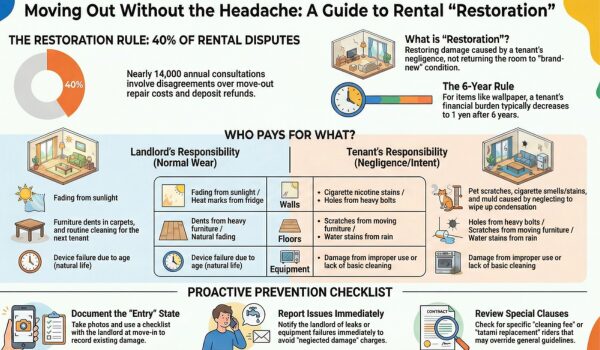
If you are moving out in Japan, you do not have to return your apartment in brand-new condition. Under Japanese law, tenants are responsible only for damage caused by negligence or improper use. Natural wear and aging are the landlord’s responsibility, and most interior materials are depreciated over six years.
Yet disputes remain common. Understanding exactly how restoration costs are divided — and how real-world cases unfold — is essential to protecting your security deposit.
Landlord’s Responsibility: Natural Wear and Aging
Under Japanese restoration rules, costs that arise from normal living and aging are considered already covered by your monthly rent. These are not additional charges that can automatically be passed to the tenant.
Typical examples of the landlord’s responsibility include:
Floors: Dents or marks left by heavy furniture such as sofas or refrigerators. Simply placing ordinary household furniture in a room does not constitute negligence.
Walls: Discoloration of wallpaper caused by sunlight (fading) or dark “electric burns” that appear behind televisions or refrigerators due to heat and airflow.
Minor Holes: Small pinholes from thumbtacks or pins used to hang posters or calendars, as long as the underlying wallboard does not require replacement.
Maintenance and Turnover Cleaning: Cleaning for the next tenant or professional disinfection, provided that you performed regular, ordinary cleaning during your stay.
These examples reflect a fundamental principle: ordinary use leads to gradual change, and that change is factored into rent.
Tenant’s Responsibility: Negligence or Improper Use
By contrast, tenants must pay for damage caused by intentional acts, negligence, or failure to maintain the property properly. The issue is not whether damage exists, but whether reasonable care was exercised.
Examples of tenant responsibility include:
Kitchen Neglect: Heavy oil or soot stains in the kitchen caused by failing to clean regularly.
Bathroom and Toilet Issues: Mold or water scale buildup due to lack of cleaning and ventilation.
Spills and Stains: Stains or mold on carpets or floors caused by spilled drinks that were not cleaned up properly.
Neglected Leaks: If you notice a window leak or condensation forming and fail to report it or wipe it away, leading to wall rot or mold, you become liable for the resulting damage.
Smoking Damage: Yellowing wallpaper or lingering odors caused by cigarette smoke.
Pet Damage: Scratches on pillars, chewed frames, or persistent odors caused by keeping pets — even in pet-friendly apartments if the damage exceeds normal use.
The legal standard applied is whether the tenant exercised reasonable care as a prudent occupant. Failing to clean, report, or maintain can shift responsibility entirely to the tenant.
The 6-Year Depreciation Rule Still Applies
Even when damage is attributable to the tenant, Japan’s depreciation system reduces liability.
Wallpaper, carpets, and cushion flooring are generally considered to have a six-year service life. After six years, the residual material value is treated as one yen. Therefore:
If damage occurs after three years, only about half of the material cost should be charged.
If damage occurs after more than six years, the material value itself is effectively zero.
However, labor and installation costs may still apply if the damage resulted from negligence.
This rule becomes particularly important in disputes involving long-term tenants.
Real-World Case Studies: What Actually Happens
Official reports from the National Consumer Affairs Center (NCAC) highlight recurring patterns in restoration disputes. The following cases illustrate common problems.
Case 1: The “Zero-Zero” Trap
A tenant moved out of a “zero deposit/zero key money” apartment after two years. They were billed more than 100,000 yen, including 50,000 yen for cleaning, even though they had not smoked and their contract only required air-conditioner cleaning if smoking occurred. Because they had no security deposit to deduct from, they received a large lump-sum invoice.
This case demonstrates the hidden risk of zero-deposit properties. Without a deposit buffer, restoration costs are billed directly, and tenants may face significant unexpected charges.
Case 2: The 25-Year Long-Term Stay
A tenant lived in an apartment for 25 years. Upon move-out, the landlord claimed replacement costs for flooring and wallpaper. However, because the tenant had stayed so long, the value of those materials had depreciated to virtually zero. The wear was deemed natural aging rather than tenant-caused damage.
This case underscores the power of the depreciation rule. Long occupancy significantly reduces material liability.
Case 3: Unproven Pre-Existing Damage
A tenant was charged for scratches on walls and doors that they insisted were present when they moved in. However, because they had not taken photos or completed a move-in checklist, they had no proof. As a result, disputing the charge became extremely difficult.
This case illustrates why documentation at move-in is critical. Without evidence, restoration disputes become one person’s word against another’s.
Why These Details Matter
Moving out in Japan is not about restoring perfection. It is about determining:
Was the damage caused by negligence?
Has depreciation been properly applied?
Were special clauses clearly explained at signing?
Can the tenant prove the original condition?
When tenants understand these principles, disputes often resolve quickly. When they do not, restoration invoices can feel arbitrary and unfair.
Practical Steps to Protect Your Deposit
Check for Special Clauses (Tokuyaku): Landlords can add “Special Restoration Clauses” that override general guidelines (e.g., “The tenant always pays for professional cleaning”). These are valid only if they are specific, reasonable, and clearly agreed upon at the time of signing.
Document at Move-In: Take clear, timestamped photos of every existing scratch, stain, or dent the day you get your keys. If the landlord provides a “Checklist,” fill it out meticulously and keep a copy.
Perform Regular Cleaning: Failing to clean your kitchen fan or bathroom can lead to “neglect” charges.
Attend the Final Inspection: Always be present for the “room check” when you move out. If you disagree with a charge, do not sign the settlement form immediately. Ask for a breakdown and compare it to the MLIT guidelines.
What to Do If You Are Overcharged in Japan
If your landlord refuses to return your security deposit or presents excessive charges, begin by negotiating using official guidelines and depreciation rules.
If negotiation fails, you may:
Call the National Consumer Affairs Hotline (188)
Contact the Tokyo Foreign Residents’ Advisory Center
Use civil mediation (minji chotei)
File a small claims case for disputes under 600,000 yen
Japan’s system is structured and accessible. Many disputes are resolved once tenants reference the correct rules.
FAQ: Moving Out in Japan
Do I have to repaint or replace wallpaper when moving out in Japan?
No, unless the damage was caused by negligence. Normal fading and aging are the landlord’s responsibility.
What is the 6-year rule in Japan apartments?
Interior materials like wallpaper are depreciated over six years. After that period, their material value is considered one yen.
Is the cleaning fee mandatory in Japan?
It depends on your contract. Fixed cleaning fees are often valid if clearly written and properly explained before signing.
Can I dispute move-out charges in Japan?
Yes. You can negotiate, seek consumer consultation, pursue mediation, or file a small claims case.
Final Takeaways
As a licensed real estate agent in Tokyo, I often see disputes arise not because the rules are unclear, but because tenants were unaware of how responsibility is divided. The most expensive mistakes usually occur at the beginning of the lease — when clauses are signed without full understanding — not at the end.
Moving out in Japan does not require returning your apartment in brand-new condition. It requires reasonable care, awareness of depreciation, and proper documentation.
Understanding these rules before you sign a lease is the strongest protection you can have when you move out.
For further details for those who reside in Tokyo, please refer to the official Tokyo Metropolitan Government publication here.
For foreigners considering a move to or relocation within Japan, choosing “where to live” is a decision just as critical as your career path.
The latest results of the “SUUMO Best Places to Live Ranking 2026 (Kanto Edition)” have been released. This ranking is based on a highly reliable survey of 9,000 residents aged 20 to 49 living in the Tokyo metropolitan area (Tokyo, Kanagawa, Saitama, Chiba, and Ibaraki). SUUMO is one of Japan’s largest and most influential real estate information platforms.
Here are the top areas to watch in 2026 for those looking to start a new chapter in Japan:
🏆 No.1 for 9 Consecutive Years: Yokohama
Yokohama continues its dominance, securing the No.1 position for the 9th consecutive year.
Why professionals choose Yokohama:
Direct access to central Tokyo (approx. 30 minutes to Tokyo Station)
International atmosphere and long-standing expat presence
Coastal scenery and open waterfront spaces
Large-scale commercial facilities and shopping districts
High livability score across demographics
For executives working in Marunouchi, Shinagawa, or even Shibuya, Yokohama offers a rare combination: urban convenience with breathing room.
🚉 Living in Central Tokyo: Business Convenience First
If proximity to headquarters, embassies, or tech hubs is your top priority, stations along the JR Yamanote Line remain dominant.
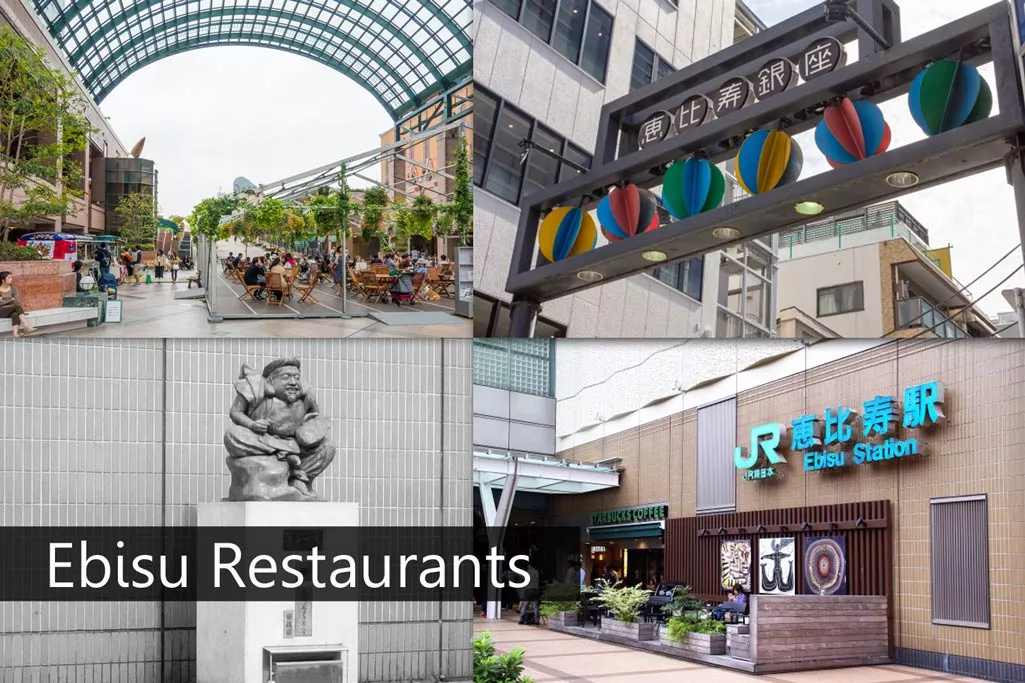
🌿 Ebisu (Ranked 4th)
Refined dining scene
Strong international community
High-end residential buildings
Easy access to Shibuya and Tokyo Station
Ebisu remains a top-tier choice for globally minded professionals.
🚅 Tokyo Station (Ranked 5th)
4
Gateway to all major Shinkansen lines
Direct airport access
Surrounded by Marunouchi’s financial district
Ideal for frequent business travelers
Living near Tokyo Station is a strategic choice for regional or global executives.
🌆 Shibuya (Ranked 10th)
Major tech and startup ecosystem
Massive redevelopment projects
Vibrant nightlife and cultural energy
For professionals in tech, media, or venture capital, Shibuya remains highly attractive.
📊 Remarkable Stability in the Top Rankings
The top six stations — Yokohama, Omiya, Kichijoji, Ebisu, Tokyo, and Ikebukuro — maintained identical positions compared to last year.
This level of ranking stability signals:
Mature, well-established infrastructure
Consistent resident satisfaction
Strong long-term residential demand
For property buyers and investors, this stability often indicates lower volatility risk.
🌳 Spotlight on Rank 3: Kichijoji
According to the 2026 ranking:
Rank: 3rd place
Total Score: 846 points
Positioned firmly behind only Yokohama and Omiya
Maintained the same ranking as the previous year
Major station on the JR Chuo Line
Why Kichijoji Matters for Relocation Decisions
1️⃣ Extreme Ranking Stability
Kichijoji has held 3rd place for at least two consecutive years. Among 9,000 working-age respondents, its appeal remains consistently strong.
2️⃣ Strategic Location
Direct JR Chuo Line access to Shinjuku (approx. 15–20 minutes)
Easy commuting to central business districts
Well-connected yet outside the hyper-dense urban core
3️⃣ Balanced Urban Lifestyle
While the survey focuses on statistical data, Kichijoji is widely associated with:
Access to Inokashira Park
Strong shopping and dining streets
A blend of residential calm and urban vibrancy
For dual-income professional couples or families wanting proximity to Tokyo without living inside it, Kichijoji is often the “ideal compromise.”
📈 Rising Stars: Next Break Areas to Watch
Beyond central Tokyo, several areas are gaining momentum.
🚉 Omiya (Ranked 2nd)
Largest terminal in Saitama
Strong commuter infrastructure
Affordable relative to central Tokyo
📍 Record High Rankings Since 2018:
Funabashi (12th)
Maihama (15th)
Tsukuba (24th)
Tsukuba, often called a “Science City,” is particularly attractive for researchers, academics, and families seeking spacious housing.
Also Reaching Historical Highs:
Ofuna (43rd)
Tachikawa (49th)
These rising areas often provide:
Larger homes
Lower price per square meter
Improving infrastructure
Increasing retail and commercial development
What This Means for Expats & Foreigners
When relocating to Japan, the decision should balance:
Commute time
International school access
Business district proximity
Airport connectivity
Lifestyle preference (urban vs suburban)
Investment potential
Long-term resale stability
The SUUMO ranking provides data-backed insight into real resident satisfaction, which is far more reliable than marketing brochures.
Final Thoughts: Where Should You Live in Japan?
Whether you prefer:
A vibrant tech hub (Shibuya),
A refined international district (Ebisu),
A coastal cosmopolitan city (Yokohama),
Or a balanced, lifestyle-oriented neighborhood (Kichijoji),
Greater Tokyo offers a wide spectrum of living environments.
If you are planning a relocation to Japan — or considering purchasing property as an expat — understanding these ranking trends can help you make a smarter long-term decision.
If you’d like a personalized consultation based on your industry, commute needs, family situation, or investment strategy, feel free to reach out.
Finding the right neighborhood isn’t just about convenience. It’s about designing your next chapter in Japan strategically!
Rising Prices, Falling Transactions — and What It Really Means
(January 2026 Latest Report)
“Should I sell my home now, or wait?” “I want to buy in Tokyo, but prices feel too high.”
These are questions I hear frequently from both foreign residents and international investors.
According to the January 2026 data, the Greater Tokyo existing home market has entered an unusual phase—one that requires careful interpretation.
In simple terms:
Fewer homes are selling, yet prices continue to rise.
This growing mismatch between supply and demand is becoming increasingly clear. Let’s look at what’s actually happening—and how to read the market correctly.
1. Existing Condominiums: Prices Above Bubble Levels, Oversupply at 4.6x
On the surface, the condominium market looks exceptionally strong.
Prices beyond the bubble era The average transaction price per square meter in January 2026 reached ¥869,900, exceeding the previous all-time high recorded in September 1990 during Japan’s asset bubble.
69 consecutive months of price growth Prices have risen continuously since May 2020—more than five and a half years without interruption.
However, beneath these headline numbers lies a clear imbalance.
Oversupply is widening In January, 15,514 properties were newly listed, while only 3,343 transactions were completed. This means the market supplied approximately 4.6 times more properties than were actually sold.
While year-on-year transaction volume shows a slight increase, sales have dropped sharply over the past two months, which could be interpreted as a sign that buyers are becoming increasingly cautious. However, my sense on the ground is somewhat different. Given that the market remains relatively strong, a sizable group of sellers is listing their properties at higher prices to test the market. Many are not under pressure to sell, which is why prices are not breaking down easily. At the same time, buyer interest remains strong, but current pricing levels are making it difficult for many to move forward with transactions.
The same pattern appears even more clearly in the detached housing market.
Transaction volumes declining January 2026 recorded 1,496 completed transactions, down from 1,932 in November 2025—a decline of about 22% in just two months.
Inventory rising for 41 consecutive months Homes are taking longer to sell, and excess supply has become structural rather than temporary.
Prices remain elevated Despite weaker demand, the average transaction price rose to ¥40.56 million, up 7.1% year-on-year.
3. Why Are Prices Rising When Homes Aren’t Selling?
Under normal market conditions, falling demand leads to lower prices. But today’s existing home market in Greater Tokyo is behaving differently.
The key driver is listing prices.
Condominiums: New listing prices are up 30.0% year-on-year
Detached houses: New listings are up 9.4% year-on-year, averaging ¥47.28 million
As I mentioned above, this means that sellers across the market are raising their asking prices. As a result, the limited number of transactions that do occur are pulled upward by these higher expectations—keeping average prices elevated even as liquidity declines.
4. What This Means for Foreign Buyers
For foreigners unfamiliar with Japan’s market dynamics, this environment can feel confusing.
The key takeaway: Headline prices alone do not tell the full story.
Inventory is abundant
Properties are staying on the market longer
Negotiation opportunities are increasing, especially for long-listed homes
This is particularly true outside Tokyo’s central wards, including parts of Chiba, Saitama, Yokohama, and Kawasaki.
5. Investor View: Yield, Liquidity, and Negotiation
From an investment perspective, the current market shows clear warning signals:
Liquidity is declining
Oversupply is persistent
Price inflation is seller-driven, not demand-driven
At the same time:
Acquisition prices are compressing yields
Rent growth has not kept pace with listing price increases
Cap rate expansion risk must be considered, especially if interest rates rise further
This is not a uniform seller’s market—it is a market with pricing inefficiencies.
For disciplined investors, opportunities may exist in:
Long-listed or overpriced assets
Motivated sellers adjusting expectations
Non-prime but well-connected locations
Selective underwriting and negotiation strategy are essential.
Final Insight: Expensive Locally, But Still Affordable Globally
Despite these cautionary signals, one critical point should not be overlooked:
Compared to many major global cities, Greater Tokyo remains relatively affordable.
When viewed against markets such as New York, London, Hong Kong, or Singapore, Tokyo still offers:
Lower price per square meter
Clear and stable ownership rights
A large, liquid metropolitan market
Consistent rental demand in central and commuter-accessible areas
This is why many international buyers and investors continue to see Tokyo not as an overheated market, but as a long-term, structurally sound market with reasonable entry pricing.
The key is not perfect market timing—but choosing the right property, in the right location, at the right price.
📺 YouTube Video Available I also explain this market situation in detail in my YouTube video.
If you’re considering buying or selling property in Tokyo, understanding these market dynamics is key. Feel free to reach out if you’d like a personalized view of how current pricing and demand may affect your specific situation.
Moving to Japan is an exciting step, but finding a place to live often becomes far more complicated than many people expect. This is especially true if you are unfamiliar with Japan’s language, systems, and rental customs as well as how the rental industry actually operates.
Unlike in some countries where you can search, apply, and sign a lease entirely online on your own, the Japanese rental market is highly agent-driven and shaped by industry-specific practices that are not always visible from the outside. Understanding these realities is key to avoiding unnecessary frustration, delays, and missed opportunities.
In this article, I take a closer look at how the Japanese rental market really works,
from the very first step of finding a property, along with the role real estate companies or agents play behind the scenes and what first-time expats should know to avoid regret later.
Pros and Cons of Your First Housing Search Options
Compared to Japanese renters, foreigners often start with a disadvantage in terms of information and local knowledge. That’s why it helps to understand some key characteristics of Japanese real estate companies, so you can make decisions you won’t regret, and avoid unnecessary losses or frustration.
First, let’s walk through the typical options people use to begin searching for housing in Japan.
Option 1: Start with Online Property Search Portals
When you start your home search in Japan, it’s only natural to search online with phrases like ‘Real Estate Agent in Japan’ or ‘Apartments for rent in Japan.’ You’ll quickly find a vast array of companies and websites catering to your search.
The major Japanese portals
When Japanese people search for rentals, the most common portals they use are athome, HOMES, SUUMO, etc. You can think of them as similar to Zillow in the U.S.
These sites are designed primarily for Japanese users, so the information is mostly in Japanese. However, even if you don’t read Japanese, you can still browse and search using automatic translation, so it’s possible to use these platforms to find listings.
English-based platforms for foreigners
There are also portals that are fully in English, such as Wagaya Japan and GaijinPot. These sites target foreign residents, so the listing information is originally provided in English.
What happens after you inquire about a listing
On any of these platforms, once you inquire about a property, the real estate company that posted the listing will respond to you individually. This is often where a key challenge begins.
Many real estate companies listing on Japanese portals cannot provide service in English. So if you’re not confident in Japanese, this can be a major barrier.
On the other hand, companies that post on foreigner-focused platforms actively want to work with foreign clients. In that sense, contacting companies through these English portals can be a good way to find an agent who can support foreigners.
Problems with relying only on portals
However, there are limitations to this approach too:
Japanese listing portals are the go-to choice even for Japanese, but not every available home makes it onto these sites. (Because posting listings requires real estate companies to pay fees.) To access a wider range of options, it’s best to have an agent run a comprehensive search for you.
Although you can filter listings by rent and area, if you don’t know the neighborhoods well, you may not be able to narrow down your search and may feel lost trying to search on your own. In some cases, you might be drawn only to property photos and end up looking at listings in areas that don’t actually suit you.
On Japanese portals, not all the properties are available to foreigners (“foreigner-friendly” is sometimes stated but the opposite is rarely stated.)
Foreigner-focused portals usually include listings from only a limited number of real estate companies. Again, those companies choose which listings to upload, so the selection is limited. It’s a limited set of properties, from a limited set of companies. The upside is that at least these listings are usually foreigner-friendly.
Also, please keep in mind that rental properties move quickly, and a listing may no longer be available by the time you inquire.
Option 2: Contact a Foreigner-Friendly Real Estate Company Directly
Another approach is to directly reach out to real estate companies that advertise support for foreign clients. You’ll still find many options, so you might choose one or if you have the time and energy, you could contact several at once.
Things to keep in mind
One key point is whether the agency actually covers the specific area you want to live in.
Also, many “foreigner-specialist” agencies focus primarily on central Tokyo, where the international community is concentrated and rents tend to be higher. Some also target the luxury market, as their typical clients are expats with generous corporate housing budgets.
Therefore, it’s a good idea to check an agency’s typical price range and coverage area first to make sure they are the right fit for your search.
Option 3: Walk Into a Local Neighborhood Real Estate Shop
A third option is to visit real estate shops in the neighborhood directly.
Why this can be helpful
Local agencies are rooted in the area. They often have relationships with local landlords and may be able to introduce many properties within that neighborhood. In most cases, they are available for walk-ins, but they can be busy at times. To make the most of your visit, and if you want to discuss your situation in detail, it’s better to contact them in advance. In some cases, they may even sit down with you and search for properties together on online portals.
The downside
Unless it’s an area with a large foreign population, local agencies often are not used to working with foreign clients, and they may not handle “foreigner-friendly” properties. To be honest, bridging the language barrier takes extra effort for them. On top of that, since many landlords still say ‘no’ to foreign tenants, the search can be quite time-consuming, which, unfortunately, means some agents are hesitant to take on the challenge.
Given these realities, it’s most practical to either look for foreigner-friendly agencies online or get a personal recommendation from someone who has gone through a similar experience.
If You Found a Property You Like, What Happens Next?
So, let’s get back to the starting point.
When you use a listing portal and find a property you’re interested in, what happens next?
When you inquire through any of the portals, the real estate company that posted the property responds, and if the property is still available and you want to view it, they start coordinating viewing dates. This is where your communication with the company really begins.
But here’s the question: Just because you liked one listing and contacted that company,
Is that company really the right one for you?
If the property is a perfect fit and everything goes smoothly, that’s great. After you see the property in person, you may feel like… “Hmm… not sure.” And if you don’t know Japan’s housing standards or common trade-offs, you might not even be able to judge whether a property is truly good or not.
This is where working with the right agent becomes essential to avoid regret later.
Naturally, the next question is how to find a good agent.
Important Cautions When You Rely on a Real Estate Company
Before getting into how to find the right agent, let me briefly explain how the Japanese real estate industry works.
When browsing property portals, you may notice that while the company name is shown, the individual agent’s name is rarely displayed.
In Japan, independent agents are still relatively rare. Most “agents” work inside a company organization. That means they may move based on internal company logic, logic you may not know about unless you understand how Japanese real estate companies operate.
If you don’t know this, you could end up making costly mistakes or feeling pressured into a decision that isn’t right for you.
Even if you contact a company because of one specific listing, that company may not necessarily be the best match for you.
Here’s something many first-time expats don’t realize, and your agent doesn’t tell.
Common issues to be aware of
If the company also manages properties, they are more likely to introduce their own managed units first. That can mean you may not receive broad options. Even if you don’t love what they show you, you might hear something like, “We don’t have any other options to show you.”
Many agents are driven by efficiency and commission logic. Some real estate agents want to close deals with less time and effort, and want to work on higher-rent properties. This pressure can be stronger for agents working inside a company structure (not always, but it happens). In companies with a strong efficiency-driven culture, they may not patiently search for the best match for your needs. You may feel they keep recommending only expensive units. It can also happen that they only show listings where the company earns a better commission rate. (That said, I have worked with many real estate companies as both a professional and as a property owner, and I can say there are also sincere and honest agents.)
The person helping you may not be a licensed professional. In Japan, there is a qualification called 宅建士 (Takken-shi), a national real estate transaction specialist license. However, the “agent” who assists you may not necessarily be licensed. In some cases, the person handling your case may have very limited knowledge or experience. Legally, even without the license, they can still do client communication, property tours, and contract preparation. But real estate contracts in Japan can be extremely detailed, with property-specific conditions and different clauses depending on the unit. To handle these transactions smoothly and safely, it’s clearly better to work with an agent who has the 宅建士 qualification from the start. I highly recommend confirming whether your agent holds the license.
You often don’t know who your assigned person will be. While some listings may display a specific contact person, in most cases, the company simply assigns someone internally once you inquire. This means you won’t know exactly who will be responding until you hear back from them.
Some agents don’t aim to build a long-term relationship with clients. This industry often has high turnover, and it’s common for the mindset to be: “This is a one-time transaction.”
Which Agents Can Show You the Most Options?
When looking for a real estate agent, most people naturally assume that the best choice is a company or agent with access to the largest number of listings.
That assumption makes sense. After all, more listings should mean more options, right?
However, what many people don’t realize is that in Japan, the actual number of properties an agent can introduce is largely the same, regardless of the company or agent you contact.
Why Listing Volume Is Not the Real Differentiator
In Japan, there is a professional property information-sharing system used among licensed real estate companies to ensure transparency and fairness in transactions.
For property sales, listings are generally required to be registered in this system, meaning they are broadly accessible to other real estate companies.
For rental properties, registration is not legally mandatory. Given how quickly properties move and the specific requirements of landlords or agencies, not all the properties make it onto this platform. That said, from a landlord’s perspective, vacant units mean lost income. As a result, a large portion of rental listings are still shared through this professional network so that tenants can be found quickly.
Although as mentioned earlier, some properties are managed exclusively by a single company and are not available through other agencies, but In practice, most rental properties can be introduced by almost any real estate company.
So the real question is not:
“Which company has more listings?”
But rather:
“Who will represent your interests best?”
How to Choose the Right Agent
Now that you have a better understanding of how the industry works, let’s get back to the core point.
So how do you actually choose a good agent?
1) Choose an agent who listens carefully and helps you clarify what you want
You may not have a clear picture of your life in Japan yet. Your preferences may still be vague. A good agent will listen carefully, help you shape your needs into something concrete, and work to bridge the gap between your expectations and Japan’s real housing realities.
Because you may not be familiar with Japan, it is important to work with an agent who can proactively point out and advise on issues that foreigners often overlook even if you don’t know to ask about them.
2) Find an agent who will truly spend time searching for you
Agents usually search through the professional platform that mentioned above. The platform can narrow down options using detailed conditions and filters.
But here’s the key: How agents adjust the conditions, change search patterns, and refine the search takes experience and a strong “search sense,” as well as a deep understanding of your preferences.
You can often tell the quality of an agent by whether they’re willing to spend real time doing this work for you, trying different angles, not giving up, and genuinely making an effort to find good matches.
Choose someone who gives you the feeling: “They’re really trying to find something for me.”
3) Choose an agent with the 宅建士 (Takken) license
As mentioned above, real estate contracts in Japan are detailed and can vary by property. For peace of mind, it’s highly recommended to choose an agent who holds the 宅建士 qualification. Holding a Takken-shi license indicates that the agent has the skills to accurately interpret detailed property conditions, contractual terms, and important points to be aware of.
4) Avoid agents who are driven by company convenience
If the agent is forced to push the company’s own managed properties, or if they prioritize speed and efficiency over your needs, you may not get the best options.
Choose an agent who is willing to take time, listen carefully, and offer a broad range of choices—even if it takes effort.
5) Choose an agent experienced with foreign clients
Contracts with foreign clients require both specialized know-how and additional effort.
It’s important to choose someone who:
understands Japan’s real estate customs and practices
has a deep understanding of how to handle transactions with foreign clients,
understands the points that tend to confuse foreigners,
and can explain them clearly.
6) Choose an agent who can negotiate in Japanese, not only in English
Your agent will communicate and negotiate with the real estate company or agent on the landlord’s side, handling all discussions related to conditions, applications, and coordination on your behalf.
For this reason, it is essential to work with an agent who can communicate effectively with Japanese real estate companies in Japanese.
Furthermore, in Japan, the final decision on whether a tenant is accepted is made by the landlord. While in-person interviews are now rare, individual landlords almost always ask, “What kind of person is the applicant?” They want to know aspects that documents alone cannot show such as whether the applicant seems reliable, responsible, and trustworthy.
From the perspective of the landlord’s real estate company, introducing a problematic tenant can damage their relationship with the owner. As a result, if they have any concerns, they may communicate those concerns to the landlord.
Given this reality, it is highly advantageous to have an agent who can represent you effectively and create a positive impression from the very first inquiry. An agent who presents you clearly and professionally to the other real estate company can increase the likelihood of receiving the landlord’s approval.
7) Choose an agent who knows the area you want to live in and Japanese housing realities
There are many things you simply can’t understand from numbers, photos, or listings alone, such as:
– what a neighborhood actually feels like – what types of residents tend to live there – the overall “class,” atmosphere, or vibe of the area – and the real pros and cons of specific buildings and unit layouts
An experienced agent will visit properties in person and pick up on both positive and negative details that are easy to miss. This includes the atmosphere of the residents, the demeanor of the building manager, potential concerns related to surrounding buildings, as well as unexpected conveniences.
To properly recognize and interpret these factors, it is essential to find an agent who is deeply familiar with Japanese culture, local customs, and day-to-day living in Japan.
Find an agent who can see beyond the numbers and listings, and who can interpret these details through a deep understanding of Japanese culture and local living conditions.
Why Not Try Working with an Independent Agent?
When foreigners search for housing in Japan, they often have limited information and limited access to insider knowledge. That’s why finding a trustworthy agent is the first step to finding a home with less stress.
If you rely on a company you contacted through a portal listing, you may face the issues described above—and you can’t always tell whether they’re truly acting in your best interest.
So why not try finding an independent agent?
About Me: An Independent Agent in the RE/MAX Group
I belong to the RE/MAX group, but I am a fully independent agent.
Because I am not employed by a company, I don’t recommend properties based on company convenience or internal priorities. I will never push a property that doesn’t benefit you.
I have been involved in real estate for a long time, and I have personally experienced many different stages myself including renting, moving overseas, purchasing, and selling.
I was born and raised in Tokyo, so I know Tokyo extremely well.
I genuinely love looking at homes, and when I see property listings, I naturally start imagining what life there would be like
I also deeply understand or at least try to understand how challenging it can be for foreigners to live in Japan, because I have lived abroad myself as an expat.
When you relocate, it’s natural to have many small but important questions and uncertainties. I support clients not only with real estate matters, but also with everyday life concerns during the move, after they have settled in, and even when they relocate again or return to their home country.
I support my clients with sincere care, so you can find a home that truly matches your needs and so you can feel reassured and confident throughout the process.
If you’d like personalized support—from housing to relocation logistics—the consultation is completely free, and I’m happy to help you plan a smoother start to life in Japan.